Wireless Tank Monitoring
Wireless Tank Monitoring
In the landscape of modern industrial automation, the transition from traditional wired instrumentation to wireless tank monitoring represents a significant shift in operational efficiency and cost management. For process engineers and facility managers, the ability to monitor liquid or solid levels in remote or geographically dispersed tanks without the prohibitive costs of trenching and cabling is a transformative capability. This guide explores the technical foundations, communication protocols, and practical selection criteria for implementing robust wireless level measurement systems.
Fundamental Measurement Principles for Wireless Systems
Before evaluating wireless transmission methods, it is essential to understand the underlying measurement technologies. A wireless tank monitoring system consists of two primary components: the sensing element (which measures the level) and the wireless node (which transmits the data). Welk provides several core technologies that serve as the foundation for these systems.
Radar Level Measurement
Radar level meters, particularly those operating at 80 GHz or 26 GHz, are the gold standard for high-accuracy wireless monitoring. These instruments emit high-frequency microwave pulses that reflect off the product surface. The time-of-flight (ToF) is measured to determine the distance.
* Advantages: Non-contact, unaffected by temperature fluctuations, pressure, or dust.
* Wireless Integration: Because modern radar sensors have low power consumption modes, they are highly compatible with battery-powered wireless nodes.
Ultrasonic Level Measurement
Ultrasonic sensors emit acoustic pressure waves. The time taken for the echo to return from the surface is used to calculate the level.
* Advantages: Cost-effective and easy to install for standard atmospheric liquid storage.
* Wireless Integration: Ideal for water treatment and chemical storage where the medium is relatively stable and non-foaming.
Hydrostatic Pressure Measurement
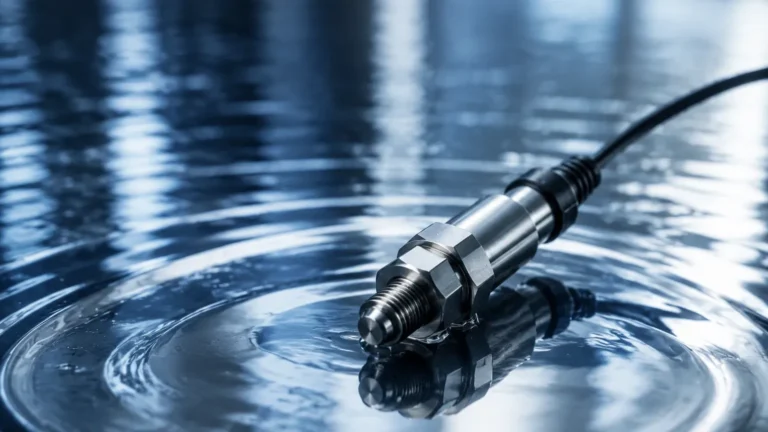
Hydrostatic transmitters measure the pressure exerted by the liquid column above the sensor. This pressure is directly proportional to the liquid height and density.
* Advantages: Excellent for deep wells or tall, narrow tanks where line-of-sight for top-mounted sensors is difficult.
* Wireless Integration: Often used in submersible applications where the wireless transmitter is housed in a vented enclosure at the top of the tank or well.
Wireless Communication Protocols and Data Transmission
The choice of wireless protocol determines the range, battery life, and data frequency of the monitoring system. In industrial environments, reliability and signal penetration are the primary concerns.
LoRaWAN (Long Range Wide Area Network)
LoRaWAN is a leading choice for wireless tank monitoring due to its exceptional range—up to 15 km (9.3 miles) in rural areas and 2–5 km (1.2–3.1 miles) in dense industrial environments. It operates on sub-GHz frequencies, which provide superior penetration through concrete and steel structures.
NB-IoT and LTE-M
These are cellular-based technologies designed specifically for the Internet of Things (IoT). They utilize existing cellular infrastructure, making them ideal for tanks located across large geographic regions where a local gateway is not feasible. NB-IoT offers deep indoor penetration and very low power consumption.
Satellite Connectivity
For extremely remote locations, such as oil and gas assets in deserts or offshore platforms, satellite-based wireless monitoring ensures data continuity where no cellular or radio infrastructure exists.
Key Evaluation Criteria for Wireless Tank Monitoring
When selecting a system, engineers must look beyond the sensor accuracy and evaluate the holistic performance of the wireless link and power management.
1. Power Autonomy: Most wireless nodes are battery-powered. Evaluation should include the expected battery life based on the reporting interval (e.g., once per hour vs. once per minute). Systems utilizing lithium-thionyl chloride (Li-SOCl2) batteries typically offer 5–10 years of service.
2. Signal Integrity: Industrial sites are often crowded with metal tanks and piping that cause multi-path interference. Selecting a protocol with high link budget and robust error correction is vital.
3. Environmental Rating: Both the sensor and the wireless transmitter must withstand the local environment. For chemical tanks, an IP67 or IP68 rating is standard, while hazardous areas require ATEX or IECEx intrinsic safety certifications.
4. Data Integration: Ensure the wireless gateway supports standard industrial protocols such as Modbus TCP, MQTT, or OPC UA to allow seamless integration into existing SCADA or ERP systems.
Practical Selection Table for Wireless Level Sensors
The following table provides a comparison of common configurations used in industrial wireless tank monitoring applications.
| Technology | Typical Application | Max Range (Sensing) | Power Demand | Best Wireless Protocol |
| :— | :— | :— | :— | :— |
| 80 GHz Radar | Chemical tanks, solids, high precision | 120m (393 ft) | Moderate | LoRaWAN / NB-IoT |
| Ultrasonic | Water/Wastewater, small sumps | 15m (49 ft) | Low | LoRaWAN / Sigfox |
| Hydrostatic | Deep wells, fuel tanks | 200m (656 ft) | Moderate | Cellular (LTE-M) |
| Level Switch | Overfill protection, high/low alarm | N/A (Point) | Very Low | LoRaWAN / Bluetooth |
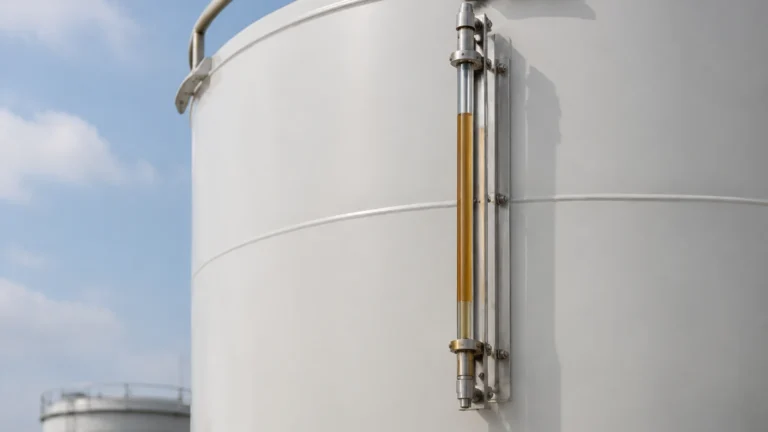
| Magnetic Gauge | High-pressure boilers, toxic liquids | 6m (20 ft) | Low | WirelessHART |

Installation Guidelines and Signal Optimization
Successful wireless tank monitoring depends as much on physical installation as it does on electronics. Follow these engineering best practices to ensure reliable data transmission:
Antenna Placement and Orientation
The antenna should be mounted as high as possible to clear local obstructions. If the sensor is installed on a tank with a heavy metal lid, an external antenna may be required. For LoRaWAN or cellular systems, maintaining a vertical orientation of the antenna is generally required for optimal polarization.
Avoiding the Faraday Cage Effect
Installing a wireless transmitter inside a fully enclosed metal tank will result in total signal loss. The transmitter or antenna must be positioned outside the tank or utilize a non-metallic (plastic or fiberglass) window/dome if internal mounting is unavoidable.
Sensor Standoffs and Nozzles
For radar and ultrasonic sensors, ensure the nozzle height and diameter do not interfere with the signal beam. An 80 GHz radar has a very narrow beam angle (typically 3° to 8°), which allows it to be installed in narrow nozzles or near tank walls without detecting false echoes from internal structures.
Limitations and Risk Mitigation in Wireless Deployments
While wireless tank monitoring offers numerous benefits, engineers must account for specific technical limitations:
* Latency: Wireless systems are typically not suitable for high-speed control loops (e.g., controlling a high-speed pump based on real-time level). They are designed for monitoring and inventory management where a delay of a few seconds or minutes is acceptable.
* Signal Attenuation: Weather conditions (heavy rain or snow) and new construction on-site can affect signal strength. It is recommended to perform a site survey to establish a "link margin" of at least 10-15 dB to account for environmental changes.
* Cybersecurity: Wireless data is susceptible to interception if not properly encrypted. Utilize protocols that offer end-to-end AES-128 encryption, such as LoRaWAN, to protect sensitive industrial data.
Frequently Asked Questions (FAQ)
Q: How often can a wireless sensor transmit data without draining the battery?
A: For most LoRaWAN or NB-IoT systems, transmitting once every 15 to 30 minutes allows for a battery life of over 5 years. Increasing the frequency to every minute will significantly reduce battery life, often to less than a year.
Q: Can wireless tank monitoring be used in explosive atmospheres?
A: Yes, but the entire assembly (sensor and wireless node) must be certified as Intrinsically Safe (Ex i) or Flameproof (Ex d). Always verify the zone rating (Zone 0, 1, or 2) before installation.
Q: What happens if the wireless signal is lost?
A: Most advanced wireless nodes have internal data logging capabilities. If the connection to the gateway is lost, the device stores the time-stamped level readings and uploads them once the connection is restored, preventing data gaps.
Q: Is it possible to monitor multiple tanks with one wireless node?
A: Some wireless transmitters feature multiple inputs (e.g., 2x 4-20mA or RS485). If the tanks are close together, you can wire multiple sensors to a single wireless node to reduce hardware costs.
Conclusion
Wireless tank monitoring is a robust solution for modernizing industrial inventory management and process safety. By selecting the appropriate measurement principle—whether radar, ultrasonic, or hydrostatic—and pairing it with a long-range, low-power communication protocol, organizations can achieve significant cost savings and operational visibility. For those looking to implement these technologies, it is advisable to Review product options and application support on our Main Page to ensure the selected hardware meets the specific chemical compatibility and environmental demands of your facility.