Radar Level Transmitter Frequency Range
Radar Level Transmitter Frequency Range: A Technical Engineering Guide
In the field of industrial process automation, selecting the correct instrumentation is critical for ensuring operational safety, efficiency, and data accuracy. Among the various technologies available, non-contact radar level measurement has emerged as a preferred solution for challenging environments. However, the performance of these instruments is fundamentally governed by the radar level transmitter frequency range.
Understanding the nuances of frequency—typically categorized into 6GHz (C-band), 26GHz (K-band), and 80GHz (W-band)—is essential for engineers and procurement specialists. This guide explores the measurement principles, technical trade-offs, and practical selection criteria for Radar Level Meters in modern industrial applications.
1. Core Principles of Radar Level Measurement
Before evaluating frequency ranges, it is necessary to understand how radar level transmitters operate. These devices emit electromagnetic pulses or continuous waves that travel at the speed of light. When these waves encounter a medium with a different dielectric constant (εr) than the air or vapor space, a portion of the energy is reflected back to the sensor.
Pulse Radar (Time of Flight)
Pulse radar transmitters emit a short microwave signal and measure the time it takes for the pulse to travel to the product surface and return. This "Time of Flight" (ToF) is directly proportional to the distance. While effective, pulse radar often requires a higher dielectric constant to provide a reliable signal-to-noise ratio.
FMCW (Frequency Modulated Continuous Wave)
FMCW technology is increasingly common in high-precision applications. Instead of a single pulse, the transmitter emits a continuous signal with a constantly changing frequency. The difference between the emitted frequency and the received frequency (the frequency shift) is used to calculate the distance. FMCW provides superior accuracy and is less susceptible to interference, making it the standard for high-frequency 80GHz systems.
2. Defining the Radar Level Transmitter Frequency Range
The frequency of a radar signal determines its wavelength, which in turn dictates how the signal interacts with the process environment, the size of the antenna required, and the focus of the radar beam.
6GHz (C-Band) Radar
Low-frequency radar, typically operating around 6.3GHz, was the early standard for industrial level measurement.
* Wavelength: Approximately 48mm.
* Characteristics: Long wavelengths are highly resistant to heavy steam, dust, and surface foam. They can "see through" atmospheric disturbances that would scatter higher-frequency signals.
* Limitations: Low frequency requires a very large antenna (often 150mm / 6 inches or larger) to achieve a manageable beam angle. The wide beam is prone to interference from internal tank structures like agitators or heating coils.
26GHz (K-Band) Radar
Often referred to as the "industrial workhorse," 26GHz radar offers a balance between signal focus and environmental robustness.
* Wavelength: Approximately 11mm.
* Characteristics: It allows for smaller antenna sizes (down to 40mm / 1.5 inches) while maintaining a narrower beam than C-band units. It is suitable for a wide range of liquids and solids.
* Limitations: While better than 80GHz in moderate foam, it may still struggle in extremely dense steam or dust compared to 6GHz models.
80GHz (W-Band) Radar
80GHz technology represents the current state-of-the-art in the radar level transmitter frequency range.
* Wavelength: Approximately 3.75mm.
* Characteristics: The extremely short wavelength allows for a very narrow beam angle (as low as 3 degrees). This enables the radar to bypass narrow nozzles and internal obstructions with ease. It also provides much higher resolution, allowing for measurement of low-dielectric materials like plastic pellets or oils.
* Limitations: High-frequency signals are more easily attenuated by heavy foam or extremely thick dust clouds.
3. Technical Selection Table: Frequency Comparison
| Feature | 6GHz (C-Band) | 26GHz (K-Band) | 80GHz (W-Band) |
| :— | :— | :— | :— |
| Beam Angle | Wide (approx. 20°-30°) | Medium (approx. 8°-12°) | Narrow (approx. 3°-6°) |
| Antenna Size | Large (150mm+) | Medium (40mm-100mm) | Small (20mm-50mm) |
| Steam/Dust Resistance | Excellent | Good | Moderate |
| Foam Penetration | High | Moderate | Low |
| Accuracy | ±5mm to ±10mm | ±2mm to ±5mm | ±1mm |
| Typical Application | Large tanks with steam | General process tanks | Narrow vessels, solids, precision |
4. Factors Influencing Frequency Selection
Beam Angle and Tank Geometry
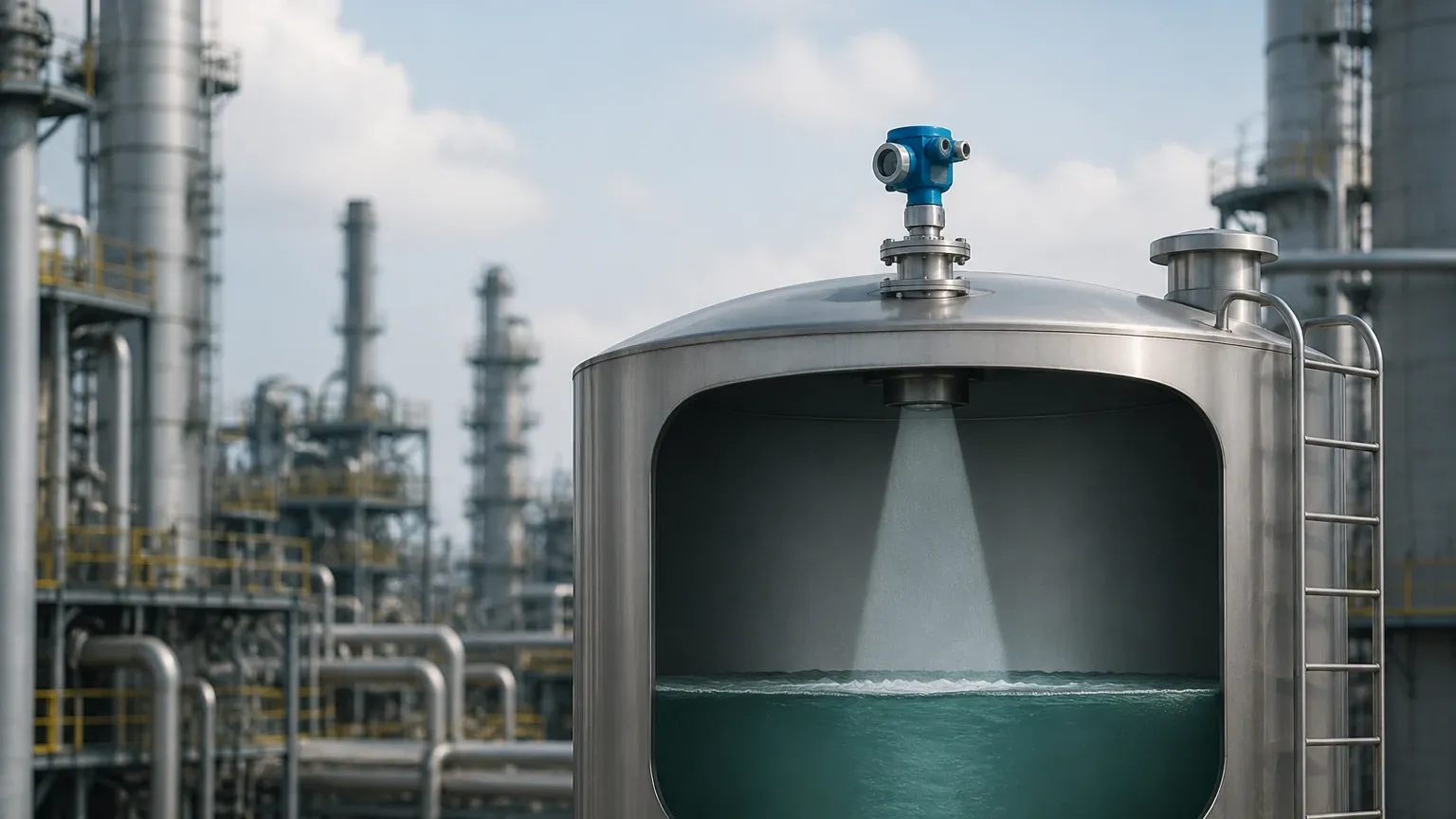
The beam angle is perhaps the most critical practical consideration. A 6GHz radar in a tall, narrow tank will likely hit the vessel walls, causing "false echoes" that the software must filter out. Conversely, an 80GHz radar can be installed in a small nozzle or close to a wall without signal interference. For vessels with agitators, ladders, or baffles, a higher frequency (narrower beam) is almost always preferred.
Dielectric Constant (εr)
The dielectric constant of the material determines how much energy is reflected.
* High εr (>10): Water-based liquids. These are easy to measure with any frequency.
* Low εr (1.4 to 4): Hydrocarbons, solvents, and dry solids. Higher frequencies (80GHz) are generally better at detecting these weak reflections because they offer a higher signal-to-noise ratio.
Atmospheric Conditions
In applications involving heavy condensation or steam (such as boiler feed water or chemical reactors), lower frequencies are more reliable. The longer wavelength of a 6GHz signal can pass through water droplets in the air without being scattered. In contrast, 80GHz signals may be attenuated if the steam density is high enough to approach the wavelength size.
5. Installation Considerations and Best Practices
To ensure the selected radar level transmitter frequency range performs as expected, follow these engineering guidelines:
1. Nozzle Height and Diameter: For 26GHz and 80GHz units, ensure the antenna extends slightly past the bottom of the mounting nozzle to prevent "ringing" or internal reflections within the nozzle neck.
2. Mounting Position: Avoid mounting the transmitter in the center of a tank with a domed roof, as this can concentrate reflected signals and cause measurement errors. Ideally, mount the unit at 1/3 the radius of the tank.
3. Obstruction Clearance: Maintain a clear "signal cone" based on the beam angle. If an obstruction (like a pipe) enters the beam, use a higher frequency to narrow the beam or use a "false echo suppression" configuration in the transmitter software.
4. Stilling Wells: If the liquid surface is extremely turbulent or covered in thick foam, consider using a bypass pipe or stilling well. This effectively turns the measurement into a 1D environment, though it requires careful maintenance to prevent clogging.
6. Application-Specific Recommendations
Water and Wastewater Treatment
For open channel flow or large storage basins, 26GHz or 80GHz radars are standard. 80GHz is particularly useful for measuring through plastic tank tops without opening the vessel, as the signal can penetrate non-conductive materials.
Chemical and Petrochemical
In reactors with high agitation and internal coils, 80GHz is the superior choice due to its narrow beam. However, if the process involves boiling liquids with heavy vapors, a 26GHz unit with a horn antenna may provide better stability.
Bulk Solids and Powders
Measuring solids (like cement, grain, or plastic pellets) is notoriously difficult due to the uneven surface and low dielectric constant. 80GHz radar is the industry standard here, as the narrow beam can be aimed at the specific "angle of repose" of the material, and the high frequency provides the necessary sensitivity for low-dielectric dusts.
7. Limitations and Risks
While radar is highly versatile, it is not a "one-size-fits-all" technology. Engineers should be aware of the following limitations:
* Vacuum Conditions: While radar works in a vacuum, the pressure seals (flanges/lens) must be rated for the specific vacuum/pressure levels of the process.
* Conductive Foam: Extremely thick, conductive foam can act as a solid surface, reflecting the signal before it reaches the liquid. In these cases, a contact-based technology like a magnetic level gauge or a guided wave radar (GWR) may be required.
* Extreme Temperatures: The electronics of the radar head must be protected. High-temperature applications (above 200°C / 392°F) often require cooling fins or specialized antenna extensions.
8. International Buyer’s Checklist
When sourcing equipment from a manufacturer like Welk, international buyers should confirm the following technical specifications to ensure the chosen frequency range is appropriate:
* Process Media: What is the dielectric constant? Is there foam, steam, or dust?
* Vessel Dimensions: Height, diameter, and nozzle specifications (height/width).
* Internal Obstructions: Are there agitators, heating coils, or ladders? Provide a tank drawing if possible.
* Accuracy Requirements: Is this for process control (±5mm) or custody transfer (±1mm)?
* Output Protocol: Does the facility require 4-20mA HART, Modbus RS485, or Profibus?
* Certifications: Are ATEX, IECEx, or SIL2 certifications required for hazardous areas?
9. Frequently Asked Questions (FAQ)
Q: Can I use an 80GHz radar for all applications?
A: While 80GHz is highly versatile due to its narrow beam and high accuracy, it may not be the best choice for applications with extremely heavy, dense foam or very thick steam, where a 6GHz or 26GHz unit might offer better signal penetration.
Q: How does the antenna type affect the frequency?
A: The antenna acts as the lens. For a given frequency, a larger antenna produces a narrower beam. This is why 6GHz radars require very large horn antennas to achieve the same beam focus that an 80GHz radar achieves with a small 1-inch lens.
Q: Does radar frequency affect the measurement range?
A: Generally, higher frequencies can measure longer distances in solids (up to 120 meters / 393 feet) because they can focus the energy more effectively. However, for liquids, all modern frequencies can typically cover standard tank heights (up to 30 meters / 98 feet).
Q: Is 80GHz radar more expensive than 26GHz?
A: Historically, 80GHz technology carried a premium. However, as the technology has matured and production volumes have increased, the price gap has narrowed significantly, making 80GHz a cost-effective choice for most new installations.
Conclusion
Selecting the appropriate radar level transmitter frequency range is a technical decision that balances beam focus, environmental resistance, and vessel geometry. While 80GHz radar is becoming the dominant choice for its precision and ease of installation, 26GHz and 6GHz systems remain vital for specific high-interference or heavy-vapor environments. By understanding these principles, engineers can ensure reliable, long-term level measurement performance across their industrial assets.