Radar Level Transmitter Supplier
Radar Level Transmitter Supplier: An Engineering Guide to Selection and Application
In the landscape of industrial process control, accurate level measurement is a fundamental requirement for safety, inventory management, and process efficiency. Among the various technologies available, radar-based measurement has emerged as the gold standard for challenging environments. Selecting a reliable radar level transmitter supplier involves more than just comparing price points; it requires a deep understanding of the underlying physics, the specific constraints of the application, and the technical support capabilities of the manufacturer.
This guide provides a comprehensive technical overview of radar level measurement technology, offering engineers and procurement professionals the factual basis needed to evaluate equipment and suppliers for industrial applications.
Understanding Radar Measurement Principles
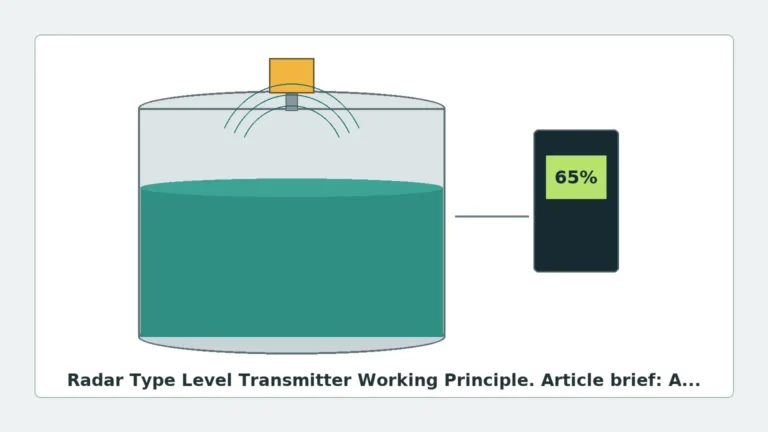
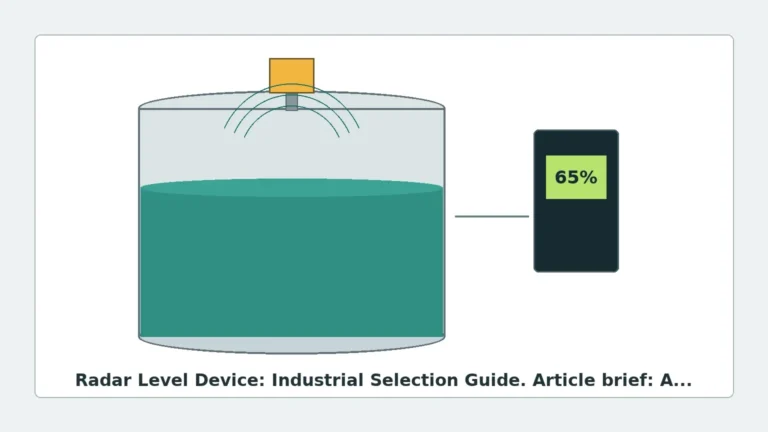
Before engaging with a radar level transmitter supplier, it is essential to understand how these instruments function. Radar level meters operate on the principle of "Time of Flight" (ToF). The device emits electromagnetic waves toward the surface of the medium, which are then reflected back to the sensor. By measuring the time interval between emission and reception, the instrument calculates the distance to the product surface.
There are two primary methods used in industrial radar measurement:
1. Pulse Radar (Non-Contact)
Pulse radar transmitters emit a series of high-frequency, short-duration microwave pulses. These pulses travel at the speed of light, hit the material surface, and return to the receiver. The circuitry calculates the distance based on the travel time. This technology is traditionally robust and energy-efficient, making it suitable for many standard tank applications.
2. Frequency Modulated Continuous Wave (FMCW)
FMCW radar does not send pulses but rather a continuous signal with a constantly changing frequency (a frequency sweep). The reflection from the product surface is received, and the difference between the transmitted frequency and the received frequency is proportional to the distance. FMCW is generally more accurate than pulse radar and is the preferred choice for high-precision requirements and complex environments where signal noise is a factor.
Frequency Bands
The frequency of the radar signal significantly impacts its performance:
* 6 GHz (C-Band): Better at penetrating foam and heavy dust, but requires larger antennas to maintain a narrow beam.
* 26 GHz (K-Band): A versatile middle ground used for many liquid and solid applications.
* 80 GHz (W-Band): The modern standard for high precision. It offers a very narrow beam angle, allowing for installation in small nozzles and avoiding internal tank obstructions like agitators or heating coils.
Selecting the Right Radar Technology
When evaluating Radar Level Meters, the choice between contact and non-contact technology is the first major decision point.
Non-Contact Radar
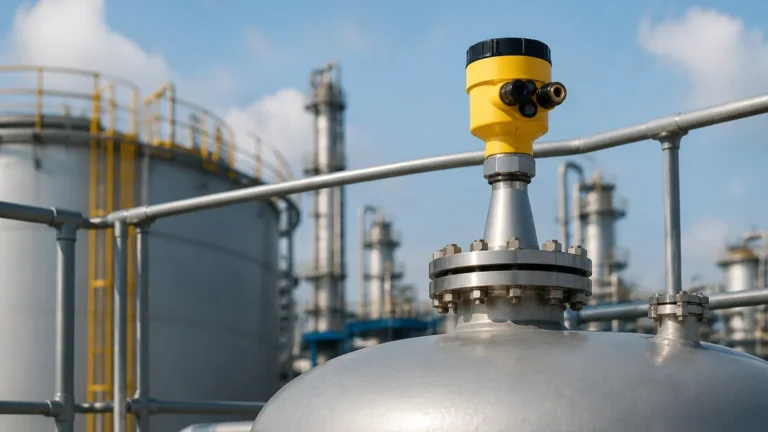
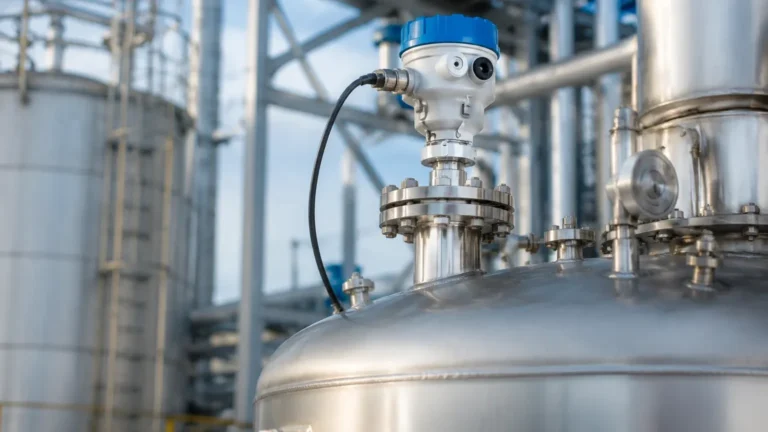
These instruments are mounted at the top of the vessel and do not touch the medium. They are ideal for corrosive, viscous, or abrasive materials. Because there are no moving parts and no contact with the process, maintenance requirements are minimal. They are widely used in the chemical, water treatment, and oil and gas industries.
Guided Wave Radar (GWR)
GWR uses a probe (cable or rod) to guide the microwave signal to the surface. While this is a "contact" method, it is highly effective for low dielectric constant (εr) liquids, interface measurement (e.g., oil over water), and applications with heavy foam or extreme turbulence that might scatter a non-contact signal.
Technical Selection Criteria for Engineers
To ensure a successful installation, a radar level transmitter supplier must be provided with specific process data. The following table outlines the critical parameters for selection:
| Parameter | Requirement | Engineering Consideration |
| :— | :— | :— |
| Medium State | Liquid, Slurry, or Solid | Solids require high-frequency radar to handle uneven surfaces. |
| Dielectric Constant (εr) | Range 1.4 to 100 | Lower εr values reflect less energy; GWR or high-gain antennas may be needed. |
| Process Temperature | -40°C to +450°C | High-temperature applications require cooling extensions or specialized seals. |
| Process Pressure | Vacuum to 160 bar (16 MPa) | Flange ratings and seal materials must match vessel design limits. |
| Measuring Range | 0.5m to 120m | Signal strength and antenna type must be optimized for the distance. |
| Accuracy | ±1mm to ±10mm | FMCW 80GHz units provide the highest precision for custody transfer. |
| Output Signal | 4-20mA HART, RS485, Modbus | Compatibility with existing PLC/DCS infrastructure is mandatory. |
Installation Considerations and Best Practices
Even the highest-quality instrument from a reputable radar level transmitter supplier will fail if installed incorrectly. Engineers should adhere to the following guidelines:
1. Beam Angle and Obstructions: The radar beam spreads as it travels. Ensure the "footprint" of the beam does not intersect with tank walls, ladders, or agitators. An 80GHz radar with a 3° beam angle is far easier to site than a 6GHz radar with a 20° beam angle.
2. Nozzle Dimensions: The antenna should ideally extend slightly below the mounting nozzle to prevent signal ringing or interference from the nozzle edge. If the nozzle is long and narrow, high-frequency radar is required.
3. Dead Zone (Blocking Distance): Every radar has a minimum measuring distance (typically 50mm to 200mm). The highest expected level must not enter this zone, or the signal will be lost.
4. Orientation: For solid materials, a swiveling flange is often necessary to aim the radar at the material's angle of repose. For liquids, the sensor must be mounted perpendicular to the surface.
5. Avoid the Center: Never mount a radar in the exact center of a domed-top tank, as this can cause multiple reflections that confuse the sensor electronics.
Limitations and Application Risks
While radar is highly versatile, it is not a universal solution. Engineers must be aware of the following limitations:
* Low Dielectric Media: Materials like liquefied gases or certain hydrocarbons have very low dielectric constants. If the εr is below 1.5, a non-contact radar may struggle to detect the surface without a stilling well or the use of Guided Wave Radar.
* Heavy Foam: While some radar frequencies can penetrate light foam, thick, dense foam (like shaving cream) can absorb the microwave signal entirely, leading to a "loss of echo" error.
* Heavy Dust and Build-up: In solid silos, extreme dust during filling can attenuate the signal. Furthermore, if the medium is conductive and sticky, build-up on the antenna can cause measurement errors. In these cases, air purging systems or PTFE-coated antennas are recommended.
Evaluating a Radar Level Transmitter Supplier
When choosing a partner for industrial instrumentation, consider the following factual benchmarks of a professional manufacturer:
Technical Support and Configuration
A reliable supplier should provide software tools or expert consultation to help predict beam spread and signal strength based on your tank geometry. They should offer pre-configuration services so the units arrive ready for your specific process parameters.
Quality Control and Certification
Ensure the supplier adheres to international standards. For hazardous areas, ATEX, IECEx, or SIL2/3 certifications are often mandatory. In the food and pharmaceutical sectors, FDA or EHEDG compliance for wetted parts is required.
Customization (OEM/ODM)
In many industrial automation projects, standard off-the-shelf units may not fit. A professional radar level transmitter supplier like Welk offers customization options, including specialized flange sizes, specific probe lengths for GWR, and various housing materials (Aluminum or Stainless Steel) to suit the environmental conditions.
Frequently Asked Questions (FAQ)
Q: Can radar measure level through a plastic tank wall?
A: Yes. Non-contact radar signals can penetrate non-conductive materials like plastic, fiberglass, or glass. This allows for measurement without any tank penetration, provided the wall thickness is not excessive and the material does not contain carbon or metal reinforcement.
Q: What is the difference between 2-wire and 4-wire transmitters?
A: 2-wire transmitters use the same pair of wires for both power and the 4-20mA signal, simplifying wiring. 4-wire transmitters have separate power supplies, which is often necessary for high-power FMCW units or when integrated heating/display elements require more current.
Q: How does temperature affect radar accuracy?
A: Unlike ultrasonic sensors, which are affected by the speed of sound changing with air temperature, radar uses electromagnetic waves. The speed of light is constant regardless of air temperature, making radar much more stable in processes with temperature fluctuations.
Q: Is maintenance required for radar level meters?
A: Generally, no. Non-contact radar has no moving parts. The only common maintenance task is cleaning the antenna if the process involves heavy splashing or condensation that causes significant build-up, though many modern units feature "mapping" software that can ignore static build-up.
Conclusion
Radar level transmitters represent a significant investment in plant reliability. By understanding the nuances of frequency, dielectric constants, and installation geometry, engineers can select a solution that provides years of maintenance-free service. When selecting a radar level transmitter supplier, focus on those who provide clear technical boundaries, robust hardware options, and the engineering support necessary to navigate complex application challenges. For more information on specific models and technical data, you may review product options and application support to find the optimal match for your industrial requirements.