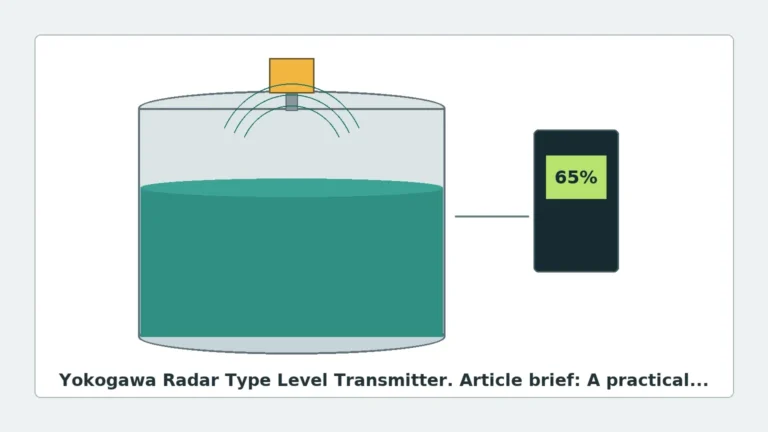
Rosemount Radar Level Transmitter 5900s
Rosemount Radar Level Transmitter 5900s: High-Precision Engineering for Industrial Tank Gauging
In the landscape of industrial process automation, the ability to accurately measure liquid levels in large storage tanks is fundamental to inventory management, safety, and operational efficiency. Among the most advanced solutions in this field is the rosemount radar level transmitter 5900s, a non-contacting radar instrument designed specifically for high-precision tank gauging.
This article provides a technical overview of the measurement principles, selection criteria, and installation requirements for the 5900s, while situating it within the broader context of Radar Level Meters used across the oil and gas, chemical, and power industries.
1. Understanding the Measurement Principle: FMCW Technology
Before selecting a specific instrument, it is essential to understand the underlying technology. The Rosemount 5900s utilizes Frequency Modulated Continuous Wave (FMCW) technology. Unlike traditional pulse radar, which measures the time-of-flight of a single microwave pulse, FMCW radar transmits a continuous signal with a constantly changing frequency.
How FMCW Works
1. Signal Transmission: The transmitter emits a continuous microwave signal that sweeps across a frequency band (typically around 10 GHz for the 5900s).
2. Reflection: The signal travels to the liquid surface and reflects back toward the antenna.
3. Frequency Comparison: Because the transmitter is constantly changing its frequency, by the time the reflected signal returns, the transmitter is already emitting a different frequency.
4. Distance Calculation: The difference between the transmitted frequency and the received frequency (the "beat frequency") is directly proportional to the distance.
This method allows for significantly higher precision than pulse radar. While standard industrial radar level meters might offer an accuracy of ±2 mm to ±10 mm, the FMCW-based 5900s can achieve an instrument accuracy of ±0.5 mm (0.02 in.), making it suitable for custody transfer applications where even minor errors result in significant financial discrepancies.
2. Key Features and Engineering Advantages
The 5900s is often integrated into a larger tank gauging system (such as the Rosemount TankMaster). Its design addresses several critical industrial challenges:
2-in-1 Redundancy
One of the unique features of the 5900s is the "2-in-1" option. This configuration allows two independent radar gauges to be housed within a single transmitter head. This provides level measurement and independent overfill protection (SIL 2 or SIL 3) through a single tank opening, reducing installation costs and mechanical complexity.
Non-Contacting Design
As a non-contacting instrument, the 5900s is not subject to the wear, corrosion, or coating issues that plague mechanical float systems or contact probes. This is particularly advantageous for volatile liquids, corrosive chemicals, or fluids with high viscosity.
Power Over Bus
The unit is typically powered by a 2-wire tank bus (FISCO), which simplifies wiring and allows for the integration of multiple sensors (such as temperature probes and pressure transmitters) on a single digital communication loop.
3. Technical Selection and Antenna Types
Selecting the correct antenna is the most critical step in ensuring the performance of the rosemount radar level transmitter 5900s. The choice depends on the tank type, the properties of the liquid, and the presence of internal obstructions.
| Antenna Type | Typical Application | Max Range (Metric) | Key Advantage |
| :— | :— | :— | :— |
| Parabolic Antenna | Large bulk storage, fixed roof tanks | 50 meters | Highest signal strength; resistant to condensation and contamination. |
| Still-pipe Array Antenna | Tanks with stilling wells (floating roofs) | 40 meters | Specifically designed to eliminate interference from pipe welds and slots. |
| Horn Antenna | Smaller vessels, chemical tanks | 20 meters | Compact design for smaller nozzles (typically 4-inch or 8-inch). |
| LPG/LNG Antenna | Pressurized liquefied gas storage | 60 meters | Includes a fire-proof seal and can handle high-pressure environments. |
Selection Criteria Checklist
* Accuracy Requirements: Is the application for process control (±2-3 mm) or custody transfer (±0.5 mm)?
* Product Dielectric Constant (εr): Lower dielectric liquids (like liquefied gases) reflect less energy and may require more sensitive antenna configurations.
* Tank Geometry: Are there internal agitators, heating coils, or baffles that could create false echoes?
* Process Conditions: What are the maximum operating pressures and temperatures? The 5900s is rated for a wide range, but specific seals (e.g., Kalrez or Viton) must be selected based on chemical compatibility.
4. Installation Considerations and Constraints
Proper installation is paramount to achieving the sub-millimeter accuracy the 5900s is capable of. Engineers must adhere to strict mechanical guidelines during the design phase.
Nozzle Positioning
The transmitter should be mounted such that the radar beam has a clear, unobstructed path to the liquid surface.
* Wall Distance: The antenna should be placed at least 500 mm (approx. 20 inches) from the tank wall to avoid interference from side-wall reflections.
* Vertical Alignment: The antenna must be mounted perfectly vertical (within ±1°). Any tilt can cause the signal to reflect away from the receiver, resulting in signal loss, especially on calm liquid surfaces.
Stilling Wells (Still-pipes)
In tanks with internal turbulence or floating roofs, stilling wells are used to provide a calm surface for measurement. When using the 5900s with a still-pipe, the antenna must be matched to the pipe diameter (typically 5, 6, 8, 10, or 12 inches). It is vital that the interior of the pipe is smooth; burrs or misaligned welds can create "ghost" targets that the radar may mistake for the liquid level.
Obstruction Avoidance
While modern software can perform "false echo suppression" (mapping out static reflections from internal structures), it is always best practice to avoid mounting the transmitter directly over ladders, pipes, or heating coils. If an obstruction is unavoidable, the parabolic antenna’s narrow beam angle (typically 6 to 10 degrees) is often the best choice to bypass these objects.
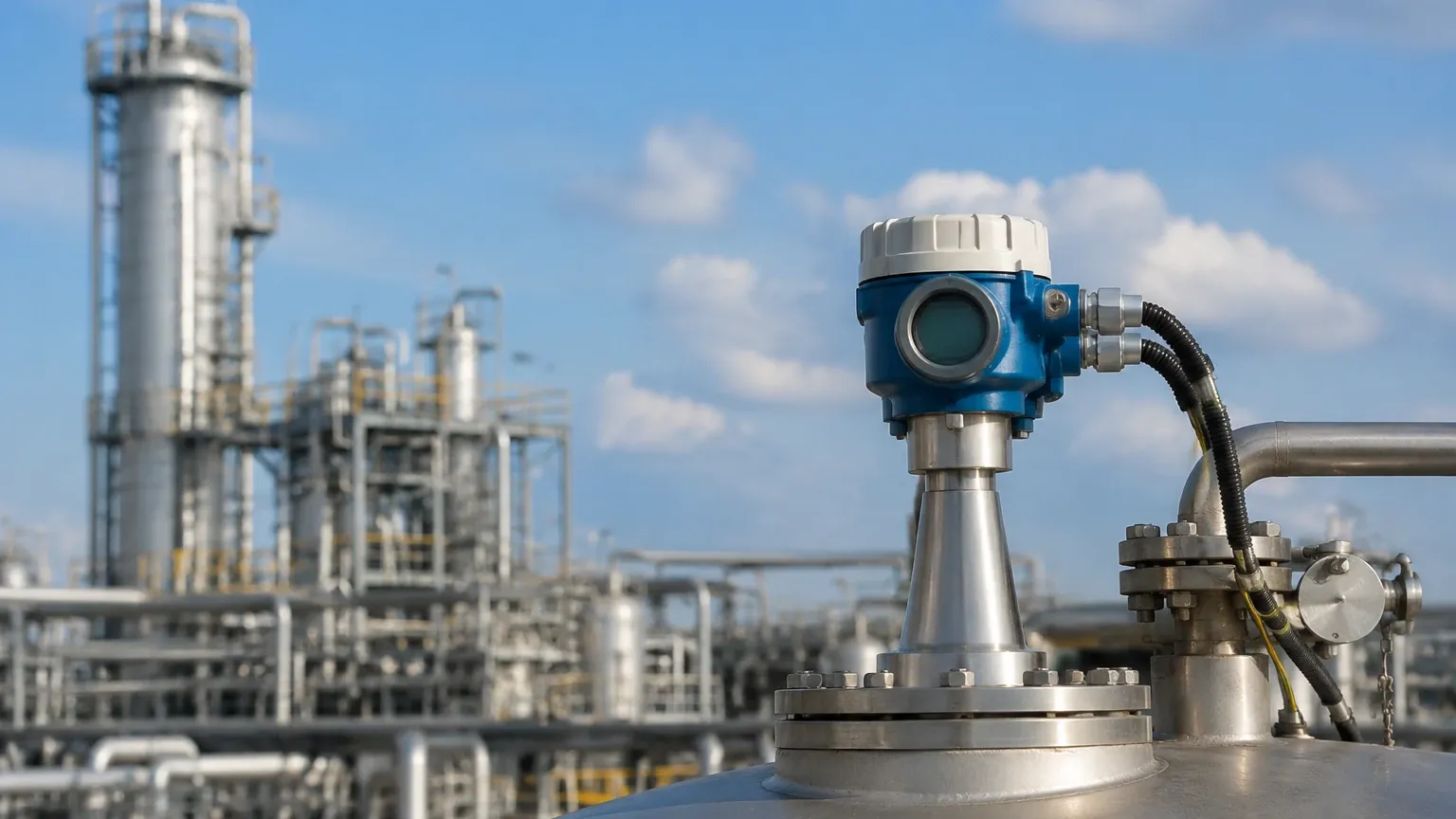
5. Application Risks and Limitations
While the 5900s is a robust instrument, certain conditions can challenge its performance:
1. Heavy Foam: Extremely dense, thick foam can absorb the radar signal rather than reflecting it. In such cases, the radar may lose the surface or report a level at the top of the foam layer. If thick foam is a constant factor, a guided wave radar or hydrostatic transmitter might be considered as an alternative.
2. Extreme Turbulence: While FMCW is better at handling surface agitation than pulse radar, extreme turbulence can scatter the signal. This is usually mitigated by using a stilling well.
3. Vacuum Conditions: In high-vacuum applications, the dielectric properties of the vapor space change. While the 5900s can operate in a vacuum, the system must be calibrated to account for the change in the speed of light through the medium.
4. Condensation and Coating: While the parabolic antenna is somewhat self-cleaning, heavy buildup of waxes or bitumen on the antenna face can eventually attenuate the signal.
6. Comparison with General Industrial Radar Level Meters
For many industrial applications, the 5900s may be "over-engineered." It is important to distinguish between high-precision tank gauging and standard process level measurement.
General-purpose Radar Level Meters are often more cost-effective for applications such as:
* Day tanks and buffer tanks.
* Water and wastewater treatment basins.
* Chemical dosing skids.
* Simple level monitoring where ±5 mm accuracy is acceptable.
The rosemount radar level transmitter 5900s should be prioritized when the financial value of the stored product is high, or when the safety requirements (SIL 3) demand the highest level of reliability and redundancy available in the market.
7. Frequently Asked Questions (FAQ)
Q: Can the 5900s measure the interface between two liquids?
A: Generally, non-contacting radar is not the primary choice for interface measurement (e.g., oil over water) because the signal largely reflects off the top layer. Guided Wave Radar (GWR) is typically preferred for interface applications. However, if the top layer is non-conductive and thin enough, some signal may penetrate, but this is not the 5900s's primary function.
Q: What is the maintenance requirement for the 5900s?
A: Because it has no moving parts, maintenance is minimal. Periodic verification of the electronics and a visual inspection of the antenna for significant coating are usually sufficient. Many units operate for over a decade without requiring recalibration.
Q: How does temperature affect the accuracy?
A: The 5900s includes internal temperature compensation. However, extreme temperature gradients in the vapor space can slightly affect the speed of the radar signal. For custody transfer, the system often integrates multi-point temperature sensors to calculate the corrected volume based on the liquid's temperature profile.
Q: Is it possible to retrofit the 5900s onto old tanks?
A: Yes. It is frequently used to replace old mechanical float and tape gauges. Since it can use existing still-pipes and tank openings, it is a common choice for modernization projects.
8. Summary for International Buyers
When procuring a high-precision radar system, international buyers should confirm the following data points with their supplier:
* Certification Requirements: Ensure the device meets local hazardous area certifications (ATEX, IECEx, FM, etc.).
* Communication Protocol: Confirm if the system needs to communicate via Modbus, Foundation Fieldbus, or a proprietary tank bus.
* Material Traceability: For chemical and offshore applications, request 3.1 material certificates for all wetted parts.
* Flange Standards: Specify whether ANSI, DIN, or JIS flanges are required to match existing tank nozzles.
By understanding the technical nuances of the rosemount radar level transmitter 5900s and the specific requirements of the installation site, engineering teams can ensure a reliable, high-accuracy solution that serves the facility's inventory and safety needs for years to come.