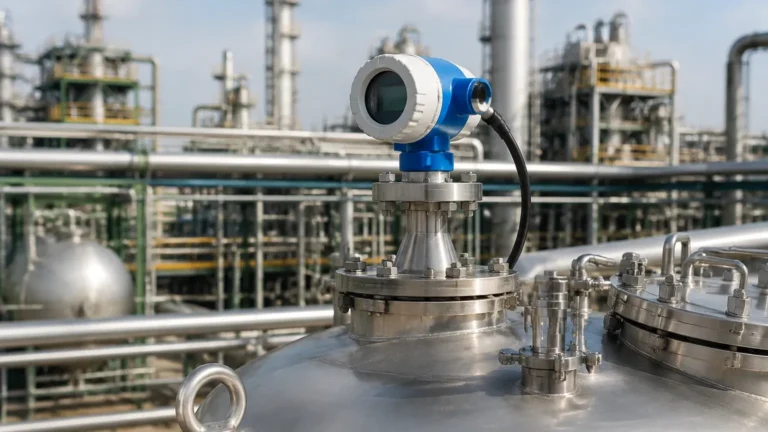
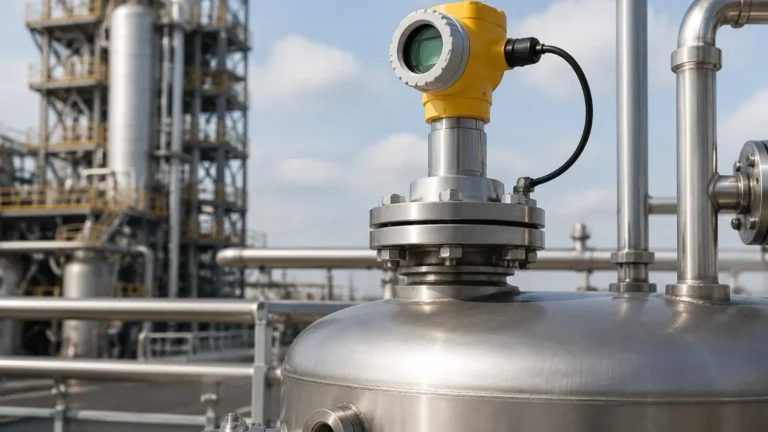
80 GHz Radar Level Transmitter
80 GHz Radar Level Transmitter
In the landscape of industrial process automation, the transition from legacy ultrasonic and low-frequency radar systems to high-frequency millimeter-wave technology has significantly improved measurement reliability. The 80 GHz radar level transmitter represents the current pinnacle of non-contact level measurement, offering precision and signal focus that were previously unattainable with 6 GHz or 26 GHz systems.
For engineers and procurement professionals, understanding the technical nuances of 80 GHz technology is essential for optimizing process control in sectors ranging from chemical processing to bulk solids handling. This guide examines the operating principles, selection criteria, and installation best practices for Radar Level Meters operating in the W-band frequency range.
Measurement Principles: FMCW and the 80 GHz Advantage
Modern 80 GHz radar level transmitters primarily utilize Frequency Modulated Continuous Wave (FMCW) technology. Unlike pulse radar, which measures the time-of-flight of a single microwave burst, FMCW transmits a continuous signal with a constantly changing frequency.
The FMCW Mechanism
1. Signal Emission: The transmitter emits a high-frequency signal that sweeps across a bandwidth (typically up to 4 GHz, from 76 GHz to 81 GHz).
2. Reflection: The signal bounces off the surface of the medium and returns to the sensor.
3. Frequency Difference: Because the transmitted frequency changes over time, there is a measurable difference ($\\Delta f$) between the frequency being emitted and the frequency being received at any given moment.
4. Distance Calculation: This frequency shift is directly proportional to the distance. The internal microprocessor uses a Fast Fourier Transform (FFT) to convert this frequency signal into a precise distance measurement.
Why 80 GHz Matters
The move to 80 GHz is not merely an incremental upgrade; it fundamentally changes the signal's physical behavior. The shorter wavelength (approximately 3.75 mm) allows for a much narrower beam angle. While a 26 GHz radar might have a beam angle of 10° to 15°, an 80 GHz unit can achieve a beam angle as narrow as 3°. This focus ensures that the energy is concentrated on the product surface rather than reflecting off tank walls, agitators, or internal ladders.
Technical Comparison: 26 GHz vs. 80 GHz
When selecting instrumentation, it is helpful to compare the performance characteristics of high-frequency units against traditional mid-frequency models.
| Feature | 26 GHz Radar Level Meter | 80 GHz Radar Level Transmitter |
| :— | :— | :— |
| Frequency Range | ~24 GHz to 26 GHz | ~76 GHz to 81 GHz |
| Beam Angle (typical) | 8° to 20° | 3° to 8° |
| Measurement Accuracy | ±2 mm to ±5 mm | ±1 mm |
| Bandwidth | ~1 GHz | ~4 GHz |
| Minimum Nozzle Size | DN50 (2") | DN20 (3/4") |
| Dead Zone (Blind Zone) | 200 mm to 400 mm | <50 mm |
| Max Range (Solids) | Up to 70 m | Up to 120 m |
Selection Criteria for Industrial Applications
Choosing the right 80 GHz radar level transmitter requires a detailed analysis of the process environment. As a manufacturer of professional industrial level measurement instruments, Welk emphasizes the following factors:
1. Dielectric Constant (DK) of the Medium
The reflectivity of a material depends on its dielectric constant ($\\epsilon_r$). High-DK materials like water ($\\epsilon_r \\approx 80$) are easy to measure. However, low-DK materials like plastic pellets, oil, or dried powders ($\\epsilon_r < 2.0$) reflect very little energy. The high sensitivity and signal-to-noise ratio of 80 GHz systems make them ideal for these challenging low-reflectivity media.
2. Process Temperature and Pressure
Standard 80 GHz transmitters often handle temperatures from -40°C to +200°C. For high-temperature applications (up to 450°C or higher), specialized cooling extensions or ceramic process seals are required. Pressure ratings typically range from vacuum to 40 bar (4.0 MPa), though high-pressure versions are available for specific oil and gas applications.
3. Tank Geometry and Internals
In small vessels or tanks crowded with heating coils, agitators, and baffles, the narrow beam of the 80 GHz transmitter is a critical advantage. It allows the signal to "thread the needle" between obstructions that would cause false echoes in lower-frequency systems.
4. Antenna Material and Protection
* Lens Antennas: Most 80 GHz units use a flush-mounted PTFE or PEEK lens. This design is resistant to buildup and condensation.
* Corrosive Environments: For highly aggressive chemicals, a full PTFE flange or protective coating is necessary to prevent corrosion of the stainless steel housing.
Installation Considerations and Best Practices
Correct installation is as vital as selecting the right hardware. Even the most advanced 80 GHz radar level transmitter will underperform if mounted incorrectly.
Positioning
* Avoid the Center: Do not install the sensor in the exact center of a domed tank. This can lead to multiple reflections that interfere with the primary signal.
* Distance from Wall: Maintain a minimum distance from the tank wall, typically 200 mm or 10% of the tank height, to prevent interference from wall seams or weld beads.
* Nozzle Height: Ensure the antenna extends slightly beyond the nozzle or that the nozzle is short enough to prevent "ringing" or internal reflections within the mounting pipe.
Orientation
* Solids: When measuring bulk solids in silos, the material often forms a cone. An adjustable mounting flange (aiming device) allows the engineer to point the radar beam at the most representative part of the slope to ensure a consistent return signal.
* Agitators: If an agitator is present, the transmitter should be positioned so the beam does not hit the blades directly. If this is unavoidable, most modern 80 GHz units feature "False Echo Suppression" software to map out and ignore stationary or periodic obstructions.
Environmental Factors
* Condensation and Steam: While 80 GHz is highly effective through steam, heavy condensation on the lens can attenuate the signal. Choosing a lens antenna with a convex shape helps moisture droplets run off.
* Dust: In high-dust environments (e.g., cement silos), 80 GHz radar is superior to ultrasonic sensors because microwaves are not affected by air density or suspended particles. However, extremely heavy dust buildup on the antenna face may eventually require an integrated air purge system.

Application Engineering: Where 80 GHz Excels
Bulk Solids and Silos
In tall, narrow silos containing grain, cement, or plastic resins, 26 GHz radars often struggle with signal scattering. The 80 GHz radar level transmitter provides a focused beam that reaches the bottom of 100-meter silos while ignoring wall interference. Its ability to measure accurately during the filling process, despite significant dust, makes it the industry standard for inventory management.
Small Process Vessels
In the pharmaceutical and food industries, vessels are often small (under 2 meters) and require sanitary fittings. The compact size of 80 GHz antennas allows them to be mounted on small 1-inch or 2-inch Tri-clamp fittings without sacrificing accuracy. The small dead zone (as low as 10 mm) allows for measurement even when the tank is nearly full.
Corrosive Chemical Storage
Measuring the level of acids or alkalis requires non-contact technology. By using an 80 GHz radar with a PTFE lens, the instrument remains completely isolated from the corrosive vapors, extending the service life compared to contact-based methods like magnetic level gauges or hydrostatic transmitters.
Limitations and Risks
Despite its advantages, 80 GHz technology is not a universal solution for every scenario:
1. Heavy Foam: Extremely thick, dense foam (like shaving cream) can absorb microwave signals entirely. In such cases, a guided wave radar (GWR) or a low-frequency radar might be more effective at penetrating the foam layer.
2. Cost: 80 GHz units generally command a higher price point than 26 GHz or ultrasonic sensors. For simple water tank applications where high precision isn't required, 80 GHz may be over-engineered.
3. Complex Interfaces: Radar measures the top surface. If the goal is to measure the interface between two liquids (e.g., oil and water), guided wave radar is usually the preferred technology.
Frequently Asked Questions (FAQ)
Q: Can an 80 GHz radar level transmitter measure through a plastic tank lid?
A: Yes. Because plastic is a non-conductive material with a low dielectric constant, the 80 GHz microwave signal can pass through it. This allows for measurement without cutting a hole in the tank, provided the plastic is not carbon-filled or metallic-coated.
Q: Does the 80 GHz frequency pose any safety risks to personnel?
A: No. The power output of industrial radar level meters is extremely low (typically less than 1 mW). It is significantly lower than the output of a standard mobile phone and is safe for continuous operation in workplaces.
Q: How does 80 GHz radar handle heavy turbulence?
A: Turbulence causes the liquid surface to scatter the radar signal. However, because 80 GHz systems have a high sampling rate and advanced signal processing algorithms, they can average these fluctuations to provide a stable level reading.
Q: Is calibration required frequently?
A: No. Radar level meters are solid-state devices with no moving parts. Once calibrated to the tank height during commissioning, they typically do not drift. Periodic verification is usually sufficient for regulatory compliance.
Conclusion
The 80 GHz radar level transmitter has redefined the boundaries of what is possible in industrial level measurement. By offering a narrow beam, high precision, and a compact form factor, it solves many of the traditional challenges associated with tank internals, low-dielectric materials, and long-range measurement. For international buyers and engineers, selecting a high-quality instrument from a reliable manufacturer like Welk ensures long-term operational stability and reduced maintenance costs. When evaluating options, always prioritize the specific dielectric properties of your medium and the physical constraints of your vessel to ensure the optimal application of this powerful technology.