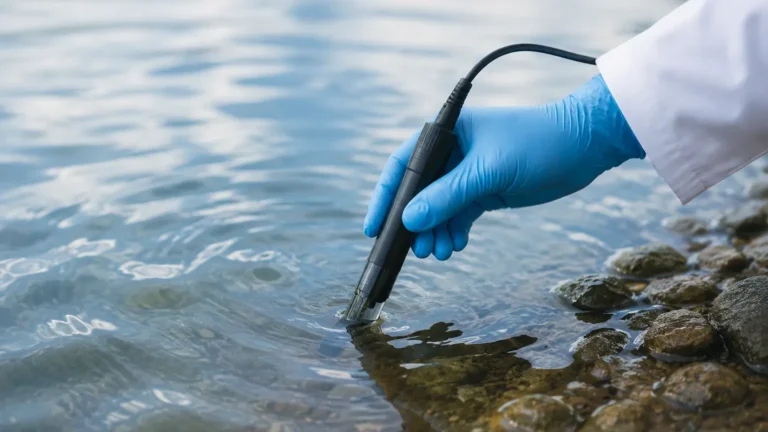
Analog Ph Meter
Analog Ph Meter
In the landscape of industrial process control, the measurement of hydrogen ion activity—commonly known as pH—remains one of the most critical parameters for ensuring product quality, equipment longevity, and environmental compliance. While digital protocols are increasingly common, the analog pH meter remains a foundational tool in water treatment, chemical manufacturing, and pharmaceutical production. This guide explores the technical principles, selection criteria, and practical application of analog pH measurement systems within a broader industrial automation framework.
Fundamental Principles of pH Measurement
To effectively select and deploy an analog pH meter, one must first understand the electrochemical principles that govern its operation. The measurement is based on the potential difference generated between a measuring electrode and a reference electrode when they are immersed in a solution.
The Nernst Equation
The relationship between the electrical potential and the pH value is defined by the Nernst equation. In a theoretical environment at 25°C (298.15 K), a change of one pH unit corresponds to a change in electrical potential of 59.16 millivolts (mV). The equation is expressed as:
$$E = E_0 – \frac{2.303 RT}{nF} \log(aH^+)$$
Where:
* E is the measured potential.
* E0 is the standard electrode potential.
* R is the ideal gas constant.
* T is the absolute temperature in Kelvin.
* n is the valence of the ion.
* F is the Faraday constant.
* aH+ is the activity of hydrogen ions.
Electrode Dynamics
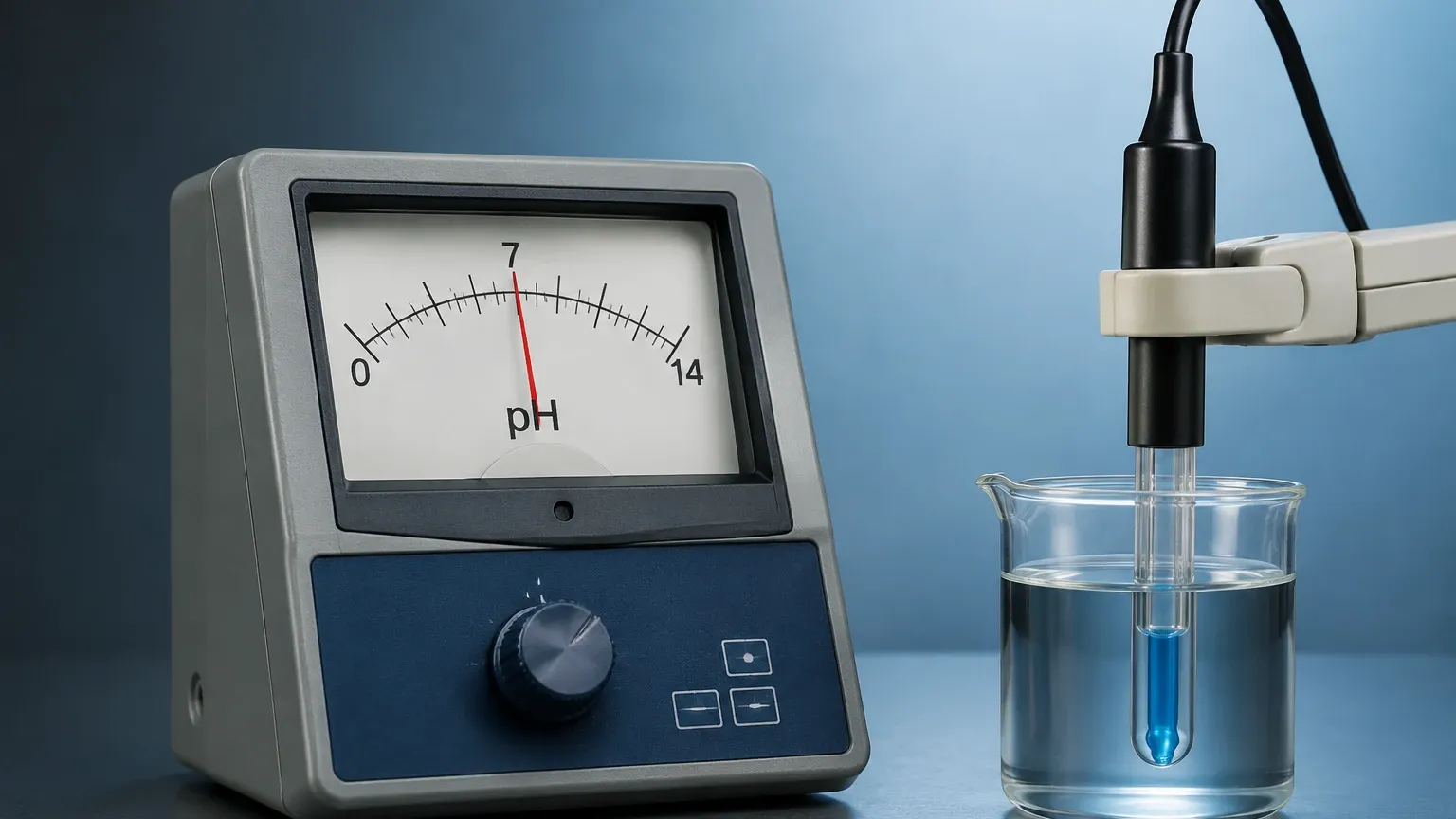
An analog pH meter system typically consists of a glass electrode and a reference electrode. The glass electrode features a specialized pH-sensitive membrane that develops a charge proportional to the hydrogen ion concentration. The reference electrode provides a stable, constant potential against which the measuring electrode is compared. Most modern industrial sensors are "combination electrodes," housing both elements within a single body for easier installation and maintenance.
Components and Signal Chain of an Analog pH Meter
An industrial analog pH measurement loop is more than just a probe; it is a signal chain designed to handle extremely high impedance signals. Because the glass membrane of the electrode has a resistance ranging from 10 MΩ to over 1000 MΩ, the resulting signal is incredibly weak and susceptible to interference.
1. The Sensor (Electrode): The primary sensing element that generates the raw millivolt signal.
2. The High-Impedance Cable: Specialized coaxial cables with low-noise shielding are required to transport the mV signal from the sensor to the transmitter. Standard copper wiring is insufficient due to the risk of signal leakage and electromagnetic interference.
3. The Transmitter/Amplifier: This component performs the "analog" conversion. It takes the high-impedance mV signal and converts it into a robust, standardized industrial signal, typically 4-20 mA or 0-10 V. This allows the data to be transmitted over long distances to a PLC (Programmable Logic Controller) or DCS (Distributed Control System).
4. Temperature Compensation (ATC): Since the Nernstian slope is temperature-dependent, most analog pH systems include an integrated Resistance Temperature Detector (RTD), such as a Pt100 or Pt1000, to provide Automatic Temperature Compensation.
Technical Selection Criteria for Industrial Environments
Choosing the right analog pH meter requires a detailed analysis of the process conditions. Unlike level measurement, which often relies on physical reflection (like radar or ultrasonic), pH measurement is a contact-based chemical reaction that consumes the sensor over time.
Selection Table: Electrode Materials and Applications
| Process Condition | Recommended Junction | Membrane Type | Temperature Range |
| :— | :— | :— | :— |
| General Water Treatment | Ceramic | Standard Green Glass | 0°C to 80°C |
| Harsh Chemical Processing | PTFE (Teflon) | High-Temp Glass | -10°C to 110°C |
| High Solids / Slurries | Open Aperture / Solid Polymer | Abrasion Resistant | 0°C to 100°C |
| Pure Water / Low Conductivity | Large Surface Area Ceramic | Low Impedance Glass | 0°C to 50°C |
| Food & Beverage | Sanitary Flush Mount | Lead-Free Glass | 0°C to 135°C (CIP) |
Key Evaluation Factors
* Pressure Rating: Standard electrodes are often rated for atmospheric pressure. For pressurized pipelines or deep tanks, a pressure-compensated or electrolyte-filled electrode is necessary to prevent process fluid from entering the reference junction.
* Chemical Compatibility: The body material (typically glass, Ryton, or PVDF) must withstand the corrosivity of the medium.
* Signal Distance: If the distance between the sensor and the controller exceeds 10-15 meters, an analog pre-amplifier or a transmitter located near the sensor is required to prevent signal degradation.
Integration with Level Measurement and Process Automation
In industrial tank management, pH monitoring rarely exists in isolation. It is frequently paired with level measurement instruments to ensure safe and efficient chemical dosing. For instance, in a neutralization tank, an ultrasonic or radar level meter monitors the volume of the effluent, while the analog pH meter determines the amount of acid or caustic required for treatment.
Welk provides a comprehensive range of industrial level measurement instruments, including radar level meters and hydrostatic transmitters, which are essential for managing the vessels where pH sensors are installed. For engineers looking to optimize their entire liquid management system, reviewing product options and application support on the Main Page can provide insights into how level and analytical data work together to improve process safety.
Installation Considerations
* Submersion Depth: Ensure the pH sensor is always submerged. If the liquid level drops below the sensor, the glass membrane will dry out, leading to permanent damage or sluggish response. This is why integrating a reliable level switch is critical.
* Flow Velocity: In pipeline installations, the sensor should be placed in a location with steady flow to ensure a representative sample, but away from high-turbulence zones that could cause mechanical stress on the glass bulb.
* Mounting Angle: Analog pH electrodes should generally be mounted at an angle of at least 15° above the horizontal. This ensures that the internal electrolyte stays in contact with the pH bulb and prevents air bubbles from being trapped inside the electrode.
Maintenance, Calibration, and Troubleshooting
An analog pH meter is a "consumable" instrument. Its accuracy is entirely dependent on a rigorous maintenance and calibration schedule.
Calibration Procedure
Calibration should be performed using at least two buffer solutions (usually pH 4.01, 7.00, or 10.01) that bracket the expected process value.
1. Zero Point (Offset): Calibrate at pH 7.00. The theoretical output is 0 mV. Any deviation is recorded as the offset.
2. Slope: Calibrate at a second point (e.g., pH 4.01). This determines the efficiency of the electrode. A new electrode typically has a slope of 95% to 102%. If the slope drops below 85%, the electrode should be replaced.
Common Risks and Limitations
* Junction Fouling: The most common cause of failure in analog pH meters is the clogging of the reference junction. In wastewater applications, oils or precipitates can block the junction, leading to erratic readings or "drifting."
* Ground Loops: Since the pH signal is millivolt-based, electrical noise from pumps or motors can create ground loops. Using a transmitter with galvanic isolation is the standard engineering solution for this problem.
* Dehydration: If a sensor is left in a dry tank for an extended period, the hydrated gel layer on the glass bulb will collapse. While some sensors can be rejuvenated by soaking in a storage solution (KCl), many will require replacement.
Frequently Asked Questions
Q: How often should I calibrate my analog pH meter?
A: The frequency depends on the process. In stable water treatment applications, once a month may suffice. In harsh chemical processes or high-accuracy pharmaceutical applications, daily or even shift-based calibration may be required.
Q: Can I use a standard multimeter to check an analog pH probe?
A: No. A standard multimeter does not have a high enough input impedance. Connecting a standard meter to a pH probe will load the circuit, causing the voltage to drop to zero and potentially damaging the electrode's polarization.
Q: What is the lifespan of an industrial pH electrode?
A: In clean water at ambient temperatures, an electrode may last 12 to 24 months. In high-temperature, high-pressure, or highly corrosive environments, the lifespan may be as short as 3 to 6 months.
Q: How does cable length affect an analog pH signal?
A: Without a pre-amplifier, the raw mV signal from a pH probe should not travel more than 15 meters (approx. 50 feet). Longer distances increase the risk of signal noise and attenuation due to the high impedance of the source.
Q: Why is temperature compensation necessary if my process is always at room temperature?
A: Even small fluctuations of 5°C can significantly affect the pH reading. Temperature compensation corrects for the change in the Nernstian slope, ensuring that the meter reflects the actual hydrogen ion activity regardless of thermal variations.
By understanding these technical nuances, process engineers can ensure that their analog pH meter systems provide the reliable data necessary for automated control. When combined with precision level measurement from the Main Page, these analytical tools form the backbone of modern industrial fluid management.