High Precision Thermometers
High Precision Thermometers
In industrial process control, the accuracy of temperature measurement is often the determining factor in product quality, safety, and operational efficiency. High precision thermometers are specialized instruments designed to provide measurements with minimal uncertainty, typically utilized in laboratory calibration, pharmaceutical manufacturing, and complex chemical processing. While temperature is a fundamental variable on its own, it also plays a critical role in the accuracy of other process measurements, such as liquid level and flow, where fluid density is temperature-dependent.
Selecting the appropriate high-precision instrument requires a deep understanding of the underlying physics of thermometry, the environmental constraints of the application, and the long-term stability requirements of the process. This guide explores the principles, selection criteria, and practical installation considerations for high precision thermometers in industrial B2B environments.
Core Principles of High Precision Temperature Measurement
To achieve high precision, thermometers rely on physical properties that change predictably and repeatably with temperature. The three most common technologies used in high-precision industrial applications are Resistance Temperature Detectors (RTDs), Thermocouples, and Thermistors.
Resistance Temperature Detectors (RTDs)
RTDs operate on the principle that the electrical resistance of a metal increases as its temperature rises. Platinum is the most common material used for high-precision RTDs (often referred to as Pt100 or Pt1000) due to its excellent linearity, wide temperature range, and chemical inertness.
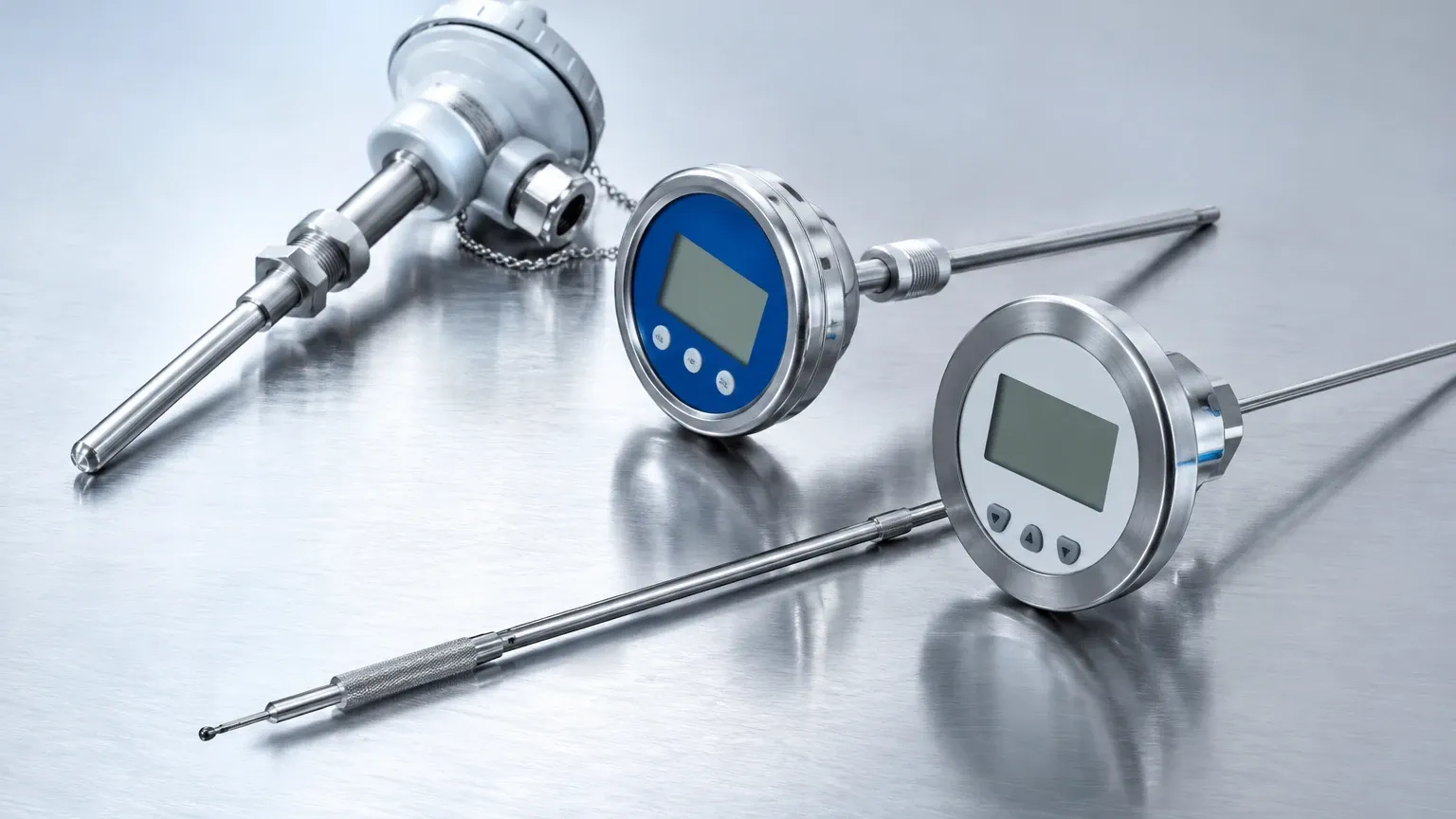
In high-precision applications, "Class AA" or "1/10 DIN" RTDs are used. These sensors provide much tighter tolerances than standard industrial probes. For example, a standard Class B RTD might have an accuracy of ±0.3°C at 0°C, whereas a 1/10 DIN sensor can achieve ±0.03°C. To maintain this precision, 4-wire configurations are mandatory to eliminate the influence of lead wire resistance.
Thermocouples
Thermocouples function based on the Seebeck effect, where a voltage is generated at the junction of two dissimilar metals when subjected to a temperature gradient. While thermocouples are generally known for their ruggedness and wide temperature range rather than extreme precision, specific "Special Limits of Error" (SLE) grade wires can provide high accuracy in high-temperature environments (above 600°C) where RTDs might fail or drift.
Thermistors
Thermistors are semiconductor-based resistors that exhibit a very large change in resistance over a narrow temperature range. While they offer the highest sensitivity and resolution among the three types, they are historically limited by non-linearity and a narrower operating range. However, modern high precision thermometers utilizing NTC (Negative Temperature Coefficient) thermistors are often the preferred choice for medical and laboratory applications between -40°C and 150°C.
Defining High Precision in Industrial Contexts
In a B2B engineering context, "high precision" is not a single value but a combination of several performance metrics:
1. Accuracy: The proximity of the measurement to the true temperature value. This is usually defined by international standards such as IEC 60751 for RTDs.
2. Resolution: The smallest temperature change the instrument can detect. High precision digital thermometers often feature resolutions of 0.001°C, though resolution should not be confused with accuracy.
3. Repeatability: The ability of the sensor to provide the same output for the same temperature under identical conditions over a short period.
4. Stability (Drift): The ability of the sensor to maintain its accuracy over time. High precision sensors are characterized by very low annual drift, often measured in millikelvins (mK) per year.
Selection Criteria and Comparative Analysis
Choosing between different high precision thermometers involves balancing the required temperature range against the necessary accuracy and the physical environment of the installation. The following table provides a comparison of the primary technologies used in high-precision industrial sensing.
Comparison of High Precision Sensing Technologies
| Feature | Platinum RTD (Pt100) | SLE Thermocouple (Type S/R) | Precision Thermistor |
| :— | :— | :— | :— |
| Temperature Range | -200°C to +850°C | 0°C to +1600°C | -50°C to +150°C |
| Typical Accuracy | ±0.03°C to ±0.1°C | ±0.6°C or 0.1% | ±0.01°C to ±0.05°C |
| Long-term Stability | Excellent (<0.05°C/year) | Fair (Drifts at high temp) | Good (if kept <100°C) |
| Linearity | High | Low (Requires complex scaling) | Very Low (Exponential) |
| Response Time | Moderate | Fast | Very Fast |
| Cost | High | Very High (Noble metals) | Moderate |
When evaluating these options, engineers must also consider the integration with existing control systems. For comprehensive instrumentation solutions and technical support regarding sensor integration, users may review product options and application support on our Main Page.
Installation and Engineering Best Practices
Even the highest quality high precision thermometers will yield inaccurate data if installed incorrectly. In industrial settings, several factors can introduce measurement errors that far exceed the sensor's rated accuracy.
Immersion Depth
One of the most common errors is "stem conduction," where heat travels along the sensor probe to or from the ambient environment. To prevent this, the sensor must be immersed deeply enough into the process medium. A general rule of thumb for high-precision measurement is an immersion depth of at least 10 to 15 times the diameter of the thermowell or probe.
Thermowell Design
In pressurized or high-velocity flows, sensors are protected by thermowells. However, the thermowell adds thermal mass, which increases the response time (thermal lag). For high precision, the gap between the sensor and the thermowell wall should be minimized, often by using heat-conductive paste, to ensure efficient thermal transfer.
Wiring and Signal Integrity
For RTDs, a 4-wire bridge circuit is essential to compensate for lead wire resistance. For thermocouples, the use of proper extension wire and cold-junction compensation (CJC) is critical. In all cases, shielded cabling should be used to protect the low-voltage signals from electromagnetic interference (EMI) common in industrial plants.
The Interdependence of Temperature and Level Measurement
In many B2B applications, high precision thermometers are not standalone instruments but are integrated into larger measurement loops. A primary example is in hydrostatic level measurement. Hydrostatic level transmitters calculate the height of a liquid based on the pressure exerted by the liquid column. Since pressure is a function of density ($P = \rho gh$), and density changes with temperature, an inaccurate temperature reading will result in an incorrect level calculation.
Similarly, in high-accuracy radar level applications involving liquefied gases or high-pressure steam, the dielectric constant of the vapor space may change with temperature. High precision thermometers provide the necessary data for real-time compensation algorithms, ensuring that the level meter maintains its specified accuracy across varying process conditions.
Limitations and Operational Risks
While high precision thermometers offer superior data, they come with specific limitations that must be managed:
* Fragility: High-precision RTD elements, especially wire-wound types, are more sensitive to mechanical shock and vibration than standard industrial sensors. Excessive vibration can cause the fine platinum wire to strain, leading to permanent calibration drift.
* Self-Heating: RTDs and thermistors require an excitation current. This current generates a small amount of heat within the sensor (Joule heating). In high-precision applications, the excitation current must be kept very low (typically <1 mA for RTDs) to prevent the sensor from reading higher than the actual process temperature.
* Calibration Requirements: High precision instruments require regular calibration against traceable standards (e.g., NIST or ITS-90). The frequency of calibration depends on the stability of the sensor and the criticality of the process.
Frequently Asked Questions (FAQs)
Q: What is the difference between a Pt100 and a Pt1000 for high precision?
A: A Pt100 has a resistance of 100 ohms at 0°C, while a Pt1000 has 1000 ohms. Pt1000 sensors are often preferred in 2-wire or battery-powered applications because the higher resistance makes the lead wire resistance less significant. However, for the highest precision in industrial 4-wire systems, Pt100 is the industry standard due to its stability and the wide availability of high-precision transmitters designed for this resistance value.
Q: Can I use a high precision thermometer in a high-vibration environment?
A: Standard high-precision wire-wound RTDs are susceptible to vibration. In these cases, thin-film RTDs are a better choice as they are more rugged, though they historically offered slightly lower stability than wire-wound versions. Modern high-quality thin-film sensors can now meet Class AA requirements.
Q: How often should high precision thermometers be calibrated?
A: For most industrial B2B applications, an annual calibration is standard. However, in highly regulated industries like pharmaceuticals or custody transfer in oil and gas, calibration may be required every six months or after any process excursion that exceeds the sensor's rated limits.
Q: How does ambient temperature affect the precision of the measurement?
A: Ambient temperature affects the transmitter (the electronics that convert the sensor signal to 4-20mA or digital output) more than the sensor itself. High-quality transmitters feature ambient temperature compensation to ensure the output remains accurate even if the control room or field housing temperature fluctuates.
Conclusion
Implementing high precision thermometers requires more than just purchasing a high-spec probe; it requires a holistic approach to the measurement loop, including proper wiring, thoughtful thermowell design, and regular calibration. By understanding the physical principles of RTDs, thermocouples, and thermistors, and how they interact with other process variables like liquid level, engineers can ensure their systems operate at peak performance. For further technical specifications and to explore a wide range of industrial measurement instruments, visit the Main Page for detailed product information.