Types of Radar Level Transmitter
In the field of industrial automation, the precision and reliability of level measurement are critical for process safety, inventory management, and operational efficiency. Among the various technologies available, radar level transmitters have emerged as the gold standard for challenging environments involving high temperatures, varying pressures, and corrosive media.
Understanding the different types of radar level transmitter is essential for engineers and procurement professionals to ensure the selected instrument matches the specific requirements of the application. This guide explores the underlying physics of radar measurement, categorizes the available technologies, and provides practical selection criteria for industrial implementation.
Measurement Principles of Radar Level Technology
Before categorizing the hardware, it is necessary to understand how radar (Radio Detection and Ranging) interacts with process media. Radar transmitters emit electromagnetic waves, typically in the microwave spectrum, which travel at the speed of light. When these waves encounter a change in the dielectric constant ($ε_r$)—such as the transition from air to a liquid or solid surface—a portion of the energy is reflected back to the sensor.
There are two primary methods used to calculate the distance based on these reflections:
1. Pulse Radar (Time of Flight)
Pulse radar transmitters emit a short microwave pulse toward the target. The instrument measures the time it takes for the pulse to travel to the surface and return to the receiver. Since the speed of light is constant, the distance is calculated as:
$$Distance = \frac{Speed\ of\ Light \times Time\ of\ Flight}{2}$$
Pulse radar is generally known for its lower power consumption and is often used in battery-powered or loop-powered applications where extreme precision (sub-millimeter) is not the primary requirement.
2. Frequency Modulated Continuous Wave (FMCW)
FMCW radar transmits a continuous signal while constantly varying its frequency (creating a "sweep"). The reflected signal is received with a frequency shift compared to the signal being transmitted at that exact moment. The difference in frequency ($Δf$) is directly proportional to the distance.
Modern Radar Level Meters frequently utilize FMCW technology, particularly at higher frequencies like 80GHz, because it offers superior signal-to-noise ratios and higher accuracy, even in the presence of agitation or surface turbulence.
Main Types of Radar Level Transmitter
Industrial radar transmitters are broadly classified into two categories based on how the signal is delivered to the process media: Non-contact Radar and Guided Wave Radar (GWR).
Non-Contact Radar Level Transmitters
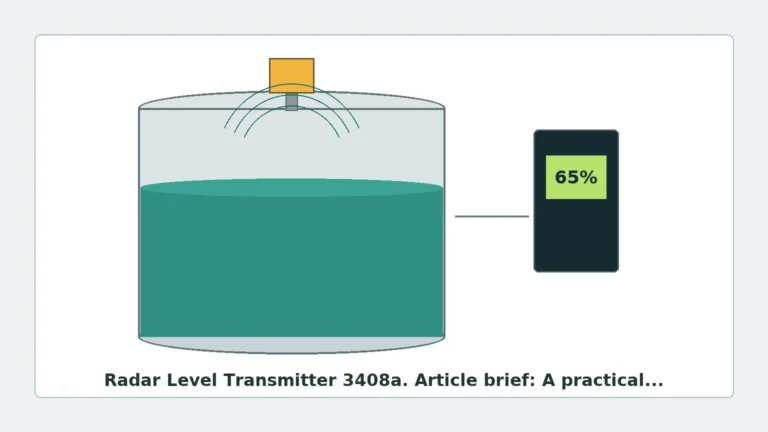
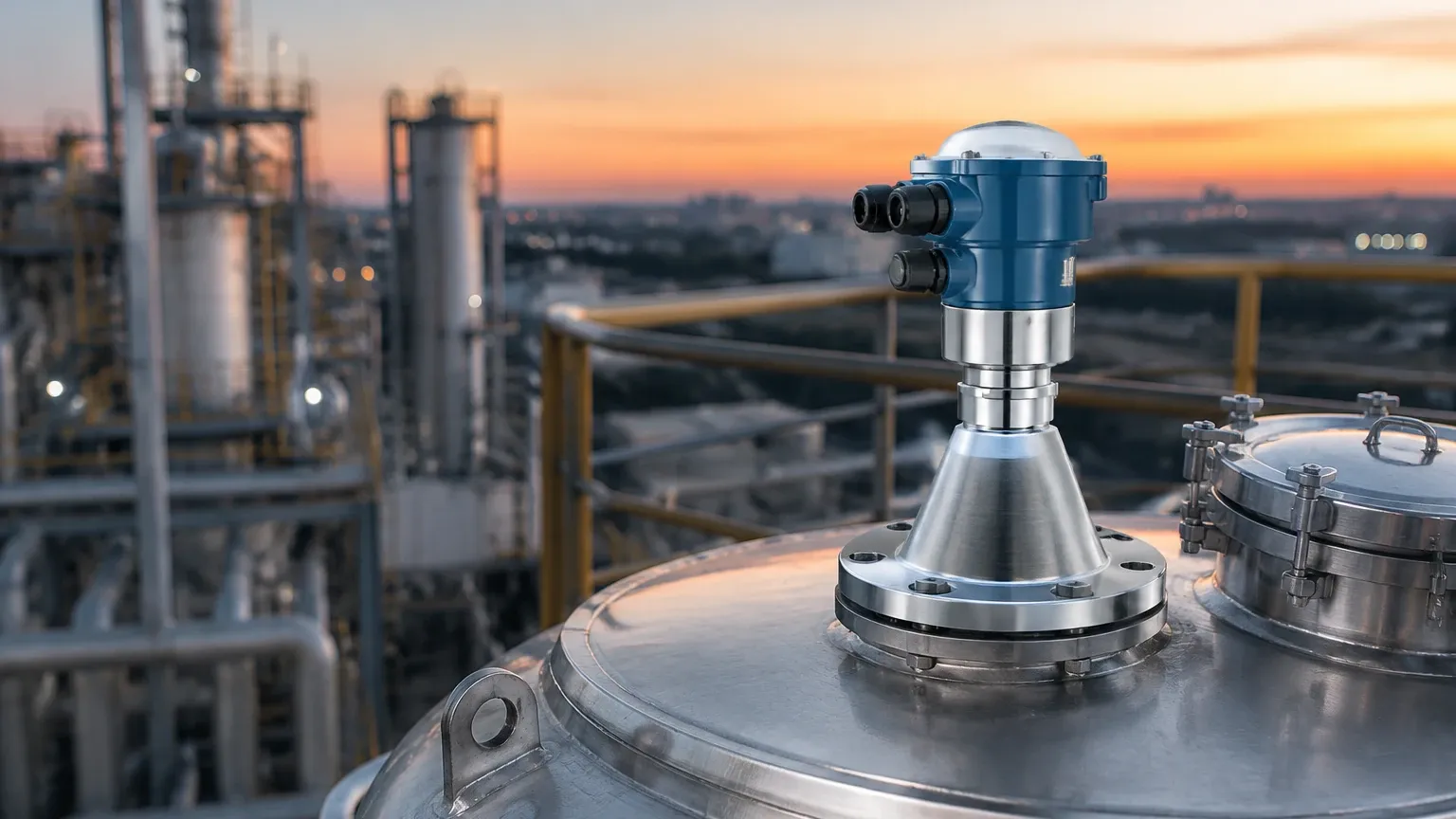
Non-contact radar units are mounted at the top of a vessel and transmit microwaves through the air (or vapor space) to the product surface. Because the instrument does not touch the media, it is ideal for corrosive, viscous, or hygienic applications.
* High-Frequency Radar (76–81 GHz): These units offer a very narrow beam angle (often as small as 3°). The focused beam avoids internal tank obstructions like agitators, ladders, or heating coils. They are highly effective for both liquids and solids (powders/granules).
* Mid-Frequency Radar (26 GHz): A versatile choice for many liquid applications. It balances beam focus with the ability to penetrate moderate levels of foam or steam.
* Low-Frequency Radar (6 GHz): While less common today, low-frequency radar is used in applications with heavy steam, dust, or thick foam, as the longer wavelength can penetrate these obstacles more effectively than high-frequency signals.
Guided Wave Radar (GWR) Transmitters
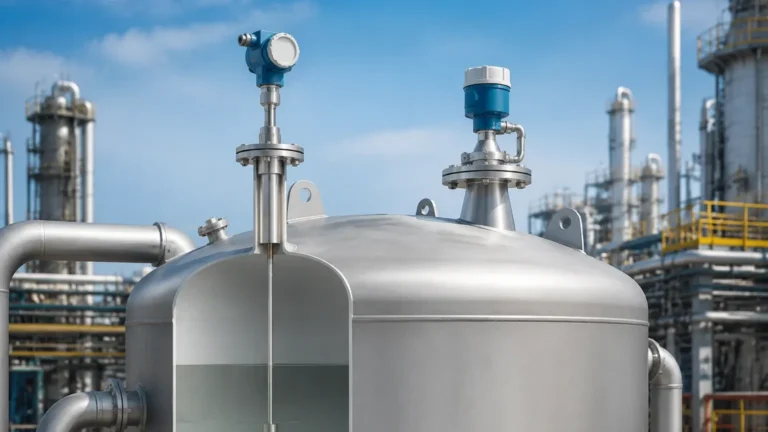
Guided Wave Radar utilizes a physical probe (a rod, coaxial tube, or flexible cable) that extends into the media. The microwave pulse travels along the probe. When it hits the product, the change in dielectric constant causes a reflection that travels back up the probe to the electronics.
* Advantages: GWR is highly efficient because the energy is concentrated along the probe rather than spreading out in a cone. It is unaffected by turbulence, foam, or dust in the vapor space.
* Interface Measurement: GWR is the primary technology used for measuring the interface between two liquids (e.g., oil and water), provided the upper liquid has a lower dielectric constant than the lower liquid.
Antenna Types and Their Applications
The antenna is the interface between the transmitter electronics and the process. The choice of antenna determines the beam angle and the instrument's resistance to the environment.
| Antenna Type | Typical Application | Key Benefit |
| :— | :— | :— |
| Horn (Bell) Antenna | Large tanks, storage vessels | Robust, handles high temperatures and pressures. |
| Rod Antenna | Small openings, corrosive chemicals | Usually encapsulated in PTFE or PP for chemical resistance. |
| Parabolic Antenna | Long-range solids measurement | Very high gain; ideal for ranges up to 100 meters. |
| Lens/Drop Antenna | Hygienic or dirty environments | Flat or curved surface prevents condensation or buildup. |
Technical Selection Criteria
Choosing between different types of radar level transmitter requires an analysis of the process conditions. Use the following table as a general engineering reference:
| Feature | Non-Contact (80GHz) | Non-Contact (26GHz) | Guided Wave Radar (GWR) |
| :— | :— | :— | :— |
| Accuracy | ±1 mm to ±2 mm | ±3 mm to ±5 mm | ±2 mm to ±5 mm |
| Max Range | Up to 120m | Up to 30m | Up to 75m (cable) |
| Dielectric (ε_r) | Low to High (ε_r > 1.4) | Medium to High (ε_r > 2.0) | Very Low to High (ε_r > 1.2) |
| Foam Handling | Moderate | Good | Excellent |
| Internal Obstructions | Excellent (Narrow beam) | Fair | Excellent (Signal follows probe) |
| Installation | Top-mounted | Top-mounted | Top-mounted (requires probe) |
Installation Considerations
To ensure the reliability of a radar level transmitter, several mechanical and electrical factors must be addressed during installation:
1. Nozzle Dimensions: For non-contact radar, the nozzle height and diameter must not interfere with the signal beam. High-frequency 80GHz radars are more forgiving of long nozzles due to their narrow beam.
2. The "Dead Zone" (Blocking Distance): Every radar has a minimum distance near the antenna where measurement is not possible. Ensure the maximum fill level of the tank does not enter this zone.
3. Positioning: Avoid mounting the transmitter in the center of a tank with a domed roof, as this can cause multiple reflections (parabolic effect). It should also be kept away from the tank wall to prevent side-lobe interference (typically 1/6th of the tank diameter from the wall).
4. Obstructions: Ensure the signal path is clear of inflow streams. If an agitator is present, FMCW radars with "false echo suppression" software can be configured to ignore the periodic reflections from the blades.
Limitations and Application Risks
While radar is highly versatile, it is not a universal solution. Engineers should be aware of the following limitations:
* Dielectric Constant: If the media has an extremely low dielectric constant (e.g., liquid nitrogen or certain dry powders), the reflection may be too weak for the sensor to detect. In these cases, GWR or specialized high-sensitivity non-contact units are required.
* Heavy Foam: While low-frequency radar can penetrate some foam, extremely thick, dense foam (like shaving cream) can absorb the microwave signal entirely, leading to a "loss of echo" error.
* Vacuum and Pressure: While microwaves travel through a vacuum, the physical seal of the transmitter (the process window) must be rated for the specific pressure and temperature of the vessel.
Frequently Asked Questions (FAQ)
Q: Can radar level transmitters measure solids?
A: Yes. High-frequency non-contact radar (80GHz) is particularly effective for solids because it can handle the low dielectric constant of powders and the uneven surface of heaps/cones.
Q: Is Guided Wave Radar better than Non-contact Radar?
A: Neither is "better" overall; it depends on the application. GWR is superior for interface measurement and small tanks with many obstructions. Non-contact radar is superior for corrosive media, hygienic applications, and where a probe cannot be inserted into the tank.
Q: How does condensation affect the measurement?
A: Condensation on the antenna can attenuate the signal. To mitigate this, engineers should select a "drop" or "lens" antenna design which allows droplets to run off, or use a purging system to keep the antenna dry.
Q: What information should I provide when ordering?
A: To ensure the correct type of radar level transmitter is supplied, confirm the following:
1. Media name and dielectric constant.
2. Tank height and required measuring range.
3. Process temperature and pressure.
4. Connection type (flange, thread, or tri-clamp).
5. Presence of foam, agitation, or dust.
For more detailed technical specifications and to explore specific models for your industry, you can Review product options and application support to find the most cost-effective solution for your process.