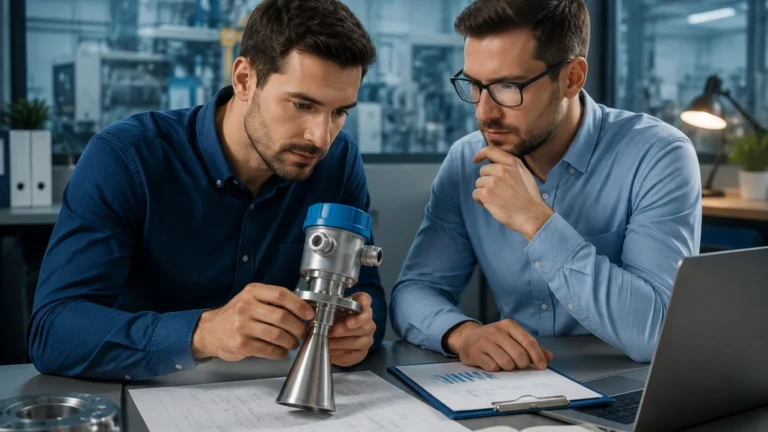
Ultrasonic Level Sensors for Liquids
Ultrasonic Level Sensors for Liquids
In the landscape of industrial automation, the ability to accurately monitor liquid volumes is fundamental to operational efficiency, safety, and inventory management. Ultrasonic level sensors for liquids have emerged as a primary choice for engineers seeking a balance between precision, reliability, and cost-effectiveness. As a non-contact measurement technology, these instruments provide a solution that avoids the wear and tear associated with mechanical floats or the maintenance requirements of contact-based probes.
This article provides a technical overview of ultrasonic level measurement, exploring the underlying physics, selection criteria, and practical installation strategies necessary for successful deployment in sectors such as water treatment, chemical processing, and industrial manufacturing.
Understanding the Measurement Principle
The operation of ultrasonic level sensors for liquids is based on the "Time-of-Flight" (ToF) principle. The sensor, typically mounted at the top of a tank or above an open channel, contains a piezoelectric transducer. This transducer converts electrical energy into mechanical energy, emitting high-frequency sound pulses—usually in the range of 20 kHz to 200 kHz—directed toward the liquid surface.
The Pulse-Echo Cycle
1. Emission: The sensor sends out a burst of ultrasonic waves.
2. Propagation: These waves travel through the air or vapor space at the speed of sound.
3. Reflection: Upon reaching the liquid surface, the sound waves are reflected back toward the sensor due to the change in density between the air and the liquid.
4. Reception: The transducer receives the returning echo and converts it back into an electrical signal.
Calculation of Level
The internal processor of the instrument measures the time interval ($t$) between the emission of the pulse and the reception of the echo. Since the speed of sound in air ($v$) is known (approximately 343 meters per second at 20°C), the distance ($D$) from the sensor to the liquid surface is calculated using the formula:
$$D = \frac{v \times t}{2}$$
To determine the actual level of the liquid ($L$), the sensor subtracts the measured distance ($D$) from the total height of the tank ($H$), which is pre-configured during setup:
$$L = H – D$$
Modern sensors, such as those provided by Welk, incorporate sophisticated algorithms to filter out false echoes caused by internal tank obstructions or surface turbulence, ensuring a stable output signal (typically 4-20mA, Modbus, or HART).
Key Advantages for Industrial Liquid Management
Ultrasonic technology offers several distinct benefits that make it suitable for a wide range of liquid applications:
* Non-Contact Measurement: Because the sensor never touches the liquid, it is immune to the corrosive, viscous, or coating properties of the medium. This significantly reduces maintenance requirements and extends the lifespan of the instrument.
* High Accuracy: Most industrial-grade ultrasonic level sensors for liquids offer an accuracy of ±0.25% of the detected range, which is sufficient for most process control and inventory monitoring tasks.
* Versatility: These sensors can measure a variety of liquids, from clean water and wastewater to acids, alkalis, and oils, provided the surface is relatively calm and the atmosphere is not overly dense with foam or heavy dust.
* Ease of Installation: With no moving parts and a top-down mounting configuration, installation is generally straightforward and does not require emptying the tank.
For engineers evaluating various measurement technologies, including radar or hydrostatic options, the Main Page offers a comprehensive look at how ultrasonic solutions fit into a broader instrumentation strategy.
Selection Criteria for Ultrasonic Level Sensors
Choosing the correct sensor requires a detailed analysis of the process environment. Engineers should consider the following factors before procurement:
1. Measuring Range
Ultrasonic sensors have a defined operating range. Standard industrial models typically cover distances from 0.1 meters up to 15 or 20 meters. It is crucial to select a sensor where the maximum tank height falls within the sensor’s effective range while accounting for the "Dead Zone."
2. The Dead Zone (Blocking Distance)
The dead zone is a small area immediately below the transducer face where the sensor cannot accurately measure. This occurs because the transducer cannot simultaneously transmit and receive. If the liquid level enters this zone (e.g., 0.2m to 0.5m depending on the model), the sensor will provide an error or an incorrect reading. Always mount the sensor high enough to ensure the maximum liquid level never reaches the dead zone.
3. Material Compatibility
While the sensor is non-contact, the transducer face is exposed to the tank's atmosphere. For water applications, standard ABS or PVC housings are often sufficient. However, for corrosive chemicals like sulfuric acid or hydrochloric acid, transducers made from PVDF (Polyvinylidene fluoride) or PTFE (Teflon) are required to prevent chemical degradation.
4. Process Temperature and Pressure
The speed of sound is highly dependent on air temperature. A change of 1°C can result in a 0.17% error in distance measurement. Therefore, high-quality sensors must include integrated temperature compensation. Furthermore, ultrasonic sensors are generally limited to atmospheric pressure or low-pressure applications (typically up to 3 bar), as high pressure significantly alters the acoustic properties of the medium.
Practical Selection Table for Liquid Applications
| Application Type | Common Liquids | Recommended Sensor Features | Primary Challenge |
| :— | :— | :— | :— |
| Water Treatment | Raw water, treated water | Standard housing, IP68 rating | Humidity/Condensation |
| Chemical Storage | Acids, bases, solvents | PVDF/PTFE transducer, explosion-proof | Corrosive vapors |
| Food & Beverage | Milk, juice, oils | Sanitary (Tri-clamp) fittings, CIP/SIP | Foam and Steam |
| Wastewater | Sewage, sludge | Large measuring range, self-cleaning face | Turbulence and debris |
| Open Channels | River water, flumes | High-accuracy, solar-powered options | Ambient temperature swings |
Critical Installation Guidelines
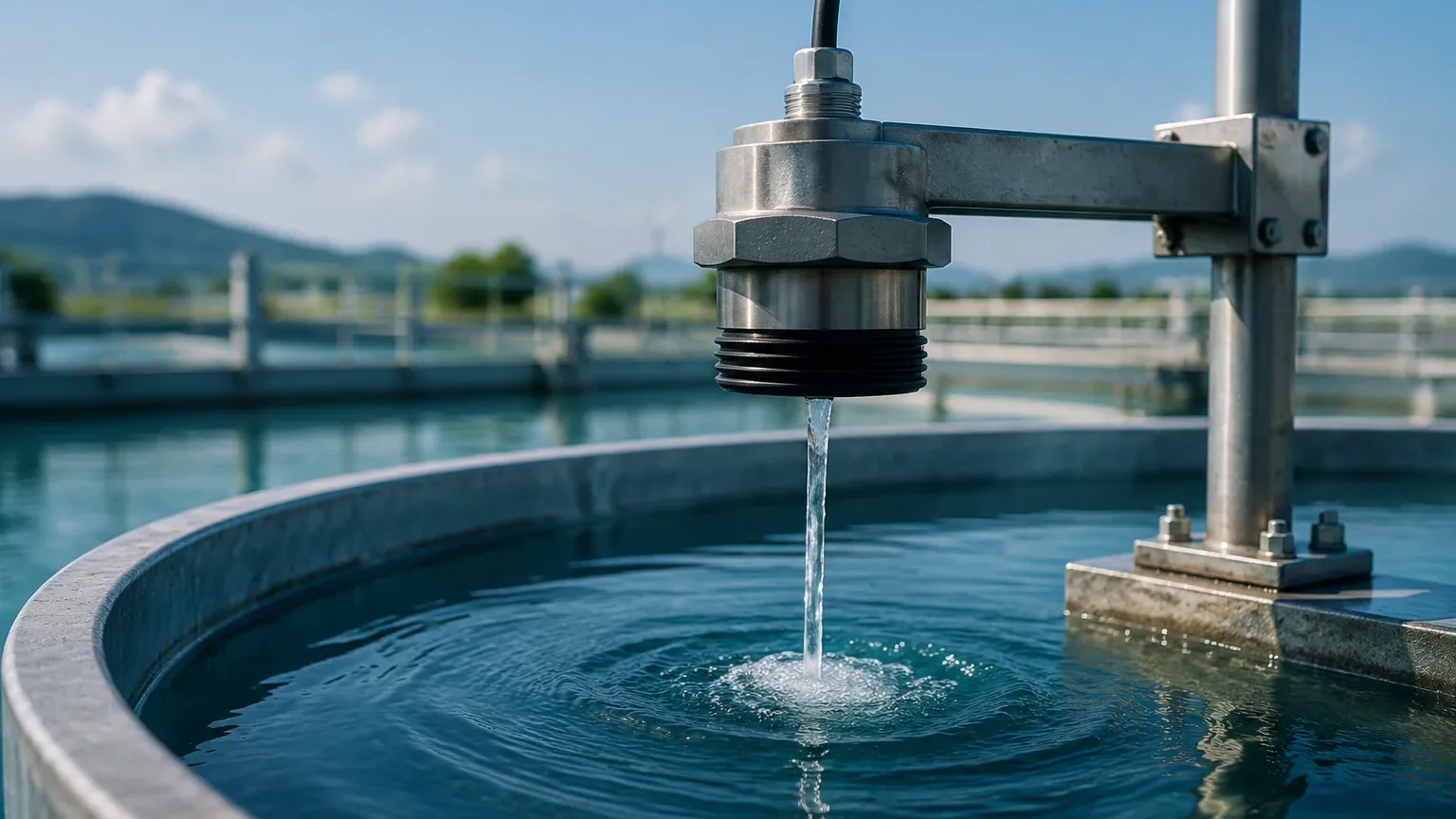
Proper installation is the most influential factor in the performance of ultrasonic level sensors for liquids. Following these engineering best practices will minimize signal loss and false readings:
1. Perpendicular Alignment: The sensor must be mounted perfectly perpendicular to the liquid surface. If the sensor is tilted, the sound waves will reflect away from the transducer, resulting in a "Lost Echo" error.
2. Avoid the Fill Stream: Never install a sensor directly above the point where liquid enters the tank. The falling liquid and the resulting turbulence will scatter the ultrasonic pulses and create significant noise.
3. Clearance from Walls: Do not mount the sensor too close to the tank wall. Sound waves spread in a conical shape (the beam angle, usually 5° to 12°). If the beam hits a wall or a weld seam, it will return a false echo. A general rule is to maintain a distance from the wall equal to at least 10% of the tank height.
4. Obstruction Management: Avoid placing the sensor above internal structures such as ladders, heating coils, or agitators. If obstructions are unavoidable, many Welk sensors feature "False Echo Suppression," allowing the user to program the sensor to ignore specific reflections at fixed distances.
5. Standpipe Usage: In tanks with heavy foam or extreme turbulence, a stilling well or standpipe can be used to provide a calm surface for measurement. The pipe must be vented and have a smooth internal surface to prevent interference.
Technical Limitations and Risk Mitigation
Despite their versatility, ultrasonic level sensors for liquids are not universal solutions. Engineers must be aware of the following limitations:
* Foam Absorption: Heavy, thick foam acts as an acoustic insulator, absorbing the sound pulse rather than reflecting it. If the application involves consistent foam (e.g., in some fermentation or detergent processes), a radar level meter or a hydrostatic transmitter may be a more reliable choice.
* Vacuum Conditions: Sound requires a medium (gas) to travel. In a vacuum, ultrasonic sensors cannot function. For vacuum tanks, radar technology is the industry standard.
* Vapor and Gas Stratification: If the tank contains heavy vapors or gases other than air (such as CO2 or nitrogen), the speed of sound will change significantly. Unless the sensor is calibrated for that specific gas mixture, the readings will be inaccurate.
* Extreme Turbulence: Rapidly splashing liquids can scatter the signal. This can often be mitigated by adjusting the sensor's damping software or using a stilling well.
Frequently Asked Questions (FAQs)
Q: Can ultrasonic sensors measure the level of solids?
A: Yes, but with limitations. Solids like powders or grains do not reflect sound as uniformly as liquids and often create dust, which can attenuate the signal. Sensors for solids usually require higher power and specific beam angles.
Q: How does condensation affect the sensor?
A: Water droplets on the transducer face can attenuate the signal. Many industrial sensors use a self-cleaning transducer face or a curved design to encourage droplets to run off, but in high-humidity environments, periodic inspection is recommended.
Q: What is the maximum distance an ultrasonic sensor can measure?
A: While some specialized models can reach 30 or 40 meters, most standard industrial ultrasonic level sensors for liquids are optimized for ranges between 5 and 15 meters. For distances exceeding 20 meters, radar is typically more reliable.
Q: Is it necessary to recalibrate the sensor if the liquid changes?
A: Generally, no. Since the sensor measures the distance to the surface and not a physical property of the liquid (like density or conductivity), you can switch from water to oil without recalibrating, provided the surface characteristics remain similar.
Conclusion
Ultrasonic level sensors for liquids represent a mature, reliable, and cost-effective technology for the majority of industrial level-sensing needs. By understanding the acoustic principles and adhering to strict installation guidelines, process engineers can achieve high-precision monitoring with minimal maintenance overhead. When faced with challenging environments involving foam, vacuum, or extreme temperatures, comparing these sensors against alternative technologies is essential. For detailed product specifications and application support, professionals are encouraged to review the available options on the Main Page.