The Unit That Measures the Pressure or Force
The Unit That Measures the Pressure or Force
In industrial process control and liquid level monitoring, understanding the fundamental physics of how we quantify physical stress on a surface is essential for accurate instrumentation. The unit that measures the pressure or force per unit area serves as the foundation for hydrostatic level measurement, a widely used method for determining the volume or height of liquids in tanks and reservoirs.
Pressure is defined as the physical force exerted on an object. In a fluid system, this force is distributed across the surface area of the container or the sensor diaphragm. By measuring this pressure, engineers can derive the level of a liquid based on its known density and the constant of gravity. This article explores the various units used in these measurements, the principles of hydrostatic technology, and practical considerations for selecting the right equipment.
Defining the Unit That Measures the Pressure or Force
In the International System of Units (SI), the unit that measures the pressure or force per unit area is the Pascal (Pa). One Pascal is defined as one Newton of force applied over one square meter ($1 Pa = 1 N/m^2$). Because the Pascal is a relatively small unit—roughly equivalent to the weight of a single sheet of paper resting on a table—industrial applications typically use multiples such as the kilopascal (kPa) or megapascal (MPa).
The Relationship Between Force and Pressure
To understand how level meters function, it is necessary to distinguish between force and pressure. Force is a vector quantity representing an interaction that, when unopposed, will change the motion of an object. In a static liquid, the force is the weight of the liquid column acting downward due to gravity. Pressure, however, is the distribution of that force over the area of the sensor.
Mathematically, this is expressed as:
$$P = \frac{F}{A}$$
Where:
* P is the pressure.
* F is the force (Weight of the liquid, $m \cdot g$).
* A is the surface area.
In the context of industrial measurement, the Main Page of specialized manufacturers like Welk highlights various instruments designed to detect these subtle changes in force and convert them into readable level data.
SI vs. Imperial: Navigating Pressure Units in Industry
While the Pascal is the standard SI unit, various industries and regions utilize different units depending on historical standards or specific application requirements. Understanding the conversion between these units is critical for calibration and system integration.
1. The Bar
Commonly used in European industrial applications, the bar is nearly equal to atmospheric pressure at sea level.
* $1 bar = 100,000 Pa$ (or $100 kPa$).
* It is a convenient unit because $1 bar$ is approximately $14.5 PSI$.
2. Pounds per Square Inch (PSI)
Predominant in North America, PSI is an imperial unit where the force is measured in pounds-force and the area in square inches.
* $1 PSI \approx 6,894.76 Pa$.
3. Meters of Water Column ($mH_2O$)
In level measurement, it is often practical to express pressure directly in terms of the height of a water column. This unit represents the pressure exerted by a column of pure water at a specific height.
* $1 mH_2O \approx 9.806 kPa$.
4. Kilograms-force per Square Centimeter ($kgf/cm^2$)
Though less common today, this unit was widely used in older mechanical systems. It represents the pressure exerted by one kilogram of mass under standard gravity over one square centimeter.
The Physics of Hydrostatic Level Measurement
Hydrostatic level measurement relies on the principle that the pressure at a specific point in a static liquid is proportional to the height of the liquid column above that point. This is known as Stevin's Law.
The Hydrostatic Equation
The fundamental formula used by hydrostatic level transmitters is:
$$P = \rho \cdot g \cdot h$$
Where:
* P = Hydrostatic pressure.
* \rho (rho) = Density of the liquid ($kg/m^3$).
* g = Acceleration due to gravity (approximately $9.81 m/s^2$).
* h = Height of the liquid ($m$).
By rearranging the formula to solve for $h$ ($h = P / (\rho \cdot g)$), the transmitter can determine the level of the liquid. The unit that measures the pressure or force at the bottom of the tank is converted into a linear distance (meters or feet) or a volume (liters or gallons).
Sensor Technology
Most modern hydrostatic level meters use one of two sensor types:
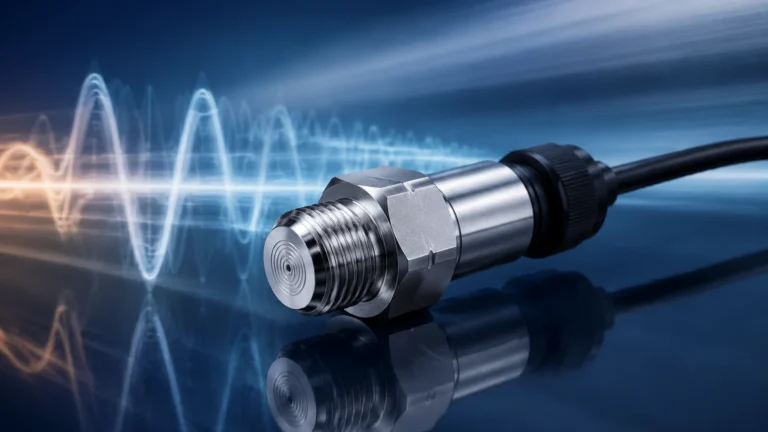
1. Piezoresistive Sensors: These utilize a strain gauge that changes electrical resistance when deformed by pressure. They are highly sensitive and cost-effective.
2. Ceramic Capacitive Sensors: These feature a ceramic diaphragm that moves slightly under pressure, changing the capacitance between two plates. They are preferred for corrosive or abrasive media due to the durability of ceramic.
Selecting the Right Pressure-Based Level Transmitter
Choosing the correct instrument requires more than just knowing the unit that measures the pressure or force. Engineers must account for the physical and chemical properties of the process media.
Media Density and Temperature
Since pressure is directly tied to density, any change in the liquid's density will result in a measurement error. Temperature fluctuations often cause density changes; therefore, high-precision applications may require transmitters with integrated temperature compensation.
Tank Configuration
* Open Tanks: In atmospheric tanks, a simple submersible or flange-mounted pressure transmitter can be used. The sensor measures the pressure relative to the atmospheric pressure.
* Closed/Pressurized Tanks: If the tank is pressurized (e.g., a boiler or chemical reactor), the sensor must measure "differential pressure." This involves measuring the pressure at the bottom and subtracting the gas pressure at the top to isolate the liquid's hydrostatic head.
Chemical Compatibility
The wetted parts of the sensor (the diaphragm and housing) must be compatible with the liquid. Stainless steel (316L) is standard, but aggressive chemicals may require Tantalum, Hastelloy, or PTFE coatings.

Practical Selection Table
| Feature | Hydrostatic Transmitter | Radar Level Meter | Ultrasonic Sensor |
| :— | :— | :— | :— |
| Measurement Principle | Pressure ($P = \rho gh$) | Electromagnetic Wave Time-of-Flight | Sound Wave Time-of-Flight |
| Common Units | $kPa, bar, mH_2O$ | $m, ft$ | $m, ft$ |
| Contact Type | Contact (Submersible/Flange) | Non-contact | Non-contact |
| Best For | Deep wells, water tanks, constant density liquids | Corrosive liquids, high temp, solids | Wastewater, open channels |
| Limitation | Density changes affect accuracy | Higher initial cost | Affected by foam and heavy dust |
Installation Best Practices for Pressure Sensors
To ensure the unit that measures the pressure or force provides reliable data, proper installation is mandatory. Errors in mounting often lead to offset drift or premature sensor failure.
1. Avoid Turbulence: Do not install the sensor near an inlet pipe or agitator. The kinetic energy of moving fluid can create localized pressure spikes that do not reflect the actual liquid level.
2. Venting Requirements: For gauge pressure transmitters, the reference side of the sensor must be vented to the atmosphere. This is typically achieved through a small capillary tube inside the signal cable. Ensure this tube is not kinked or blocked by moisture.
3. Positioning: Submersible sensors should be lowered to a point slightly above the bottom of the tank to avoid burial in silt or sediment. Flange-mounted sensors should be installed at the lowest possible point of the vessel to maximize the measurable range.
4. Zero Calibration: Once installed, the sensor should be zeroed while the tank is empty to account for the specific mounting height and atmospheric conditions of the site.
Limitations and Alternative Technologies
While hydrostatic measurement is robust and cost-effective, it is not universal. Understanding the limitations helps in deciding when to pivot to other technologies offered by Welk, such as radar or ultrasonic sensors.
* Density Fluctuations: If a process involves mixing different liquids or significant temperature swings that change the density, hydrostatic sensors will require frequent recalibration or a secondary density probe.
* Mechanical Stress: In high-viscosity liquids or those containing solids, the diaphragm can become coated or damaged. In these cases, non-contact radar is often a superior choice as it does not rely on the unit that measures the pressure or force but rather on wave reflection.
* Vacuum Conditions: Standard hydrostatic sensors may struggle in high-vacuum environments where the reference pressure is difficult to maintain.
FAQ: Common Questions on Pressure Measurement Units
Q: Can I use a standard pressure gauge to measure liquid level?
A: Yes, provided you know the density of the liquid. You can convert the pressure reading (e.g., in PSI) to height by using the formula $h = P / (\rho \cdot g)$. However, dedicated level transmitters are usually pre-calibrated for specific heights and offer 4-20mA or digital outputs for automation.
Q: Why is $mH_2O$ used instead of just meters?
A: $mH_2O$ is a unit of pressure, whereas "meters" is a unit of length. Saying a sensor has a range of $10 mH_2O$ means it is designed to withstand the pressure exerted by 10 meters of water. If you use that same sensor in a liquid with a higher density (like sulfuric acid), the actual liquid height at $10 mH_2O$ of pressure will be much lower than 10 meters.
Q: Does the shape of the tank affect the pressure at the bottom?
A: No. According to the hydrostatic paradox, the pressure at a certain depth depends only on the vertical height of the liquid column above it, not on the total volume or the shape of the container. This makes hydrostatic measurement highly versatile for irregularly shaped tanks.
Q: What is the difference between gauge pressure and absolute pressure?
A: Gauge pressure is measured relative to the local atmospheric pressure. Absolute pressure is measured relative to a perfect vacuum. Most level applications use gauge pressure because the surface of the liquid is also under atmospheric pressure, which cancels out the atmospheric force acting on the sensor.
By carefully considering the unit that measures the pressure or force and the environmental factors of the application, engineers can implement level measurement solutions that are both accurate and durable. For those requiring advanced industrial sensors, Welk provides a range of technologies tailored to the specific needs of water treatment, chemical processing, and oil and gas industries.
Download The Unit That Measures the Pressure or Force as a PDF