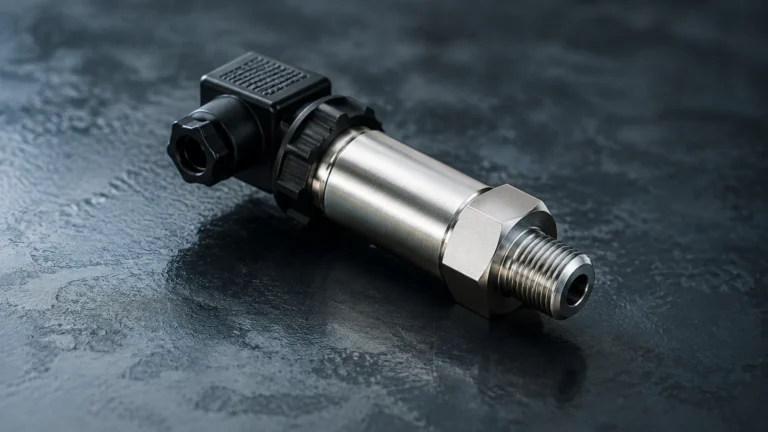
Abs Pressure to Gauge Pressure
Abs Pressure to Gauge Pressure
In industrial process control and level measurement, understanding the distinction between different pressure references is fundamental to achieving accuracy. The conversion from abs pressure to gauge pressure is not merely a mathematical exercise but a critical engineering step that ensures sensors provide meaningful data relative to their environment. For engineers specifying hydrostatic level transmitters or pressure-based instrumentation, failing to account for the reference point can lead to significant measurement errors, particularly in open-tank or vented applications.
This guide explores the principles of absolute and gauge pressure, the methodology for conversion, and the practical implications for industrial level measurement systems.
Understanding the Fundamentals of Pressure Measurement
To perform an accurate conversion from abs pressure to gauge pressure, one must first define the zero-point reference for each scale.
Absolute Pressure (psia / kPa abs)
Absolute pressure is measured relative to a perfect vacuum—a space entirely devoid of matter where the pressure is zero. Because it is referenced to a fixed, unchanging point, absolute pressure readings are always positive. This reference is typically used in scientific calculations, vacuum processes, and altimetry where atmospheric fluctuations would otherwise introduce variables.
Gauge Pressure (psig / kPa gauge)
Gauge pressure is the most common reference in industrial applications. It is measured relative to the local atmospheric pressure. When a gauge reads zero, it means the pressure inside the system is equal to the pressure of the surrounding air. If the system pressure exceeds atmospheric pressure, the value is positive; if it falls below (vacuum), it is expressed as negative gauge pressure or "suction."
Atmospheric Pressure ($P_{atm}$)
Atmospheric pressure is the force exerted by the weight of the air in the Earth's atmosphere. At sea level, standard atmospheric pressure is approximately 101.325 kPa (14.696 psi). However, this value is not static; it changes based on weather conditions and altitude. This variability is the primary reason why converting abs pressure to gauge pressure requires knowledge of the local environment.
The Mathematical Relationship: Converting Abs Pressure to Gauge Pressure
The relationship between these two scales is linear and defined by the local atmospheric pressure. The basic formula for the conversion is:
$P_{gauge} = P_{abs} – P_{atm}$
Conversely, to find absolute pressure from a gauge reading:
$P_{abs} = P_{gauge} + P_{atm}$
Practical Example
Consider a chemical storage tank located at sea level where the local atmospheric pressure is 101.3 kPa. If an absolute pressure sensor at the bottom of the tank reads 150 kPa, the gauge pressure (which represents the pressure exerted by the liquid column alone in a vented tank) would be:
$150\text{ kPa} – 101.3\text{ kPa} = 48.7\text{ kPa gauge}$
In industrial automation, high-precision instruments from manufacturers like Welk are designed to handle these calculations internally or provide the raw data necessary for PLC integration. For more information on sensor types and their specific applications, you can visit the Main Page.
Impact of Atmospheric Pressure on Level Measurement Accuracy
In hydrostatic level measurement, the sensor detects the "head pressure" exerted by a liquid. The formula for level ($h$) is $P = \rho gh$, where $\rho$ is density and $g$ is gravity.
If the tank is open to the atmosphere, the total pressure at the bottom of the tank is the sum of the liquid pressure and the atmospheric pressure.
1. Vented Tanks with Gauge Sensors: A gauge pressure sensor has a vent tube (capillary) that exposes the back of the sensing diaphragm to the atmosphere. This naturally cancels out the atmospheric pressure on both sides of the diaphragm, allowing the sensor to measure only the liquid level ($P_{gauge}$).
2. Vented Tanks with Absolute Sensors: If an absolute sensor is used, the reading will fluctuate as the weather changes. A drop in barometric pressure would be interpreted by the sensor as a drop in liquid level, even if the actual level remains constant. In these cases, a second barometric sensor is often required to subtract $P_{atm}$ in the control system.
Selection Criteria for Industrial Level Sensors
Choosing between an absolute or gauge reference depends on the process environment and the required precision. The following table provides a guideline for selection based on common industrial scenarios.
| Application Scenario | Recommended Pressure Type | Reason for Selection |
| :— | :— | :— |
| Open/Vented Water Tanks | Gauge Pressure | Automatically compensates for local barometric changes. |
| Sealed Tanks (Blanketed) | Differential Pressure | Measures the difference between liquid head and gas blanket pressure. |
| Vacuum Distillation | Absolute Pressure | Measures the process relative to a fixed vacuum; critical for chemistry. |
| High Altitude Locations | Gauge Pressure (Vented) | Eliminates errors caused by lower $P_{atm}$ at high elevations. |
| Submersible Borehole | Gauge Pressure | Requires a vented cable to ensure accurate head measurement. |

Installation Best Practices for Pressure-Based Level Meters
When implementing a system that requires converting abs pressure to gauge pressure or utilizing gauge sensors, proper installation is vital to maintain the integrity of the reference point.
Venting and Moisture Protection
Gauge pressure sensors rely on a vent path to the atmosphere. In humid or outdoor environments, moisture can enter this vent tube, leading to internal corrosion or sensor drift. High-quality transmitters use moisture barriers, such as Gore-Tex filters or desiccant cartridges, to allow air passage while blocking water.
Altitude Considerations
If you are using an absolute pressure sensor and performing the conversion to gauge pressure in a PLC, you must calibrate the $P_{atm}$ constant to your specific elevation. Atmospheric pressure drops by approximately 1.2 kPa for every 100 meters of elevation gain. Using sea-level constants (101.3 kPa) at an elevation of 2,000 meters would result in a massive error of nearly 24 kPa.
Temperature Stability
Rapid temperature changes can affect the density of the air in vent tubes or the fluid in capillary seals. Ensure that sensors are installed away from direct heat sources and that the conversion algorithms account for temperature-induced density changes in the measured liquid.
Common Challenges and Limitations
While the conversion of abs pressure to gauge pressure is mathematically simple, real-world variables introduce complexities:
* Barometric Drift: In high-precision level applications (e.g., fuel custody transfer), the natural variation in weather can cause a 3-5% error if an absolute sensor is not compensated by a local barometer.
* Clogged Vents: For gauge sensors, if the vent tube becomes pinched or clogged with debris, the sensor effectively becomes an absolute sensor with a trapped air reference. This leads to erratic readings as the trapped air expands or contracts with temperature.
* Overpressure Events: Gauge sensors are often more sensitive to overpressure than absolute sensors of the same range because their diaphragms are designed to detect smaller pressure differentials relative to the atmosphere.
Frequently Asked Questions
1. Can I use an absolute pressure sensor for level measurement in an open tank?
Yes, but you must subtract the current local atmospheric pressure from the absolute reading to get an accurate level. This requires a separate barometric pressure sensor connected to your control system. Using a dedicated gauge pressure sensor with a vented cable is generally more cost-effective and simpler to maintain.
2. Why is my gauge pressure reading negative?
If the pressure being measured is lower than the local atmospheric pressure, the gauge will show a negative value. This is common in vacuum systems or on the suction side of a pump.
3. Does the conversion formula change at high altitudes?
The formula $P_{gauge} = P_{abs} – P_{atm}$ remains the same, but the value of $P_{atm}$ will be significantly lower than the standard 101.3 kPa. You must measure or calculate the actual atmospheric pressure at your specific location.
4. What is the difference between "sealed gauge" and "vented gauge"?
A vented gauge sensor is open to the atmosphere. A sealed gauge sensor is referenced to a fixed pressure (usually 1 bar) sealed within the sensor housing. Sealed gauge sensors are typically used for high-pressure applications (above 50 bar) where atmospheric fluctuations are negligible compared to the measured pressure.
Conclusion
Accurate conversion and selection between abs pressure to gauge pressure are essential for the reliability of industrial automation systems. Whether you are monitoring water levels in a municipal reservoir or managing complex chemical reactions, the reference point of your instrumentation dictates the quality of your data.
Welk provides a comprehensive range of industrial level measurement instruments, including radar, ultrasonic, and hydrostatic solutions tailored to these specific engineering challenges. By understanding the physical principles of pressure and following rigorous installation standards, engineers can ensure their systems operate with the highest levels of precision and safety. For detailed product specifications and application support, visit the Main Page.