
Keyence Radar Level Transmitter
Keyence Radar Level Transmitter: Engineering Guide for Industrial Level Measurement
In the landscape of industrial automation and process control, non-contact level measurement has transitioned from a specialized solution to a standard requirement. Among the various technologies available, Radar Level Meters have emerged as the most reliable method for monitoring liquids, slurries, and solids in challenging environments. This guide examines the engineering principles, selection criteria, and installation nuances of the keyence radar level transmitter, providing technical personnel with the data necessary to integrate these instruments into modern industrial workflows.
1. Understanding the Measurement Principles
Before selecting a specific instrument, it is essential to understand the physics governing radar level measurement. Most high-performance transmitters, including those in the Keyence FR series, utilize Frequency Modulated Continuous Wave (FMCW) technology.
Frequency Modulated Continuous Wave (FMCW)
Unlike pulse-based radar, which measures the time-of-flight of a single microwave burst, FMCW radar emits a continuous signal with a constantly changing frequency. As the signal travels to the medium's surface and reflects back, the transmitter compares the frequency of the received signal with the frequency of the signal being emitted at that exact moment.
The difference in frequency ($Δf$) is directly proportional to the distance. This method provides several advantages over traditional pulse radar:
- Higher Accuracy: FMCW allows for millimeter-level precision even at short ranges.
- Better Signal-to-Noise Ratio: It can distinguish the actual level from background noise caused by tank internals (agitators, ladders).
- High Frequency (80 GHz): Modern units often operate at 80 GHz, which allows for a narrower beam angle and smaller antenna sizes.
The Role of the Dielectric Constant
Radar measurement relies on the reflection of electromagnetic waves. The strength of this reflection depends on the dielectric constant ($εr$) of the material being measured. Water has a high dielectric constant (~80), making it an excellent reflector. In contrast, hydrocarbons and certain powders have low dielectric constants ($εr$ < 2.0), which require more sensitive Radar Level Meters or specific configuration adjustments to ensure a stable return signal.
2. Features of the Keyence Radar Level Transmitter
The Keyence radar level transmitter is designed with a focus on ease of integration and visibility. While many industrial sensors are "black boxes" that require external software for troubleshooting, these units often incorporate features that simplify the commissioning process.
Compact Design and Integrated Display
Keyence units are frequently characterized by their compact form factor, making them suitable for small tanks or skid-mounted equipment where space is at a premium. The integrated high-resolution displays allow operators to view level data and signal strength directly at the measurement point.
Built-in Monitoring Tools
One of the distinguishing features of certain Keyence models is the inclusion of an internal camera or advanced signal visualization. This allows engineers to see what the sensor "sees," identifying whether a drop in signal is due to foam, a physical obstruction, or a change in the material’s surface profile. This diagnostic capability significantly reduces the time required for troubleshooting in complex chemical or food processing applications.
3. Technical Selection Criteria
Selecting the correct radar transmitter requires a thorough analysis of the process conditions. The following table outlines the primary considerations when evaluating a radar level transmitter against standard industrial requirements.
| Feature | Specification Detail | Engineering Importance |
| :— | :— | :— |
| Frequency | 76 GHz to 81 GHz | Determines beam angle and ability to penetrate steam/dust. |
| Measuring Range | 0.1 m to 30 m (approx. 0.3 to 98 ft) | Must cover the full height of the vessel plus a safety margin. |
| Beam Angle | 3° to 10° | Narrower beams avoid internal obstructions like agitators. |
| Process Temperature | -40°C to +150°C | High-temp versions are required for steam-jacketed tanks. |
| Process Pressure | Vacuum to 2.0 MPa | Essential for pressurized reactors or storage spheres. |
| Accuracy | ±1 mm to ±5 mm | Critical for inventory management and custody transfer. |
| Output Signal | 4-20 mA (HART), IO-Link | Determines compatibility with PLC and SCADA systems. |
4. Installation Considerations and Constraints
Even the most advanced radar transmitter will fail to provide accurate data if installed incorrectly. Engineers must adhere to specific geometric constraints to ensure signal integrity.
The Dead Zone (Blind Zone)
Every radar sensor has a "dead zone" directly beneath the antenna (typically 50 mm to 200 mm). In this area, the transmitter cannot accurately process the return signal because the emission and reception happen too quickly. The sensor should be mounted high enough so that the maximum liquid level never enters this zone.
Beam Spread and Wall Interference
The radar signal spreads as it travels. If the sensor is mounted too close to the tank wall, the signal will reflect off the wall, creating "ghost echoes."
- Rule of Thumb: Maintain a distance from the wall of at least 10% of the total tank height.
- Obstructions: Ensure the beam path is clear of heating coils, ladders, and agitator blades. If an obstruction is unavoidable, many transmitters offer "false echo suppression" software to mask these static reflections.
Nozzle Geometry
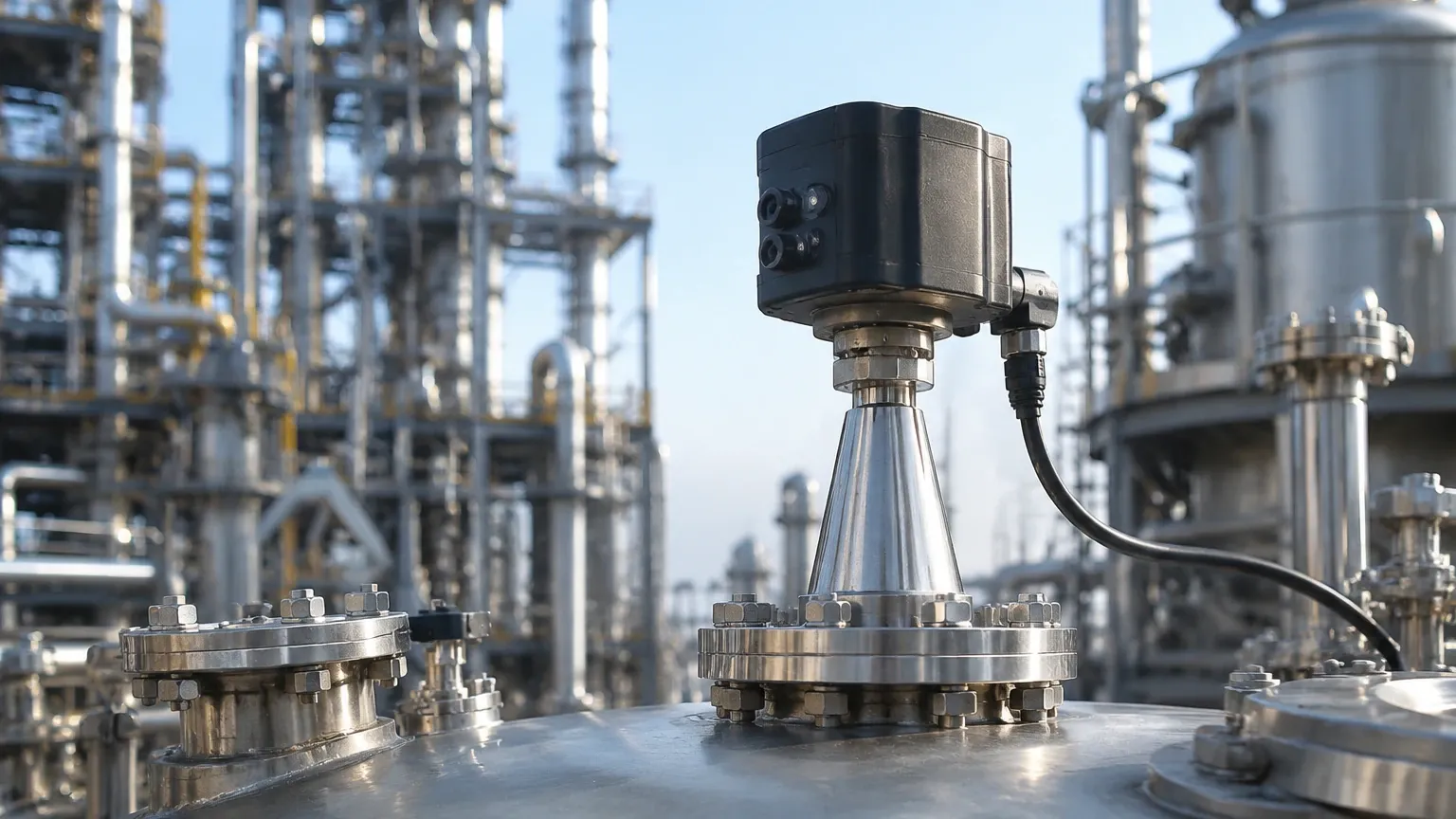
When mounting on a nozzle, the diameter and height of the nozzle are critical. If the nozzle is too long and narrow, the radar signal will reflect off the internal edges of the pipe before reaching the tank. Ideally, the antenna should extend slightly past the bottom of the nozzle into the tank space.
5. Limitations and Application Risks
While radar is highly versatile, it is not a universal solution. Certain environmental factors can degrade performance:
1. Heavy Foam: Dense, thick foam can absorb the radar signal rather than reflecting it. In applications with heavy protein-based or chemical foam, a guided wave radar or a lower-frequency pulse radar may be more effective than a high-frequency non-contact unit.
2. Agitated Surfaces: Turbulent liquids disperse the radar signal in multiple directions, reducing the amount of energy that returns to the sensor. High-frequency FMCW units use sophisticated algorithms to average these fluctuations, but extreme turbulence may still require a stilling well.
3. Dust and Condensation: While 80 GHz radar is excellent at penetrating light dust, extremely heavy buildup on the antenna lens can attenuate the signal. Keyence and other manufacturers often offer air purge connections or PTFE-faced lenses to mitigate this risk.
6. Comparison: Non-Contact Radar vs. Other Technologies
For B2B buyers evaluating their options, it is helpful to compare the keyence radar level transmitter against other common technologies used in industrial automation.
- Ultrasonic Sensors: These are lower cost but are affected by air temperature, pressure, and vapors. Radar is immune to these changes because it uses electromagnetic waves rather than sound waves.
- Guided Wave Radar (GWR): GWR uses a probe that contacts the medium. It is better for very low dielectric liquids but is susceptible to material buildup on the probe and mechanical stress from agitators.
- Hydrostatic Pressure: This measures the weight of the liquid column. It is reliable but requires contact with the fluid and is affected by changes in liquid density.
7. Frequently Asked Questions (FAQ)
Q: Can the radar transmitter measure through a plastic tank lid?
A: Yes. Because plastic is a non-conductive material with a low dielectric constant, radar signals can pass through it. This allows for "tank-outside" measurement, which is ideal for corrosive chemicals where you want to avoid any contact with the sensor.
Q: How does IO-Link benefit radar level measurement?
A: IO-Link allows for the transmission of more than just the level value. It provides diagnostic data, such as internal temperature and signal quality, and allows for remote parameter configuration, which is vital for Industry 4.0 integration.
Q: Is it necessary to calibrate the sensor for different liquids?
A: Generally, no. Unlike capacitive sensors, radar measures the distance to the surface. As long as the dielectric constant is high enough to reflect the signal, the measurement remains accurate regardless of changes in density or viscosity.
8. Conclusion for International Buyers
When sourcing level measurement instrumentation for global projects, consistency and support are paramount. The keyence radar level transmitter offers a user-centric approach to complex level sensing, but it must be applied within its technical boundaries.
For engineers designing systems for water treatment, chemical processing, or food production, confirming the following data points with the supplier is recommended before procurement:
1. Minimum Dielectric Constant: Ensure the target medium meets the sensor's requirements.
2. Chemical Compatibility: Verify that the wetted parts (typically PTFE, PFA, or Stainless Steel) are resistant to the process fluid.
3. Certification Requirements: Determine if the application requires explosion-proof (ATEX/IECEx) or food-grade (FDA/3-A) certifications.
By following these engineering guidelines and understanding the underlying FMCW technology, facilities can achieve high-precision level control that minimizes maintenance and maximizes uptime.


