Wet Differential Pressure Transmitter
Wet Differential Pressure Transmitter
In industrial process control, measuring the level of liquids in pressurized or closed vessels presents unique challenges. Unlike open tanks where a simple hydrostatic pressure sensor can suffice, closed systems require a differential approach to account for the internal vessel pressure. The wet differential pressure transmitter is a specialized configuration used specifically when the vapor space above the liquid is prone to condensation. This guide provides a technical overview of the principles, selection criteria, and installation requirements for wet leg differential pressure systems.
Understanding the Measurement Principle
Differential pressure (DP) level measurement relies on the principle of hydrostatic pressure. The pressure exerted by a liquid column is proportional to its height and density, expressed by the formula $P = \rho gh$ (where $P$ is pressure, $\rho$ is density, $g$ is gravity, and $h$ is height).
In a closed tank, the total pressure at the bottom of the vessel is the sum of the liquid's hydrostatic pressure and the gas pressure in the headspace. To isolate the liquid level, the headspace pressure must be subtracted from the total pressure. A differential pressure transmitter achieves this by measuring the difference between a "High Pressure" (HP) tap at the bottom of the tank and a "Low Pressure" (LP) tap at the top.
The Role of the Wet Leg
There are two primary ways to connect the LP tap to the transmitter: the dry leg and the wet leg.
1. Dry Leg: Used when the gas in the headspace is non-condensable (e.g., dry nitrogen). The impulse line remains filled with gas.
2. Wet Leg: Used when the headspace contains vapors that may condense into liquid at ambient temperatures (e.g., steam or heavy hydrocarbons). If a dry leg were used in these applications, condensate would randomly accumulate in the impulse line, creating an unpredictable liquid head that introduces significant measurement errors.
In a wet differential pressure transmitter setup, the LP impulse line is intentionally filled with a stable liquid (often the process fluid or a compatible seal fluid) to a constant height. This creates a known, constant pressure head on the low side of the transmitter, which can then be mathematically compensated for during calibration.
Wet Leg vs. Dry Leg Comparison
Choosing between a wet and dry leg configuration is critical for long-term accuracy. The following table highlights the primary differences and application contexts.
| Feature | Dry Leg Configuration | Wet Leg Configuration |
| :— | :— | :— |
| Headspace Condition | Non-condensable gases | Condensable vapors |
| Impulse Line Content | Gas/Air | Liquid (Condensate or Fill Fluid) |
| Maintenance | Low (occasional draining) | Moderate (ensuring fluid level) |
| Primary Risk | Liquid buildup in line | Evaporation or bubbles in line |
| Typical Application | Compressed air tanks, inert gas blankets | Boilers, distillation columns, evaporators |
Technical Selection Criteria
When specifying a wet differential pressure transmitter for an industrial application, several technical factors must be evaluated to ensure the instrument's longevity and precision. Engineers should consult the Main Page of the manufacturer's technical documentation to verify specific model capabilities.
1. Diaphragm and Wetted Materials
Since the transmitter is in direct contact with the process fluid (or the wet leg fluid), material compatibility is paramount. Standard 316L stainless steel is common, but highly corrosive environments may require Hastelloy C-276, Tantalum, or Monel. For food and beverage or pharmaceutical applications, sanitary diaphragms with specific surface finishes (Ra < 0.8 µm) are necessary.
2. Static Pressure Limits
DP transmitters are rated for a maximum static pressure (the total pressure the vessel can withstand). It is essential to ensure the transmitter body can handle the full system pressure, even if the differential pressure being measured is relatively small.
3. Turndown Ratio and Accuracy
The turndown ratio refers to the range over which the transmitter can be calibrated without losing significant accuracy. For level applications where the liquid density might change slightly or the tank height is unusual, a high turndown ratio (e.g., 100:1) provides necessary flexibility.
4. Temperature Compensation
Temperature fluctuations affect the density of the liquid in the wet leg. Advanced transmitters include internal temperature sensors to compensate for these density changes, ensuring the level reading remains stable regardless of ambient or process temperature swings.
Installation and Calibration Considerations
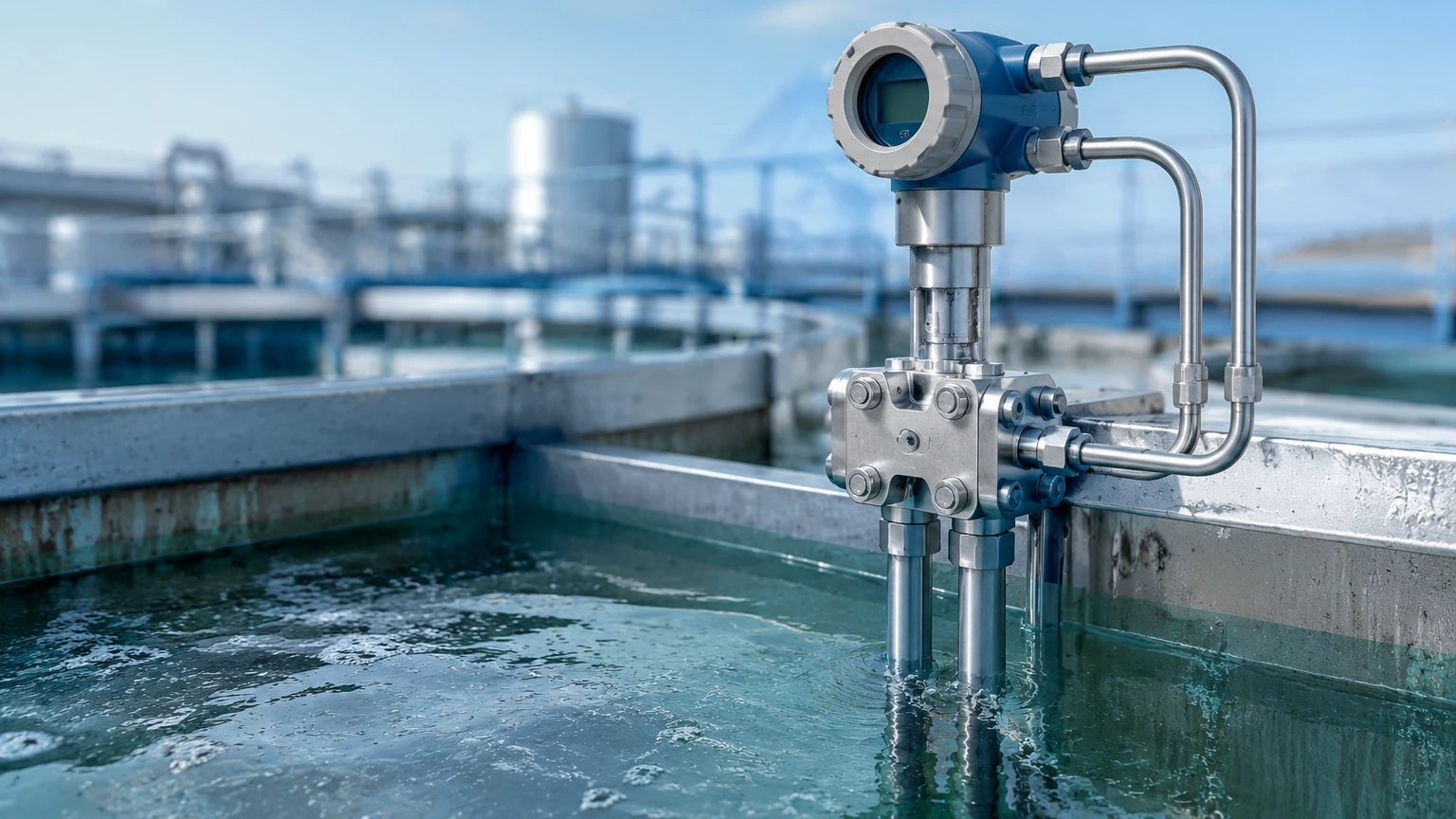
The physical installation of a wet differential pressure transmitter is more complex than a standard pressure sensor. Proper orientation and impulse line management are the keys to a reliable signal.
Impulse Line Routing
Impulse lines should be as short as possible to minimize temperature gradients. For wet legs, the line should be sloped toward the transmitter (typically at a 1:12 ratio) to allow any trapped gas bubbles to migrate back into the vessel. If the wet leg fluid is different from the process fluid, a seal pot may be required at the top of the leg to provide a reservoir that maintains the constant liquid height.
Zero Elevation and Suppression
In a wet leg setup, the low-pressure side of the transmitter is often under higher hydrostatic pressure than the high-pressure side when the tank is empty (because the wet leg is full while the tank is empty). This results in a negative differential pressure.
* Zero Suppression: Required when the transmitter is mounted below the high-pressure tap.
* Zero Elevation: Required in wet leg systems where the constant head of the wet leg must be "elevated" out of the calculation so that the transmitter reads zero when the tank is actually empty.
Modern digital transmitters allow these adjustments to be made easily through software or HART communicators, but the physical height of the wet leg must be measured accurately during commissioning.
Limitations and Common Risks
While the wet differential pressure transmitter is a robust solution, it is not without limitations. Process engineers must be aware of the following risks:
* Evaporation: In high-temperature applications, the fluid in the wet leg may slowly evaporate. If the level in the wet leg drops, the transmitter will report a false increase in the vessel level. Regular inspection or the use of a continuous condensate supply (in steam systems) is required.
* Freezing: If the impulse lines are exposed to cold environments, the liquid in the wet leg can freeze, potentially damaging the transmitter or causing a total loss of signal. Heat tracing and insulation are standard requirements for outdoor installations in temperate climates.
* Bubbles: If gas bubbles become trapped in the wet leg, they change the effective density of the column, leading to erratic readings. Proper venting during startup is essential.
* Density Shifts: If the process fluid density changes (due to concentration or temperature changes), the hydrostatic calculation becomes inaccurate. If the density is variable, a multi-variable transmitter or a different technology, such as radar, might be more appropriate.
Maintenance Checklist for Wet Leg Systems
To maintain the integrity of the measurement, a scheduled maintenance routine should include:
1. Visual Inspection: Check for leaks at the manifold and impulse line fittings.
2. Wet Leg Level Verification: Ensure the wet leg remains completely full. In some systems, this involves checking a sight glass on a seal pot.
3. Venting: Periodically bleed any air or gas from the transmitter chambers using the vent valves.
4. Zero Check: If the process allows, empty the tank to verify the zero point, or use a 3-valve manifold to equalize the HP and LP sides to check for transmitter drift.
Frequently Asked Questions (FAQ)
Q: Can I use water as a wet leg fluid for oil level measurement?
A: It is generally recommended to use a fluid that is compatible with the process. If water is used and the seal fails, it could contaminate the process. Furthermore, the density of the wet leg fluid must be known and constant for accurate calibration.
Q: What happens if the wet leg fluid is heavier than the process fluid?
A: This is acceptable as long as the density is factored into the zero elevation calculation. However, if the two fluids are miscible, they may mix over time, changing the density and causing measurement errors.
Q: Why use a wet leg instead of a remote diaphragm seal?
A: Remote seals (capillary systems) eliminate the need for impulse line maintenance and wet leg filling. However, they are more expensive and can be more sensitive to ambient temperature changes across the length of the capillary. Wet legs are often preferred for their simplicity and lower initial cost in standard applications.
Q: How do I handle a wet leg in a vacuum system?
A: In vacuum applications, maintaining a wet leg is difficult because the vacuum can cause the fill fluid to boil or flash. In these cases, a balanced capillary system (remote seals) is usually the superior choice.
Conclusion
The wet differential pressure transmitter remains a cornerstone of level measurement in power generation, chemical processing, and refining. By providing a stable reference in the presence of condensable vapors, it ensures that operators can maintain safe and efficient liquid levels in pressurized vessels. When properly selected, installed, and maintained, these systems offer high reliability and precision. For detailed specifications on DP transmitters and other level measurement technologies, engineers should Review product options and application support to find the best fit for their specific process conditions.