Ethernet Flow Meter
Ethernet Flow Meter
In the era of Industry 4.0 and the Industrial Internet of Things (IIoT), the transition from traditional analog signaling to robust digital communication has redefined process monitoring. The Ethernet flow meter represents a significant leap in this evolution, moving beyond the limitations of 4-20mA loops to provide high-speed, bidirectional data transmission. By integrating standard networking protocols directly into the field device, these instruments allow for real-time flow monitoring, advanced diagnostics, and seamless integration into enterprise-level systems.
For engineers and plant managers, selecting an Ethernet flow meter involves understanding both the physical measurement physics and the digital architecture required to support it. This guide explores the principles, selection criteria, and practical implementation of Ethernet-enabled flow measurement technologies.
Measurement Principles and Technology Types
Before evaluating the communication interface, it is essential to understand the underlying measurement principle. An Ethernet flow meter is essentially a high-performance flow primary element paired with a digital transmitter capable of Modbus TCP/IP, EtherNet/IP, or PROFINET communication.
Electromagnetic Flow Meters (Magmeters)
Electromagnetic meters operate on Faraday’s Law of Electromagnetic Induction. When a conductive liquid flows through a magnetic field generated by the meter, it produces a voltage proportional to the velocity of the fluid.
* Ethernet Advantage: Because magmeters often handle complex slurries or chemical flows, Ethernet connectivity allows for the transmission of secondary variables such as electrode impedance and conductivity, which can indicate coating or corrosion before a failure occurs.
Ultrasonic Flow Meters
Ultrasonic meters typically use the transit-time principle. Two transducers act as both transmitters and receivers of ultrasonic pulses. The time difference between pulses traveling upstream and downstream is used to calculate flow velocity.
* Ethernet Advantage: High-speed data allows for the transmission of raw signal waveforms and gain levels, enabling remote troubleshooting of signal-to-noise ratios without visiting the installation site.
Vortex Flow Meters
Vortex meters utilize the Karman Vortex Street principle. As fluid passes a shedder bar, vortices are created. The frequency of these vortices is directly proportional to the flow velocity.
* Ethernet Advantage: These meters are often used in steam and gas applications where pressure and temperature compensation are required. An Ethernet interface can pull compensation data from other network devices or transmit multi-variable data (mass flow, volumetric flow, temperature) over a single cable.
Open Channel Flow (Level-to-Flow)
In many water treatment applications, flow is measured in open channels using flumes or weirs. Here, a level sensor (such as an ultrasonic or radar level meter) measures the height (head) of the liquid. The flow rate is then calculated using standardized formulas based on the channel geometry.
* Ethernet Advantage: Integrating these sensors into a local area network (LAN) allows for the synchronization of multiple level-to-flow points across a large facility, such as a municipal wastewater plant.
Key Evaluation Criteria for Ethernet Flow Meters
Selecting the right instrument requires a balance between hydraulic requirements and network infrastructure. Use the following table to compare common technologies used in Ethernet-enabled systems.
Selection Comparison Table
| Feature | Electromagnetic | Ultrasonic (Transit-time) | Vortex | Thermal Mass |
| :— | :— | :— | :— | :— |
| Suitable Fluids | Conductive liquids | Clean liquids | Steam, Gas, Liquids | Clean Gases |
| Typical Accuracy | ±0.5% of rate | ±1.0% of rate | ±1.0% of rate | ±1.0% of full scale |
| Pipe Sizes | 10 mm to 2000 mm | 15 mm to 5000 mm | 15 mm to 300 mm | 15 mm to 1000 mm |
| Common Protocols | EtherNet/IP, Modbus TCP | Modbus TCP, PROFINET | EtherNet/IP | Modbus TCP |
| Power Source | AC/DC or PoE | AC/DC or PoE | Loop or DC | DC |
| Pressure Drop | Negligible | None (Clamp-on) | Medium | Low |
Power over Ethernet (PoE)
One of the most significant advantages of modern Ethernet flow meters is the support for Power over Ethernet (PoE). This technology allows a single Category 5e or Category 6 cable to provide both data connectivity and electrical power (typically IEEE 802.3af or 802.3at standards). This significantly reduces installation costs by eliminating the need for separate power runs and local power supplies.
Installation and Network Considerations
Proper installation of an Ethernet flow meter requires attention to both the fluid dynamics and the network topology. Failure to address either can lead to inaccurate readings or intermittent communication loss.
Hydraulic Requirements
Regardless of the communication protocol, the meter must be installed according to the manufacturer’s piping requirements. Most meters require a specific number of "straight runs" (e.g., 5D to 10D upstream and 2D to 5D downstream, where D is the pipe diameter) to ensure a stable flow profile. For ultrasonic clamp-on meters, the pipe surface must be prepared and coupled correctly to prevent signal attenuation.
Physical Connectivity
Industrial environments are electrically noisy. When installing Ethernet cabling:
1. Shielded Twisted Pair (STP): Always use shielded Cat5e/6 cables to protect against electromagnetic interference (EMI) from motors and variable frequency drives (VFDs).
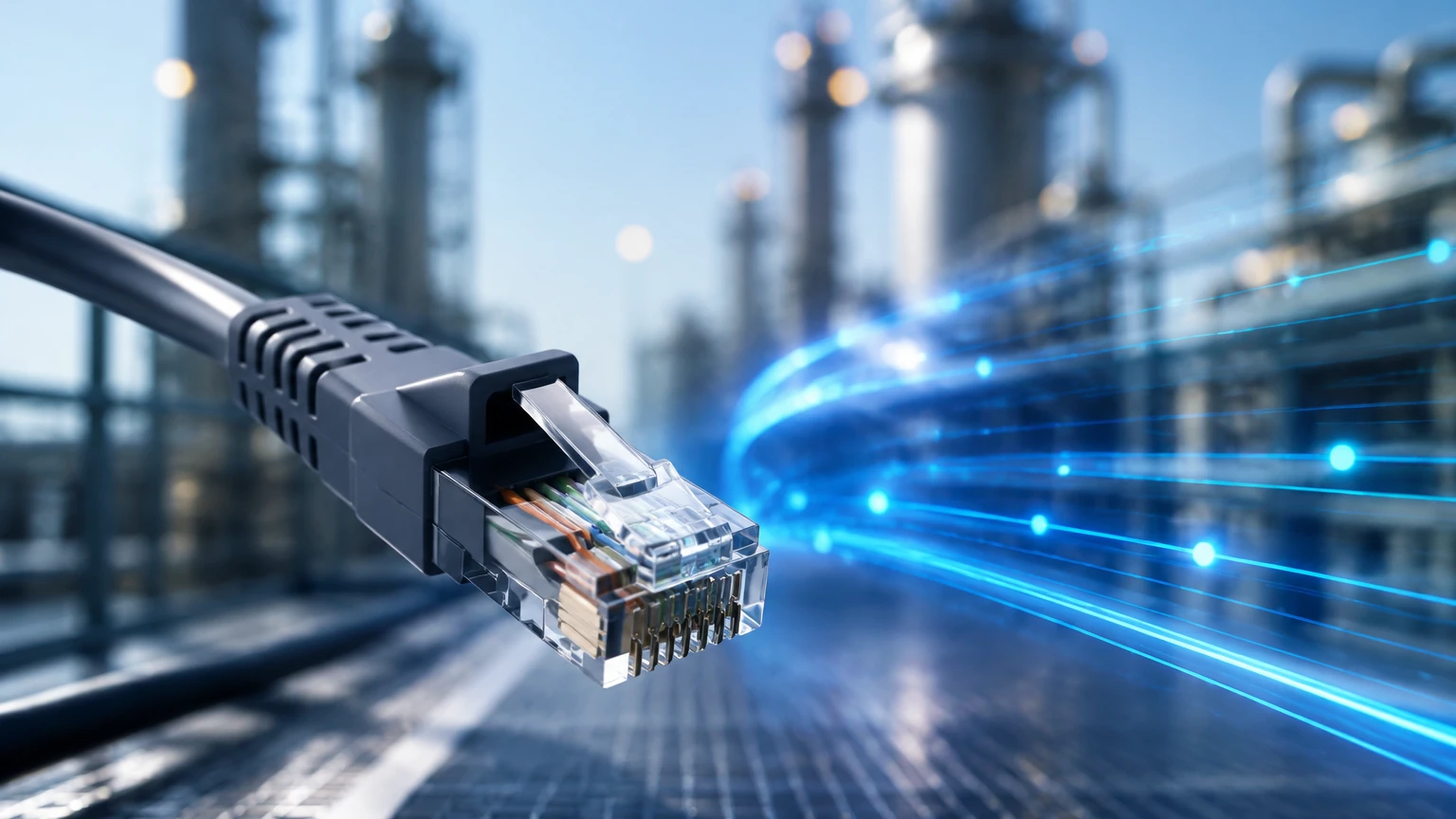
2. Connectors: While standard RJ45 connectors are common in control rooms, field-mounted meters should use M12 D-coded or X-coded industrial connectors to ensure IP67-rated water and dust protection.
3. Cable Length: Standard Ethernet segments are limited to 100 meters (approx. 328 feet). For longer distances, fiber optic media converters or industrial switches with SFP ports must be used.
Network Topology
* Star Topology: Each meter connects to a central industrial switch. This is the most reliable as a single cable failure only affects one device.
* Ring Topology: Some advanced Ethernet flow meters support Device Level Ring (DLR) or Media Redundancy Protocol (MRP). This allows for redundant paths; if one cable is cut, the data is rerouted through the other side of the ring.
Limitations and Common Risks
While an Ethernet flow meter offers superior data depth, it is not a universal solution. Engineers should be aware of the following limitations:
* Cybersecurity: Connecting field devices to a network introduces vulnerabilities. Flow meters should be placed on a dedicated Industrial Control System (ICS) VLAN, isolated from the general corporate network by a firewall.
* Network Latency: In high-speed control loops (e.g., fast-acting batching systems), the latency of a congested network can be higher than a direct 4-20mA analog signal. Quality of Service (QoS) settings on switches should prioritize industrial protocol traffic.
* Environmental Stress: Ethernet electronics are sensitive to heat. Ensure the transmitter housing is rated for the ambient temperature of the installation site, or use a remote-mounted transmitter if the process fluid is excessively hot.
Frequently Asked Questions (FAQs)
Q: Can I use a standard office switch for my Ethernet flow meters?
A: It is not recommended. Industrial switches are designed for wider temperature ranges, DIN-rail mounting, and better vibration resistance. They also support industrial protocols like IGMP snooping, which is critical for managing the multicast traffic often generated by EtherNet/IP devices.
Q: How do I integrate an Ethernet flow meter into an existing PLC?
A: Most modern PLCs (like Allen-Bradley, Siemens, or Schneider Electric) have built-in support for industrial Ethernet. You will typically need the device's EDS (Electronic Data Sheet) or GSDML file to define the data parameters (tags) within the PLC programming environment.
Q: Is an Ethernet flow meter more accurate than a 4-20mA meter?
A: The physical measurement accuracy remains the same. However, the digital transmission is more accurate because it eliminates the digital-to-analog (at the meter) and analog-to-digital (at the PLC) conversion errors, which can add 0.1% to 0.2% total uncertainty.
Q: What happens if the network goes down?
A: Most industrial Ethernet meters include local data logging or internal memory. Some also feature a secondary 4-20mA output that can act as a fail-safe signal to a local controller if the primary network communication is lost.
Conclusion and Next Steps
The transition to Ethernet-based flow measurement is a strategic move toward data-driven process management. By providing more than just a flow rate, these instruments empower maintenance teams with diagnostic insights and simplify the architecture of complex industrial plants. When planning your next installation, ensure that the chosen meter matches the chemical compatibility of your fluid and the protocol requirements of your control system.
For technical specifications on compatible sensors and integration support, Review product options and application support on our Main Page. Confirming the network protocol compatibility and power requirements (PoE vs. external DC) during the design phase will ensure a smooth commissioning process and long-term operational reliability.