Aircraft Fluid Level Sensors
Aircraft Fluid Level Sensors
In the aerospace industry, the precise measurement of fluids—ranging from combustible fuels and hydraulic oils to potable water and coolant—is a critical factor for flight safety, weight management, and operational efficiency. Aircraft fluid level sensors must operate under extreme conditions, including high vibration, rapid pressure changes, and wide temperature fluctuations. While many of the core principles of these sensors are shared with industrial level measurement, the engineering requirements for aviation are significantly more stringent.
This guide examines the primary measurement technologies used in modern aircraft, the selection criteria for specific fluid types, and the technical challenges inherent in airborne level monitoring.
Measurement Principles for Aircraft Fluid Level Sensors
Understanding the physics behind level measurement is the first step in selecting the appropriate sensor for an aviation application. Most aircraft systems rely on one of four primary technologies: capacitance, ultrasonic, hydrostatic pressure, or magnetic reed switches.
Capacitance Level Measurement
Capacitance is the most widely used technology for aircraft fuel systems. A capacitive sensor typically consists of two concentric metal tubes that act as electrodes. As the fuel level rises between these tubes, it replaces the air. Because fuel has a different dielectric constant than air, the overall capacitance of the probe changes in direct proportion to the fluid level.
* The Physics: The capacitance ($C$) is determined by the formula $C = \epsilon(A/d)$, where $\epsilon$ is the permittivity of the medium. Since the permittivity of jet fuel is roughly double that of air, the sensor can detect minute changes in volume.
* Compensators: To maintain accuracy, these systems often include a "compensator" probe at the bottom of the tank. This probe stays submerged and measures the actual dielectric constant of the fuel, which can vary based on temperature and fuel composition, allowing the computer to correct the readings.
Ultrasonic Level Measurement
Ultrasonic sensors are increasingly popular for non-contact applications, particularly in water and waste tanks. These sensors emit a high-frequency sound pulse that travels through the air, reflects off the fluid surface, and returns to the transducer.
* Time-of-Flight: The sensor calculates the distance based on the time it takes for the pulse to return.
* Advantages: Because the sensor does not touch the fluid, it is ideal for corrosive fluids or potable water where contamination must be avoided. However, in aircraft, ultrasonic sensors must be calibrated to account for changes in the speed of sound caused by varying cabin or atmospheric pressures.
Hydrostatic Pressure Sensors
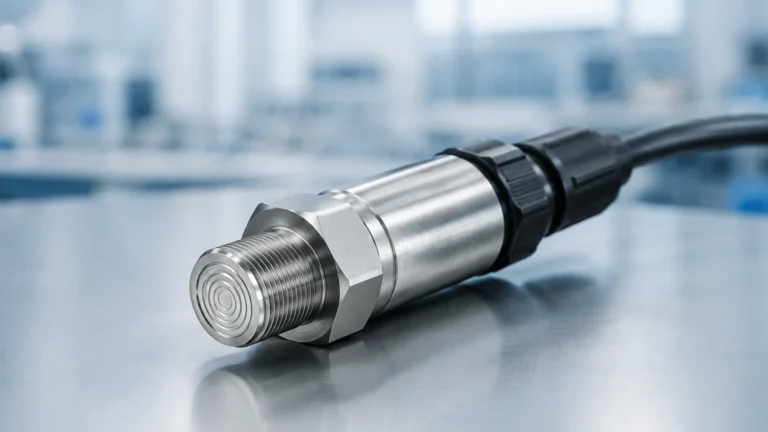
Hydrostatic sensors measure the pressure exerted by a column of liquid at the bottom of a tank. This is commonly used for oil and hydraulic reservoirs.
* The Calculation: The pressure ($P$) is equal to the height of the fluid ($h$) multiplied by the density ($\rho$) and gravity ($g$).
* Aviation Considerations: In a pressurized aircraft, the sensor must be a differential pressure type. It compares the pressure at the bottom of the tank with the air pressure at the top of the tank to ensure that changes in altitude do not result in false level readings.
Magnetic and Float Sensors
While considered older technology, magnetic float sensors are still used for simple "low level" or "full" indications (point level detection). A float containing a magnet moves up and down a stem, triggering reed switches at specific intervals.
Selection Criteria for Different Aircraft Fluids
Not all fluids can be measured using the same technology. The chemical properties and the criticality of the fluid dictate the sensor choice.
| Fluid Type | Recommended Technology | Primary Selection Factor |
| :— | :— | :— |
| Jet Fuel (Jet A/A-1) | Capacitance | Accuracy and lack of moving parts. |
| Hydraulic Fluid | Hydrostatic / Ultrasonic | Resistance to high pressure and temperature. |
| Engine Oil | Hydrostatic / Magnetic | Ability to withstand high viscosity and heat. |
| Potable Water | Ultrasonic / Optical | Hygiene and prevention of bio-fouling. |
| De-icing Fluid | Capacitance / Pressure | Chemical compatibility with glycol-based fluids. |
Fuel Level Sensing
Fuel is the most critical fluid to monitor. Because aircraft wings flex and the fuel "sloshes" during maneuvers, fuel tanks are often equipped with multiple capacitive probes. An onboard Fuel Quantity Indication System (FQIS) averages the readings from these probes to provide a stable measurement to the cockpit.
Hydraulic and Oil Systems
These systems operate under high temperatures, often exceeding 100°C (212°F), and high pressures. Sensors used here must be ruggedized. Hydrostatic transmitters are preferred because they can be integrated into the reservoir's drain or manifold, providing a robust, leak-resistant solution.
Technical Challenges: Sloshing, Attitude, and Environment
Industrial level sensors, such as those found on the Main Page of professional instrumentation sites, typically operate in stationary tanks. Aircraft sensors face a much more dynamic environment.
Sloshing and Tank Geometry
As an aircraft pitches, rolls, or accelerates, the fluid surface is rarely level. To combat this, aircraft tanks use baffles to slow fluid movement. Engineers must strategically place sensors at the "centroid" of the tank or use multi-probe arrays to ensure that the average level remains accurate regardless of the aircraft's attitude.
Temperature and Density Variations
Fluid density changes with temperature. Since aircraft may take off in 40°C (104°F) heat and cruise at altitudes where the outside air temperature is -50°C (-58°F), the sensors must account for thermal expansion and contraction. For fuel, this is often managed by measuring the mass of the fuel rather than just the volume, as the energy content of fuel is proportional to its mass.
Electromagnetic Interference (EMI)
Aircraft are packed with electronic systems. Level sensors and their wiring must be heavily shielded to prevent interference from radar, radio communications, and lightning strikes. This is particularly vital for capacitive sensors, which operate on very low electrical signals.
Installation and Maintenance Considerations
Proper installation is paramount to ensuring the longevity of aircraft fluid level sensors. Engineers must consider the following:
1. Access and Replaceability: Sensors should be located where they can be inspected or replaced without requiring the complete disassembly of the wing or fuselage structures.
2. Sealing and Leak Prevention: Any sensor that penetrates the tank wall must use aviation-grade O-rings and sealants compatible with the specific fluid (e.g., Skydrol-resistant seals for hydraulic systems).
3. Calibration: After installation, systems must be calibrated using a "wet" functional test, where the tank is filled and drained in increments to verify the accuracy of the cockpit gauges.
4. Bonding and Grounding: To prevent static electricity buildup, which is a significant fire risk in fuel tanks, all sensor components must be electrically bonded to the aircraft structure.

Limitations of Current Technologies
While highly advanced, current aircraft fluid level sensors have limitations. Capacitive sensors can be affected by water contamination in the fuel; since water has a much higher dielectric constant than fuel, even a small amount of water can cause a significant over-reading of the fuel level. Ultrasonic sensors can lose their signal if the fluid surface becomes too turbulent or if foam develops on the surface of the liquid.
For engineers looking for industrial-grade level solutions that share these robust design principles, it is useful to Review product options and application support to understand how different technologies perform in demanding environments.
Frequently Asked Questions (FAQs)
Q: Why is fuel measured in mass (kg/lbs) rather than volume (liters/gallons) in larger aircraft?
A: The energy content of jet fuel is determined by its mass. Because fuel expands and contracts significantly with temperature, a gallon of fuel in the tropics contains less energy than a gallon of fuel in the arctic. Measuring mass provides the pilot with a more accurate understanding of the aircraft's range.
Q: How do sensors handle the "dead zone" at the bottom of the tank?
A: Most tanks have a small amount of "unusable fuel" that sits below the level of the pumps or the lowest point of the sensor. The system is calibrated so that the cockpit gauge reads zero when the unusable fuel level is reached, ensuring a safety margin.
Q: Can industrial level sensors be used in aircraft?
A: While the measurement principles (ultrasonic, radar, pressure) are identical, industrial sensors generally lack the specific aerospace certifications (such as DO-160) required for flight. However, industrial sensors are frequently used in ground support equipment and fuel farm monitoring.
Q: What is the impact of tank coating on capacitive sensors?
A: If the interior of a tank is coated with a non-conductive sealant, it can act as an additional dielectric layer. Sensors must be calibrated with the specific tank coating in mind to avoid constant offset errors.
Conclusion
Aircraft fluid level sensors are sophisticated instruments that must balance the need for extreme accuracy with the realities of a harsh, high-motion environment. Whether utilizing the dielectric properties of fuel through capacitance or the time-of-flight of ultrasonic waves, these sensors are integral to modern avionics. For professionals in industrial automation and fluid management, understanding these high-stakes applications provides valuable insight into the selection and maintenance of level measurement technology across all sectors.