I&c Course at Customer Site
I&c Course at Customer Site
In the complex landscape of industrial automation, the accuracy of level measurement is a cornerstone of process safety, efficiency, and inventory management. While modern instruments are designed with high degrees of intelligence, their performance is fundamentally tied to correct selection, precise installation, and expert commissioning. An i&c course at customer site provides a specialized training environment where engineers and technicians can master Instrumentation and Control (I&C) principles using the actual hardware and process conditions they encounter daily.
For facilities utilizing advanced level measurement technologies—such as radar, ultrasonic, or hydrostatic systems—on-site training ensures that the theoretical capabilities of an instrument translate into reliable field data. This guide explores the core measurement principles, selection criteria, and practical considerations that form the backbone of a comprehensive I&C curriculum.
Core Principles of Level Measurement
Before delving into the specifics of an i&c course at customer site, it is essential to understand the physical principles governing industrial level sensors. Level measurement is generally categorized into continuous measurement and point level detection.
Radar Level Measurement (Time of Flight)
Radar level meters operate on the Time of Flight (ToF) principle. The sensor emits a high-frequency microwave signal (typically in the 26GHz or 80GHz range) that travels to the surface of the medium, reflects, and returns to the antenna.
* Principle: The distance is calculated using the formula $D = (c \times t) / 2$, where $c$ is the speed of light and $t$ is the measured time.
* Dielectric Constant (εr): The strength of the reflection depends on the dielectric constant of the material. Materials with higher εr values (like water) provide stronger reflections than those with low εr (like plastic pellets or oils).
Ultrasonic Level Measurement
Similar to radar, ultrasonic sensors use ToF but rely on sound waves rather than electromagnetic waves.
* Principle: A transducer emits an ultrasonic pulse that reflects off the liquid or solid surface.
* Environmental Factors: Unlike radar, the speed of sound is significantly affected by air temperature, pressure, and gas composition. Most high-quality ultrasonic sensors include integrated temperature compensation to maintain accuracy.
Hydrostatic Level Measurement
This method measures the pressure exerted by a liquid column at a specific point, usually the bottom of a tank.
* Principle: Level ($h$) is determined by the formula $P = \rho \times g \times h$, where $P$ is pressure, $\rho$ is the density of the liquid, and $g$ is the gravitational constant.
* Application: This is a contact-based method ideal for vented tanks or deep wells where the liquid density remains relatively constant.
Magnetic Level Gauges
Magnetic level gauges utilize a float containing a permanent magnet that moves with the liquid level in a bypass chamber. This magnet actuates a series of external flags or a transmitter.
* Principle: Buoyancy and magnetic coupling. This provides a clear visual indication and can be paired with reed switches or magnetostrictive transmitters for remote signaling.
The Value of an I&C Course at Customer Site
Generic classroom training often fails to account for the unique "noise" of a specific industrial environment. Conducting an i&c course at customer site allows for a tailored approach that addresses the following:
1. Process-Specific Challenges: Training occurs in the presence of actual agitators, internal tank structures, or steam vapors that can interfere with signals.
2. Hands-on Calibration: Technicians learn to calibrate instruments using the facility's specific PLC/SCADA integration, ensuring that the 4-20mA or digital (HART/Modbus) outputs are mapped correctly.
3. Safety Protocols: Training is conducted within the site’s specific safety framework, including Lockout/Tagout (LOTO) procedures and hazardous area (ATEX/IECEx) requirements.
4. Hardware Familiarity: Participants work with the exact models of radar level meters or ultrasonic sensors installed at their plant, reducing the learning curve for maintenance.
To explore the full range of instruments covered in these sessions, engineers can Review product options and application support on our Main Page.
Practical Selection and Application Engineering
Choosing the right technology is the first step in any I&C project. An on-site course typically includes a module on application engineering to prevent common specification errors.
Selection Table for Level Measurement Technologies
| Technology | Media Type | Temperature Range | Pressure Range | Key Advantage |
| :— | :— | :— | :— | :— |
| Radar (80GHz) | Liquids, Solids, Slurries | -40°C to +250°C | Up to 40 bar | High precision, ignores dust/vapor |
| Ultrasonic | Clean Liquids | -40°C to +80°C | Up to 3 bar | Cost-effective, non-contact |
| Hydrostatic | Liquids, Pastes | -20°C to +100°C | High (Submersible) | Simple setup, no moving parts |
| Magnetic Gauge | Liquids | -50°C to +400°C | Up to 160 bar | Visual backup, high pressure/temp |
| Level Switch | Point Detection | Wide Range | Wide Range | Overfill protection, redundant safety |
Installation Considerations and Best Practices
Correct installation is critical to instrument longevity and accuracy. During an i&c course at customer site, instructors emphasize several physical installation parameters:
Avoidance of Obstructions
For non-contact sensors (Radar and Ultrasonic), the "beam angle" must be considered. If a sensor is mounted too close to a tank wall or an internal ladder, the signal may reflect off these structures rather than the product surface. This results in "false echoes."
Nozzle Geometry
The height and diameter of the mounting nozzle can create interference. For radar, the antenna should ideally extend slightly beyond the nozzle to prevent internal reflections. For ultrasonic sensors, the "dead zone" (or blocking distance) must be respected; if the liquid reaches this zone, the sensor cannot provide a reading.
Positioning for Turbulence
In tanks with heavy agitation or surface turbulence, stilling wells or bypass pipes may be required. An on-site course allows technicians to evaluate whether a current installation requires these mechanical modifications to stabilize the reading.
Troubleshooting and Maintenance Protocols
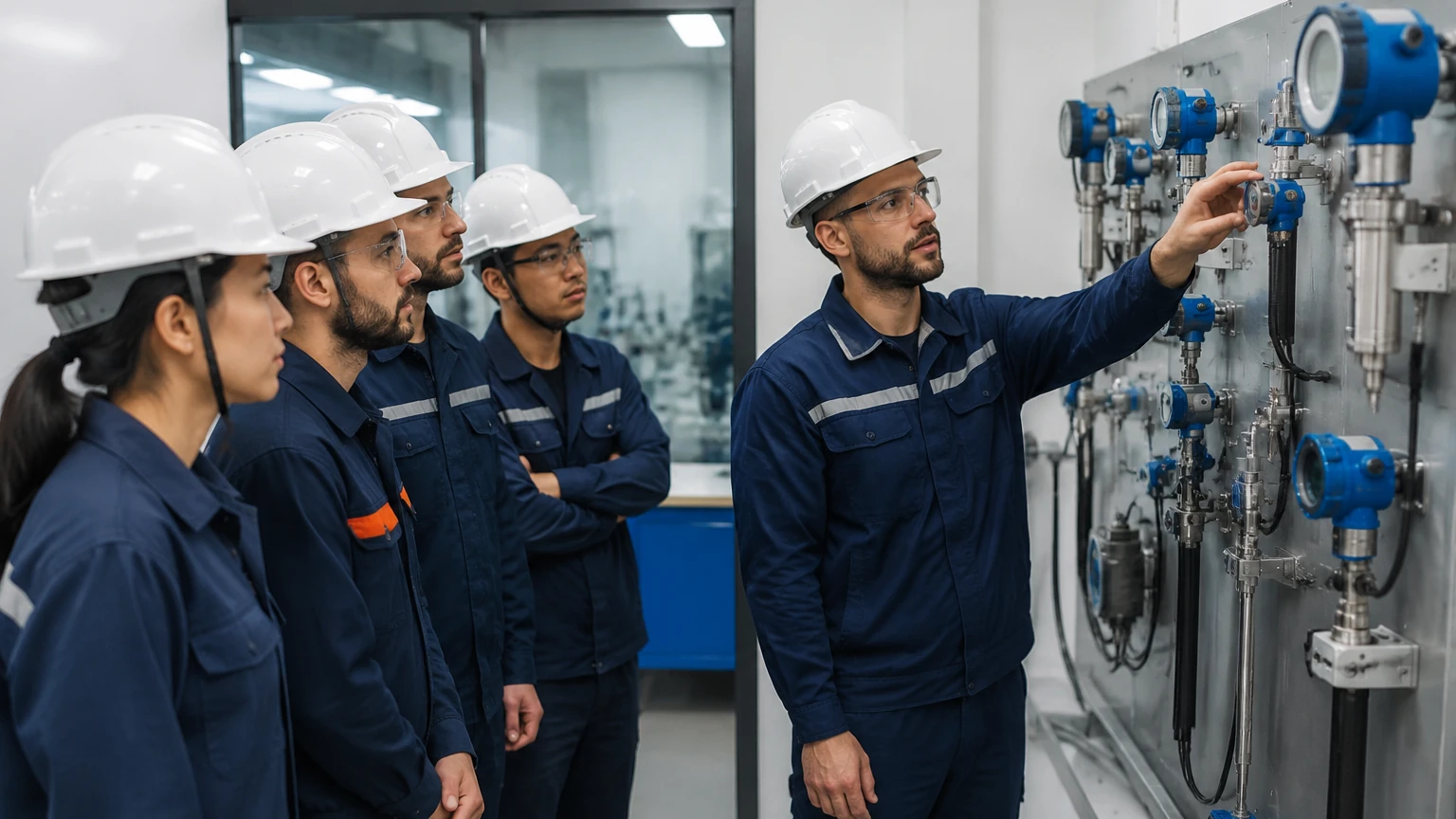
Maintenance is a primary focus of I&C training. Technicians are taught to interpret diagnostic data from the instrument's display or software.
* Echo Curves: For radar and ultrasonic meters, the echo curve is the most important diagnostic tool. Technicians learn to identify the "true" echo versus noise from foam or internal structures.
* Loop Testing: Verifying that the 4-20mA signal matches the physical level at multiple points (e.g., 25%, 50%, 75%, and 100% of span).
* Cleaning Regimens: In applications involving sticky or crystallizing media, training covers the safe cleaning of transducer faces or radar lenses without damaging the sensitive electronics.
Limitations of Level Measurement Technologies
No single technology is a "silver bullet." Understanding limitations is a key outcome of an i&c course at customer site:
* Radar: While highly versatile, extremely low dielectric materials (εr < 1.4) may require guided wave radar (GWR) rather than non-contact radar.
* Ultrasonic: Performance degrades significantly in the presence of heavy foam, which absorbs sound waves, or in vacuum conditions where sound cannot travel.
* Hydrostatic: Accuracy is dependent on constant density. If the temperature of the liquid fluctuates wildly, the density changes, leading to errors in level calculation unless compensated.
Frequently Asked Questions (FAQ)
Q: How often should level transmitters be calibrated?
A: While modern digital sensors are very stable, a yearly verification is recommended for standard industrial applications. For critical safety loops (SIL rated), the interval is determined by the specific safety manual of the device.
Q: Can radar level meters measure through plastic tank walls?
A: Yes, non-contact radar can often measure through plastic or fiberglass tank tops, allowing the sensor to be mounted outside the vessel, which is ideal for highly corrosive chemicals.
Q: What is the difference between 2-wire and 4-wire transmitters?
A: 2-wire transmitters use the same pair of wires for both power and the 4-20mA signal, making them easier to install. 4-wire transmitters have separate power and signal wires, which is often necessary for power-intensive features like heated displays or high-power radar pulses.
Q: How does foam affect ultrasonic vs. radar measurement?
A: Foam is a significant challenge. Ultrasonic waves are usually absorbed or scattered by foam. Radar waves can often penetrate light foam, but dense, thick foam may reflect the signal prematurely or attenuate it. On-site testing is often the only way to confirm performance in foaming applications.
Summary of Next Steps for I&C Management
Implementing an i&c course at customer site represents a strategic investment in human capital and operational reliability. By moving beyond basic manuals and engaging with instruments in their specific process context, maintenance teams can significantly reduce downtime and improve data integrity.
Before scheduling a course, project managers should confirm:
* The specific models and communication protocols (HART, Modbus, Profibus) currently in use.
* The most frequent failure modes observed in the facility.
* The availability of process vessels for hands-on calibration exercises.
For technical specifications, wiring diagrams, and selection guides for the latest in level measurement technology, professionals are encouraged to visit the Main Page to Review product options and application support. Proper training, combined with robust instrumentation, ensures that level measurement remains a reliable asset rather than a maintenance burden.