Ultrasonic Liquid Level Measurement
Ultrasonic Liquid Level Measurement
Ultrasonic liquid level measurement has emerged as one of the most versatile and reliable methods for monitoring fluid volumes across diverse industrial sectors. As a non-contact technology, it offers significant advantages in terms of maintenance, longevity, and hygiene, making it a preferred choice for water treatment, chemical processing, and industrial automation. This guide provides a comprehensive technical overview of ultrasonic measurement principles, selection criteria, and installation best practices to assist engineers and plant managers in optimizing their level control systems.
Measurement Principles and Technology
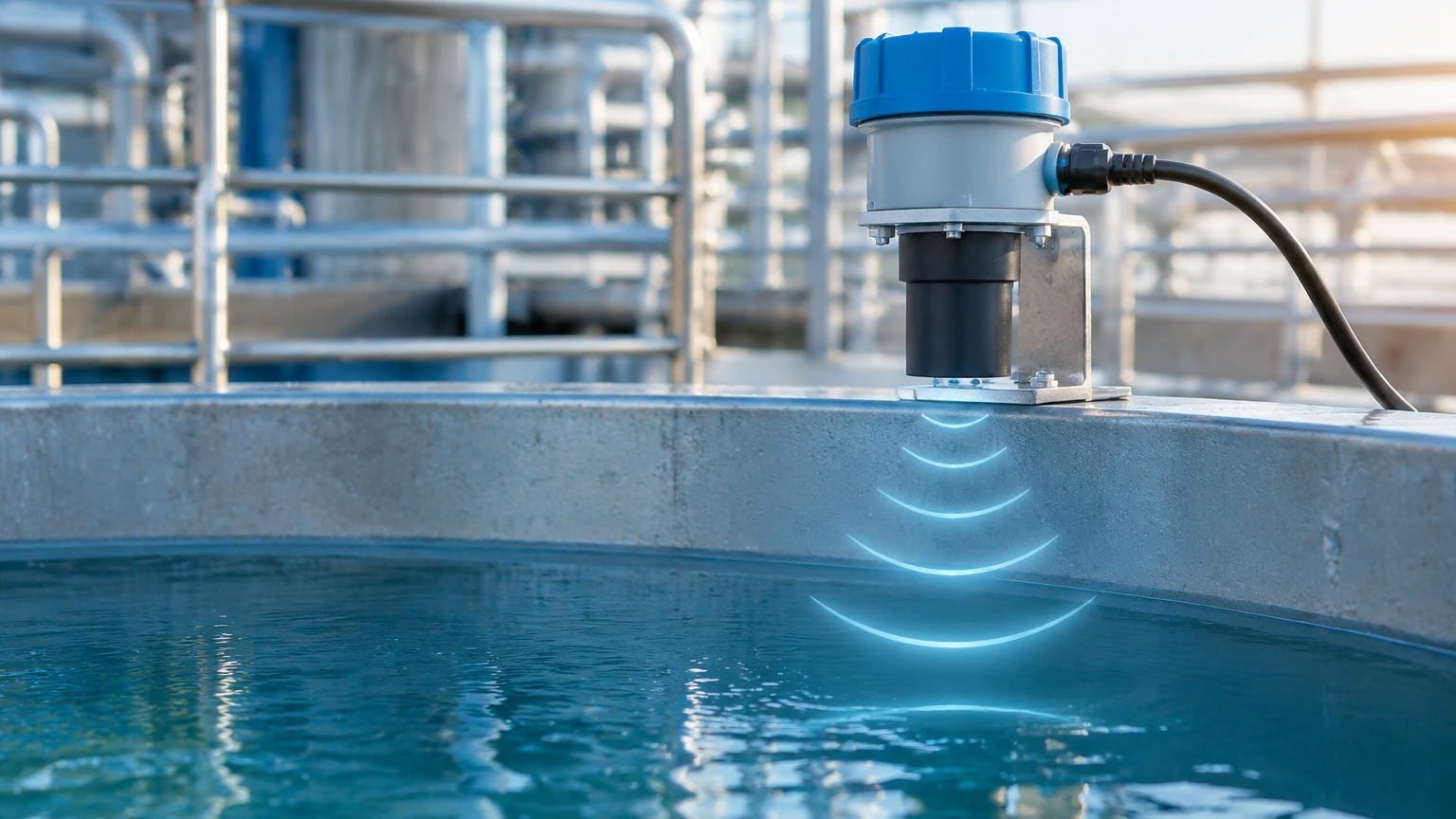
To effectively implement ultrasonic liquid level measurement, it is essential to understand the underlying physics. The system typically consists of a transducer mounted at the top of a vessel or above a liquid surface. This transducer contains piezoelectric crystals that convert electrical energy into high-frequency sound waves.
The Time-of-Flight (ToF) Method
The fundamental principle is the "Time-of-Flight" (ToF) measurement. The transducer emits a short burst of ultrasonic pulses that travel through the air space toward the liquid surface. When these waves encounter the interface between the air and the liquid, a portion of the energy is reflected back toward the sensor.
The instrument measures the time interval ($t$) between the emission of the pulse and the reception of the echo. Since the speed of sound in air ($c$) is a known constant (approximately 340 m/s at 20°C), the distance ($D$) from the sensor to the liquid surface can be calculated using the formula:
$$D = \frac{c \times t}{2}$$
The level of the liquid ($L$) is then determined by subtracting this distance from the total height of the tank ($H$):
$$L = H – D$$
Frequency and Resolution
Ultrasonic sensors operate at various frequencies, typically ranging from 20 kHz to 70 kHz. The choice of frequency dictates the performance characteristics of the device:
- Low Frequency (20–30 kHz): These waves have longer wavelengths and can travel further, making them suitable for long-range measurements (up to 30 or 40 meters). They are also more resilient to dust and light foam.
- High Frequency (50–70 kHz): These offer higher resolution and accuracy but have a shorter effective range (usually up to 10 or 15 meters). They are ideal for precision measurement in smaller tanks.
Temperature Compensation
The speed of sound is highly dependent on the temperature of the medium through which it travels. In air, the speed of sound increases by approximately 0.6 m/s for every degree Celsius increase in temperature. To maintain accuracy, modern ultrasonic level meters, such as those manufactured by Welk, include integrated temperature sensors to provide real-time compensation for these fluctuations.
Key Evaluation and Selection Criteria
Selecting the right instrument for ultrasonic liquid level measurement requires a detailed analysis of the process environment. Not every application is suitable for ultrasonic technology, and choosing the wrong specifications can lead to signal loss or inaccurate readings.
1. Measurement Range and "Dead Zone"
Every ultrasonic sensor has a "dead zone" or "blocking distance" directly beneath the transducer face. In this zone, the sensor cannot accurately process the returning echo because the transducer is still vibrating from the initial pulse emission. Typical dead zones range from 0.2 meters to 0.8 meters (approx. 8 to 31 inches). It is critical to ensure that the maximum liquid level never enters this dead zone.
2. Media Characteristics
While the technology is non-contact, the surface of the liquid significantly impacts the echo quality:
- Clean Liquids: Water, oils, and chemicals with smooth surfaces provide excellent reflection.
- Agitated Liquids: Turbulence or ripples can scatter the ultrasonic signal, requiring sensors with advanced signal processing algorithms to filter the noise.
- Foaming Liquids: Heavy foam can absorb the ultrasonic pulse entirely, preventing an echo from returning. In such cases, alternative technologies like radar or hydrostatic transmitters may be required.
3. Vessel Geometry and Internal Obstructions
The beam angle of the ultrasonic pulse (usually between 5° and 12°) determines the "footprint" of the signal at the liquid surface. If the tank contains internal structures like ladders, agitator blades, or heating coils, the signal may hit these objects and create a false echo. Selecting a sensor with a narrower beam angle or using "false echo suppression" software is vital for complex tank geometries.
Technical Selection Table
| Feature | Standard Application | Heavy Industrial Application | Corrosive Environment |
| :— | :— | :— | :— |
| Typical Range | 0.4m – 10m | 0.5m – 30m | 0.25m – 12m |
| Transducer Material | ABS / PVC | Aluminum / Stainless Steel | PVDF / PTFE |
| Output Signal | 4-20mA / HART | 4-20mA / Modbus RS485 | 4-20mA / HART |
| Accuracy | ±0.5% FS | ±0.25% FS | ±0.25% FS |
| Beam Angle | 10° – 12° | 5° – 8° | 8° – 10° |
| Protection Class | IP65 | IP67 / IP68 | IP68 / Explosion Proof |
Installation Considerations and Best Practices
Proper installation is the single most important factor in ensuring the success of ultrasonic liquid level measurement. Even the most advanced sensor will fail if it is poorly positioned.
Positioning the Sensor
1. Avoid the Center: In cylindrical tanks with domed tops, mounting the sensor in the exact center can cause "parabolic focusing," where multiple echoes converge and confuse the sensor. Position the sensor at 1/2 to 1/3 of the tank radius from the wall.
2. Stay Clear of Inflow: Never mount the sensor directly above the point where liquid enters the tank. The falling stream will interfere with the ultrasonic pulse and create erratic readings.
3. Perpendicular Alignment: The transducer face must be perfectly horizontal (perpendicular to the liquid surface). A tilt of even a few degrees can cause the reflected signal to miss the transducer entirely.
4. Distance from Walls: Ensure the beam does not hit the tank wall. If the wall is rough or has weld seams, it will create significant interference.
Mounting Methods
- Threaded Mounting: Common for open channels or small plastic tanks.
- Flange Mounting: Used for pressurized vessels or chemical tanks where a secure seal is required.
- Bracket Mounting: Ideal for open sumps, reservoirs, or over-the-side applications in water treatment plants.
Limitations and Common Risks
Despite its versatility, ultrasonic liquid level measurement has specific physical boundaries that must be respected to avoid system failure.
Vacuum and Pressure
Ultrasonic waves require a medium (gas/air) to travel. Therefore, they cannot function in a vacuum. Furthermore, high-pressure environments change the density of the air, which significantly alters the speed of sound. While some sensors are rated for moderate pressure, most ultrasonic applications are limited to atmospheric or near-atmospheric conditions.
Vapor and Dust
Heavy steam or chemical vapors can change the composition of the air in the tank, affecting the speed of sound and potentially attenuating the signal. Similarly, extremely high concentrations of dust can scatter the ultrasonic pulses. In these specific scenarios, 80GHz Radar level meters are often a more robust alternative.
Ambient Noise
High-frequency acoustic noise from heavy machinery or pneumatic systems can sometimes interfere with the sensor's ability to distinguish the true echo. Modern digital sensors use sophisticated filtering to mitigate this, but it remains a factor in heavy industrial environments.
Frequently Asked Questions (FAQ)
Q: Can ultrasonic sensors measure the level of solids?
A: Yes, but with limitations. Solids like grain or sand often have an irregular surface that scatters the signal. For solids, it is recommended to use sensors with higher power and narrower beam angles, and the effective range is typically reduced by 50% compared to liquids.
Q: How does wind affect outdoor ultrasonic measurement?
A: Strong wind can "blow" the ultrasonic pulse away or create turbulence in the air, leading to signal loss. For outdoor reservoirs, using a stilling well or a protective sunshade/windbreak for the sensor is recommended.
Q: What is a stilling well, and when should I use one?
A: A stilling well is a vertical pipe installed in the tank that provides a calm surface for measurement. It is used in tanks with heavy agitation, foam, or internal obstructions that would otherwise prevent a clean ultrasonic reading.
Q: Is maintenance required for these sensors?
A: Because the technology is non-contact, maintenance is minimal. However, in applications with high humidity or splashing, the transducer face should be checked periodically for condensation or material buildup, which can be wiped away with a soft cloth.
Conclusion and Next Steps
Ultrasonic liquid level measurement remains a cornerstone of modern process control due to its balance of accuracy, ease of installation, and cost-effectiveness. By understanding the physical requirements of the technology—such as temperature compensation, dead zones, and beam angles—engineers can implement highly reliable systems that require very little long-term intervention.
For those looking to integrate these solutions into their operations, it is vital to partner with a manufacturer that provides both high-quality hardware and technical support. You can explore a wide range of industrial-grade sensors and customized measurement solutions by visiting the Main Page of Welk, where detailed specifications and application support are available to help you choose the right instrument for your specific needs.