Flow Monitoring Devices
Flow Monitoring Devices
In the landscape of industrial automation and process control, flow monitoring devices serve as critical sensors for ensuring operational efficiency, safety, and regulatory compliance. Whether managing water treatment facilities, chemical processing plants, or oil and gas pipelines, the ability to accurately measure the movement of liquids, gases, and steam is fundamental. This guide explores the underlying principles of flow measurement, provides a framework for selecting the appropriate technology, and outlines best practices for installation and maintenance.
Core Principles of Flow Measurement
Before selecting flow monitoring devices, it is essential to understand the physical principles they employ. Industrial flow measurement is generally categorized by the method used to derive the flow rate, which can be volumetric or mass-based.
Differential Pressure (DP)
Differential pressure remains one of the most common methods. It operates on Bernoulli’s principle, which states that as the speed of a moving fluid increases, the pressure within the fluid decreases. By placing a constriction in the pipe (such as an orifice plate, Venturi tube, or nozzle), a pressure drop is created. The square root of this pressure difference is proportional to the flow rate.
Velocity-Based Measurement
These devices measure the speed at which the fluid moves through a known cross-sectional area. Common technologies include:
* Electromagnetic: Based on Faraday’s Law of Induction, these meters use magnetic fields to measure the velocity of conductive liquids. As the fluid moves through the field, it generates a voltage proportional to its speed.
* Ultrasonic: These devices use sound waves to determine velocity. Transit-time ultrasonic meters measure the time difference between signals sent upstream and downstream. Doppler ultrasonic meters reflect sound off particles or bubbles in the fluid to calculate shift in frequency.
* Turbine: A rotor is placed in the flow stream. The fluid's kinetic energy causes the rotor to spin at a speed directly proportional to the flow velocity.
Area-Based Measurement (Variable Area)
Commonly known as rotameters, these devices consist of a tapered tube and a float. As flow increases, the float rises, increasing the area through which the fluid can pass until the upward force of the fluid balances the weight of the float.
Open Channel Flow
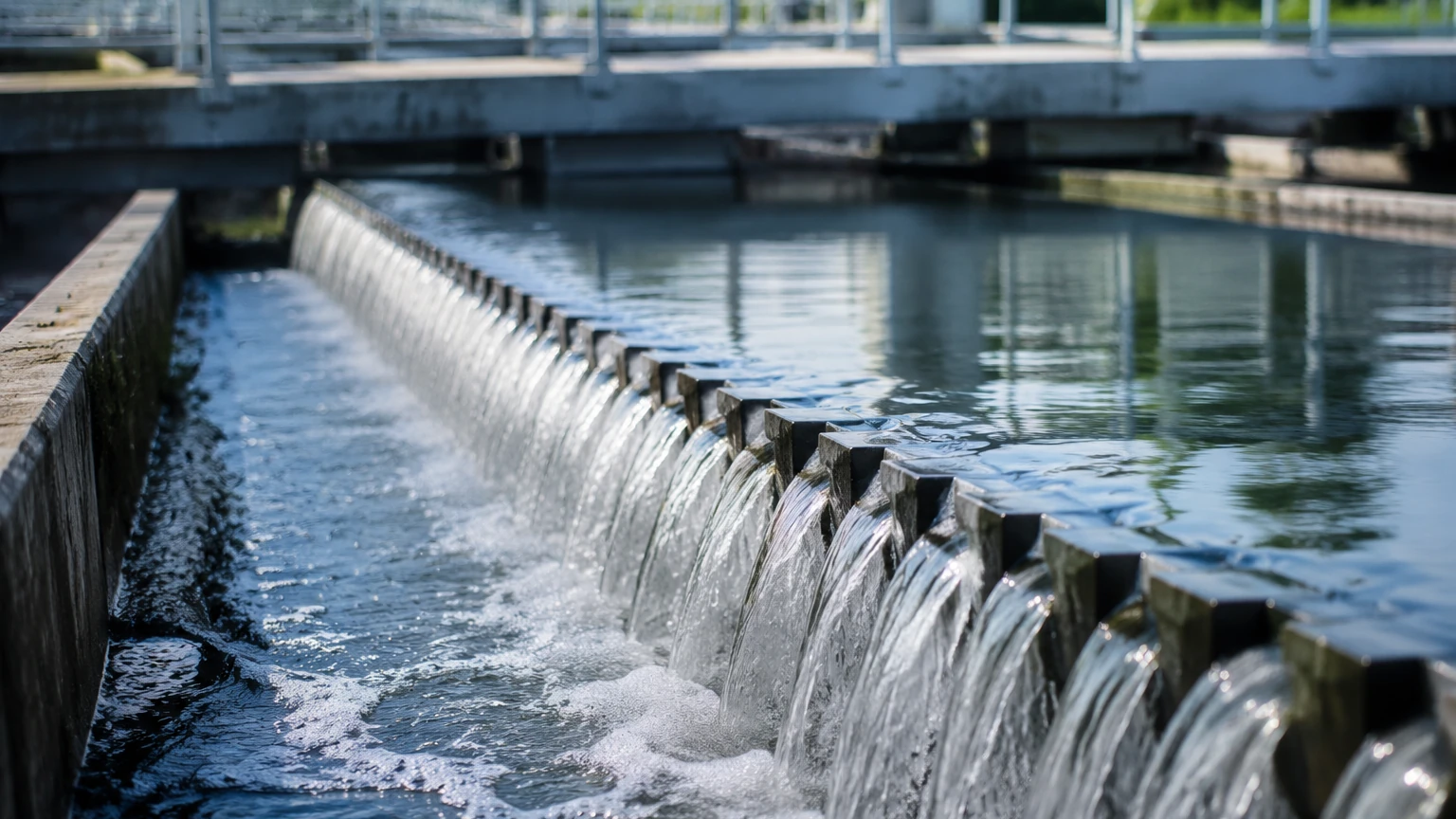
In applications like wastewater treatment or irrigation, fluid is not confined to a pipe. Here, flow monitoring devices often work in conjunction with level measurement. By measuring the "head" or height of the liquid behind a weir or within a flume, the flow rate can be calculated using standardized mathematical formulas. This is where high-precision radar or ultrasonic level sensors become integral components of a flow monitoring system.
Selection Criteria for Flow Monitoring Devices
Choosing the right instrument requires a detailed analysis of the process conditions and the physical properties of the media. Engineers should evaluate the following factors before procurement:
Fluid Characteristics
* State: Is the media a liquid, gas, or steam?
* Conductivity: Electromagnetic meters require a minimum conductivity (typically >5 μS/cm).
* Viscosity: High-viscosity fluids may require positive displacement meters or Coriolis meters, as they can cause significant pressure drops in DP meters.
* Corrosiveness: The wetted parts of the sensor must be chemically compatible with the fluid. Materials like PTFE, Hastelloy, or stainless steel are common choices.
Process Conditions
* Flow Range (Turndown Ratio): The ratio between the maximum and minimum flow the meter can accurately measure. If a process has wide fluctuations, a high turndown ratio is necessary.
* Pressure and Temperature: Ensure the device housing and sensors are rated for the maximum operating pressure (measured in bar or PSI) and temperature (measured in °C).
* Pipe Size: Some technologies, like Coriolis, become prohibitively expensive at large diameters (e.g., >250 mm), whereas ultrasonic or insertion meters remain cost-effective.
Accuracy and Repeatability
Accuracy refers to how close the measurement is to the true value, while repeatability refers to the device's ability to produce the same result under identical conditions. For billing and custody transfer, high accuracy (±0.1% to ±0.5%) is required. For simple process monitoring, ±1% to ±2% may suffice.
Practical Selection Table
| Technology | Suitable Media | Typical Accuracy | Key Advantage | Major Limitation |
| :— | :— | :— | :— | :— |
| Electromagnetic | Conductive Liquids | ±0.5% | No moving parts; low pressure drop | Requires conductive fluid |
| Ultrasonic (Transit-Time) | Clean Liquids/Gases | ±1.0% | Non-intrusive (Clamp-on) | Sensitive to entrained air/solids |
| Differential Pressure | Liquids, Gas, Steam | ±1.0% – ±2.0% | Proven technology; versatile | High pressure drop; narrow turndown |
| Coriolis | Liquids, Slurries, Gas | ±0.1% | Measures mass flow directly | High initial cost; size limitations |
| Vortex | Steam, Gas, Low-viscosity | ±1.0% | Excellent for high-temp steam | Requires minimum Reynolds number |
| Radar (Open Channel) | Wastewater, Raw Water | ±2.0% (System) | Non-contact; ignores foam/debris | Requires weir or flume structure |
Installation Considerations
Even the most advanced flow monitoring devices will fail to provide accurate data if installed incorrectly. Adhering to engineering standards ensures the flow profile is fully developed and stable when it reaches the sensor.
1. Straight Pipe Runs: Most meters require a specific length of straight pipe upstream (typically 10 to 20 diameters) and downstream (5 diameters) to eliminate turbulence caused by elbows, valves, or pumps.
2. Orientation: For liquid applications, the pipe must always be full. Horizontal installations should avoid placing sensors at the very top of the pipe (where air pockets form) or the very bottom (where sediment collects). Vertical installations should ideally have upward flow to ensure a full pipe.
3. Grounding: For electromagnetic meters, proper grounding to the fluid is essential to eliminate electrical noise that can interfere with the low-voltage signal generated by the sensor.
4. Vibration and Interference: Ultrasonic and Coriolis meters can be sensitive to mechanical vibrations. Ensure the piping is well-supported and that the device is isolated from heavy machinery if necessary.
Limitations and Common Risks
While modern flow monitoring devices are robust, they are not immune to operational challenges. Awareness of these risks allows for better system design.
* Scaling and Buildup: In wastewater or chemical applications, material can build up on the internal walls of the meter or on the sensor faces. This changes the internal diameter or dampens the signal, leading to drift. Non-contact methods, such as those found on the Main Page, can mitigate these issues in open-channel or level-based flow setups.
* Air Entrainment: Small bubbles in a liquid stream can cause ultrasonic signals to scatter or cause electromagnetic meters to read inaccurately. Air eliminators should be installed upstream if entrainment is expected.
* Calibration Drift: Over time, mechanical wear (in turbine meters) or electronic aging can cause the device to lose accuracy. Regular field verification or laboratory calibration is required for critical measurement points.
* Cavitation: If the pressure drops below the vapor pressure of the liquid, vapor bubbles form and then collapse violently. This can damage the internal components of flow meters and create significant measurement errors.
The Synergy of Level and Flow
In many industrial contexts, flow monitoring is achieved through secondary variables. For instance, hydrostatic pressure transmitters can measure the head of a tank to infer flow out of a bottom orifice, or ultrasonic level sensors can monitor the rate of change in a vessel to calculate inflow/outflow. For professionals managing complex fluid systems, integrating high-quality level measurement with dedicated flow sensors provides a redundant and highly reliable monitoring network. For a comprehensive look at the instruments used to facilitate these measurements, visit the Main Page to review technical specifications for radar, ultrasonic, and hydrostatic sensors.
Frequently Asked Questions (FAQ)
Q: Can I use a liquid flow meter to measure gas?
A: Generally, no. The physics of gas flow (compressibility) differ significantly from liquid flow. While some technologies like Thermal Mass or Vortex can handle both, they must be calibrated specifically for the medium being measured.
Q: What is the difference between Volumetric Flow and Mass Flow?
A: Volumetric flow measures the space the fluid occupies (e.g., liters per minute). Mass flow measures the actual weight of the fluid (e.g., kilograms per hour). Mass flow is preferred for gases and steam because their volume changes significantly with pressure and temperature.
Q: How often should flow monitoring devices be calibrated?
A: Calibration frequency depends on the criticality of the process and the environment. Standard industrial applications usually require annual calibration, while custody transfer applications may require semi-annual or quarterly checks.
Q: Why is my ultrasonic flow meter giving erratic readings?
A: The most common causes are insufficient straight pipe runs (causing turbulence), high concentrations of solids or bubbles (blocking the signal), or a pipe that is not completely full. Check the installation against the manufacturer’s "D" (diameter) requirements.
Q: Are non-contact flow meters as accurate as inline meters?
A: For open channel flow using radar or ultrasonic level sensors, accuracy depends heavily on the precision of the weir or flume construction. For closed pipes, clamp-on ultrasonic meters are highly accurate but require precise pipe wall thickness and material data to be entered into the transmitter.
By understanding these technical nuances, engineers can implement flow monitoring devices that provide long-term reliability and precise data, ultimately leading to better resource management and reduced operational costs.