How Thermistor Is Used to Measure Temperature
How Thermistor Is Used to Measure Temperature
In the landscape of industrial instrumentation, precision and reliability are the cornerstones of process control. Among the various sensors used to monitor thermal conditions, the thermistor stands out as a highly sensitive and cost-effective solution. Understanding how thermistor is used to measure temperature is essential for engineers and technicians who specify components for complex systems, including the advanced level measurement solutions provided by manufacturers like Welk.
This article explores the fundamental principles, electronic integration, selection criteria, and practical applications of thermistors within industrial environments, particularly their role in supporting accurate level measurement technologies.
The Fundamental Principle of Thermistors
The term "thermistor" is a portmanteau of "thermal" and "resistor." Unlike standard resistors, which are designed to maintain a stable resistance despite temperature changes, a thermistor is specifically engineered to exhibit a predictable and significant change in electrical resistance when exposed to varying temperatures.
NTC vs. PTC Thermistors
Thermistors are categorized into two primary types based on how their resistance reacts to thermal changes:
1. Negative Temperature Coefficient (NTC): These are the most common type used for temperature measurement. In an NTC thermistor, resistance decreases as the temperature increases. This relationship is typically non-linear but highly repeatable, making them ideal for precision sensing within a specific range.
2. Positive Temperature Coefficient (PTC): In these components, resistance increases as temperature increases. While some PTCs are used for measurement, they are more frequently employed as self-resetting fuses or heaters due to their "switching" characteristic at a specific Curie temperature.
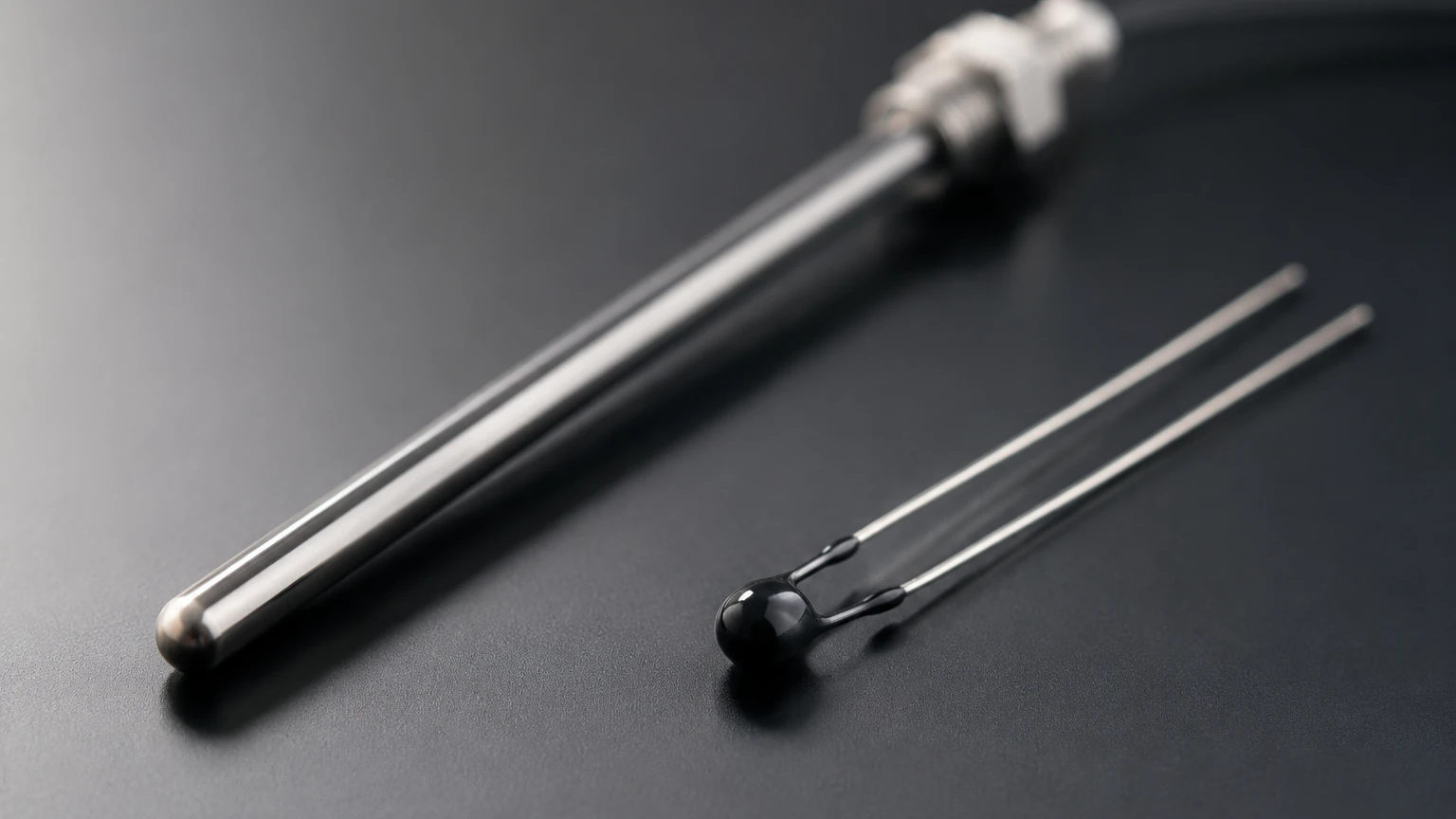
For industrial sensing, NTC thermistors are the standard choice. They are composed of sintered metal oxides—such as manganese, nickel, cobalt, and copper—encapsulated in glass or epoxy. The semiconductor nature of these materials allows for a much higher sensitivity than Resistance Temperature Detectors (RTDs) or thermocouples, often detecting changes as small as 0.01°C.
How Thermistor Is Used to Measure Temperature: The Electronic Process
To understand how thermistor is used to measure temperature in a practical B2B or engineering context, one must look beyond the component itself to the signal conditioning circuitry. A thermistor does not output a voltage or current; it modifies the flow of electricity based on its resistive state.
1. The Voltage Divider Circuit
The simplest method to convert a thermistor’s resistance into a measurable signal is a voltage divider circuit. By placing the thermistor in series with a known fixed resistor (a precision resistor), a reference voltage is applied across the pair. As the thermistor's resistance changes with temperature, the voltage drop across it changes proportionally. This analog voltage is then sent to an Analog-to-Digital Converter (ADC) within a microcontroller or a PLC (Programmable Logic Controller).
2. The Wheatstone Bridge
For higher precision applications, a Wheatstone bridge configuration is used. This circuit consists of four resistive arms. The thermistor acts as one of these arms. When the bridge is balanced, the output voltage is zero. Any change in the thermistor's temperature unbalances the bridge, producing a voltage difference that can be amplified and measured. This method is particularly effective at neutralizing the effects of lead wire resistance.
3. Resistance-to-Temperature Conversion
Once the resistance is measured, the system must convert that value back into a temperature reading (Celsius or Fahrenheit). This is achieved using mathematical models programmed into the instrument’s firmware:
* The Steinhart-Hart Equation: This is the most accurate model for NTC thermistors. It uses a third-order polynomial:
$1/T = A + B(ln R) + C(ln R)^3$
where $T$ is temperature in Kelvin, $R$ is resistance, and $A, B, C$ are constants specific to the thermistor model.
* The Beta (β) Parameter Equation: A simpler, two-point calibration formula used for less demanding applications over a narrower temperature range.
Selection Criteria for Industrial Thermistors
When selecting a thermistor for an industrial application, engineers must evaluate several technical parameters to ensure long-term stability and accuracy.
| Parameter | Description | Importance in B2B Applications |
| :— | :— | :— |
| Nominal Resistance | The resistance value at 25°C (commonly 10kΩ or 100kΩ). | Ensures compatibility with the input impedance of the controller. |
| Tolerance | The allowable deviation from the nominal resistance (e.g., ±0.1°C). | Critical for interchangeable parts without recalibration. |
| Temperature Range | The functional limits (typically -50°C to +150°C). | Thermistors are best for moderate ranges; RTDs are preferred for extremes. |
| Dissipation Constant | The amount of power required to raise the thermistor's temperature by 1°C. | High constants prevent "self-heating" errors. |
| Time Constant | The time required for the sensor to reach 63.2% of a temperature step change. | Essential for processes with rapid thermal fluctuations. |
Installation and Engineering Considerations
Proper installation is as vital as the sensor choice itself. In industrial environments, the following factors must be addressed:
* Self-Heating: Because a current must pass through the thermistor to measure resistance, the sensor generates a small amount of heat. If the current is too high, the sensor will read higher than the actual ambient temperature. Engineers must limit the excitation current to the micro-ampere range.
* Lead Wire Resistance: While thermistors have high base resistance (which minimizes the impact of lead wire resistance compared to RTDs), long cable runs in a factory can still introduce errors. Using a 3-wire or 4-wire configuration, or converting the signal to a 4-20mA loop near the source, is recommended.
* Encapsulation: In chemical or water treatment plants, the thermistor must be protected by a thermowell or a stainless steel probe housing to prevent corrosion and mechanical damage.
Integration with Level Measurement Systems
At Welk, the integration of temperature sensing is a critical component of high-accuracy level measurement. While a thermistor might not be the primary level sensor, it is often an essential secondary sensor used for compensation.
Temperature Compensation in Ultrasonic Level Meters
Ultrasonic level sensors calculate the distance to a liquid surface by measuring the time it takes for a sound pulse to travel to the surface and back. However, the speed of sound in air is highly dependent on temperature ($v \approx 331.3 + 0.606T$). Without an integrated thermistor to provide real-time temperature data to the sensor's microprocessor, a change of just 10°C could result in a measurement error of nearly 2%. By embedding a thermistor in the sensor face, Welk ensures that the Main Page of their instrumentation suite reflects corrected, high-precision data regardless of environmental shifts.
Radar Level Meter Stability
In high-frequency radar level measurement, while the speed of light is not affected by air temperature, the electronic components and the dielectric properties of the vapor space can be influenced by thermal changes. Thermistors are used within the housing to monitor internal electronics temperature, ensuring the stability of the high-frequency oscillators and preventing signal drift.
Comparison: Thermistors vs. Other Sensors
To understand why a thermistor is chosen over other technologies, consider the following comparison:
1. Thermistors: Highest sensitivity, fast response, but limited temperature range (up to ~250°C). Ideal for medical, HVAC, and precision industrial compensation.
2. RTDs (e.g., Pt100): Highly linear and stable over a wide range (-200°C to +600°C). More expensive than thermistors and less sensitive to small changes.
3. Thermocouples: Widest temperature range (up to 1700°C+) and very rugged, but least accurate and require cold-junction compensation.
Common Risks and Limitations
While thermistors are powerful tools, they are not universal solutions. The primary risks include:
* Non-linearity: The exponential relationship between resistance and temperature requires significant computational power for linearization, though modern microcontrollers handle this easily.
* Fragility: Glass-encapsulated thermistors can be fragile. In heavy industrial applications, ruggedized probe assemblies are mandatory.
* Interchangeability: Lower-grade thermistors may vary significantly from one batch to another. For B2B procurement, specifying "interchangeable" thermistors with tight tolerances (±0.1°C) is necessary to avoid system-wide recalibration during maintenance.
Frequently Asked Questions (FAQ)
Q: Can a thermistor be used in hazardous (Ex) areas?
A: Yes, but they must be used with an intrinsically safe barrier. Because they are simple resistive devices, they do not store significant energy, making them suitable for protected circuits in volatile environments.
Q: How often do thermistors need calibration?
A: High-quality NTC thermistors are extremely stable, often drifting less than 0.02°C per year. In most industrial applications, an annual system check is sufficient.
Q: Why use a thermistor instead of a digital temperature sensor?
A: Thermistors are often preferred in specialized industrial probes because they can be made much smaller than digital IC sensors and can operate in higher temperature environments where digital silicon might fail.
Conclusion
Understanding how thermistor is used to measure temperature reveals the complexity behind seemingly simple industrial components. From the semiconductor physics of NTC materials to the mathematical precision of the Steinhart-Hart equation, these sensors are vital for the accuracy of modern process automation. Whether they are providing the primary thermal data for a chemical reaction or providing essential temperature compensation for an ultrasonic level transmitter, thermistors ensure that industrial systems operate within safe and efficient parameters.
For engineers looking to integrate these technologies into their facilities, selecting a partner like Welk ensures access to instruments that prioritize both accuracy and durability. To explore the full range of level and temperature-integrated measurement solutions, you are encouraged to Review product options and application support on our official site.
Download How Thermistor Is Used to Measure Temperature as a PDF