Ph and Orp Sensor
Ph and Orp Sensor
In industrial process control and wastewater management, the accurate monitoring of liquid chemistry is as critical as the monitoring of physical parameters like level, pressure, and flow. Among the most common analytical measurements are pH and Oxidation-Reduction Potential (ORP). A ph and orp sensor serves as the primary interface between the chemical environment of a process and the electronic control system. While level measurement instruments, such as those found on the Main Page of industrial instrumentation providers, track the quantity of a substance, pH and ORP sensors define its quality and reactivity.
Understanding the fundamental principles, selection criteria, and maintenance requirements of these sensors is essential for engineers and plant operators. This guide explores the technical aspects of pH and ORP measurement, their integration into industrial systems, and the practical considerations for ensuring long-term reliability.
Principles of pH Measurement
PH is a measure of the hydrogen ion activity in a solution, which determines its acidity or alkalinity. The scale typically ranges from 0 to 14, where 7 is neutral, values below 7 are acidic, and values above 7 are alkaline.
The Potentiometric Method
Most industrial pH sensors operate on the potentiometric principle. This involves measuring the voltage (potential) difference between two electrodes submerged in the liquid: a glass measuring electrode and a reference electrode.
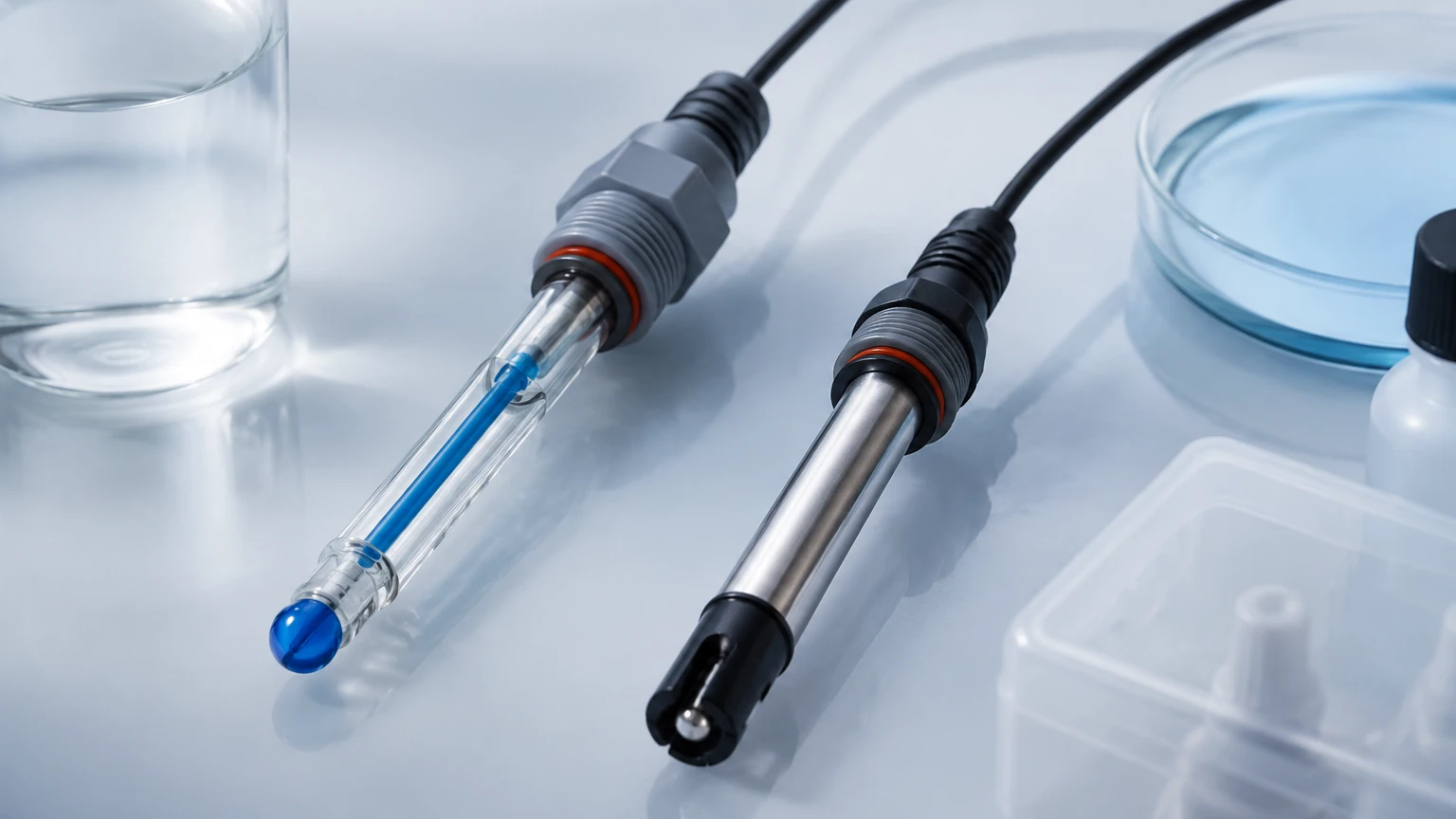
1. The Measuring Electrode: This electrode features a specialized pH-sensitive glass membrane. When immersed, a hydrated gel layer forms on the outer and inner surfaces of the glass. Hydrogen ions in the process liquid exchange with ions in the gel layer, creating a potential proportional to the pH of the liquid.
2. The Reference Electrode: The purpose of the reference electrode is to provide a stable, constant potential that is independent of the pH of the solution. It typically consists of a silver/silver chloride (Ag/AgCl) wire immersed in a potassium chloride (KCl) electrolyte.
3. The Junction: To complete the electrical circuit, the reference electrolyte must make contact with the process liquid through a porous junction (made of ceramic, Teflon, or wood).
The Nernst Equation
The relationship between the measured voltage and the pH value is defined by the Nernst Equation. At 25°C (298.15 K), a change of one pH unit corresponds to a change of 59.16 mV. Because this relationship is temperature-dependent, industrial sensors often incorporate a temperature element (like a PT100 or PT1000) to provide automatic temperature compensation (ATC).
Principles of ORP Measurement
ORP, also known as Redox (Reduction-Oxidation), measures the tendency of a chemical species to acquire electrons and thereby be reduced. Unlike pH, which is specific to hydrogen ions, ORP provides a general indication of the oxidizing or reducing power of the entire solution.
Measurement Mechanism
An ORP sensor is structurally similar to a pH sensor but replaces the pH-sensitive glass membrane with a noble metal electrode, usually platinum or gold.
* Oxidizing Environments: If the solution contains oxidizing agents (like chlorine, ozone, or hydrogen peroxide), they will tend to take electrons from the noble metal electrode, resulting in a positive millivolt (mV) reading.
* Reducing Environments: If the solution contains reducing agents (like sodium bisulfite), they will donate electrons to the electrode, resulting in a negative mV reading.
ORP is measured in millivolts (mV). It is widely used in disinfection processes, such as cooling tower water treatment and swimming pools, where a specific positive mV level ensures that enough oxidant is present to kill pathogens.
Technical Selection Criteria for Ph and Orp Sensors
Selecting the correct ph and orp sensor requires an evaluation of the process environment. Using a standard laboratory sensor in an industrial application often leads to premature failure.
Material Compatibility
The sensor body and the junction material must withstand the chemical nature of the process.
| Component | Common Materials | Application Note |
| :— | :— | :— |
| Sensor Body | PPS (Ryton), PVDF (Kynar), Glass | PPS is excellent for general chemical resistance; PVDF is preferred for high purity or highly aggressive media. |
| Junction | Ceramic, Porous Teflon, Wood | Teflon junctions resist fouling in oily or high-solids wastewater. Ceramic is standard for clean water. |
| ORP Sensing Element | Platinum, Gold | Platinum is the standard; Gold is used in strongly oxidizing environments where platinum might catalyze unwanted reactions. |
Pressure and Temperature Limits
Standard industrial sensors are typically rated for temperatures up to 80°C or 100°C and pressures up to 6 bar (approx. 87 psi). For high-pressure applications, specialized housings or retractable assemblies are required to prevent the process liquid from forcing its way into the reference electrode.
Electrolyte Type
* Liquid-filled: Requires a reservoir and provides a constant flow of electrolyte through the junction, which helps prevent clogging.
* Gel-filled: The most common for industrial use. The gel is pressurized or high-viscosity to slow down the depletion of the electrolyte, reducing maintenance frequency.
* Solid Polymer: Used in extremely harsh conditions where the electrolyte must not be poisoned by the process media.
Integration with Level Measurement Systems
In practical engineering, pH and ORP sensors are rarely used in isolation. They are typically part of a broader instrumentation suite. For instance, in a chemical neutralization tank, a ph and orp sensor provides the data needed for dosing pumps, while a radar or ultrasonic level meter ensures the tank does not overflow or run dry.
Welk’s range of industrial level measurement instruments, including radar level meters and hydrostatic transmitters, often work in tandem with analytical sensors. For example, in a wastewater sump, a hydrostatic level transmitter monitors the liquid height to trigger discharge pumps, while the pH sensor ensures the water meets regulatory standards before it is released. For more on how level measurement integrates into these systems, you can review product options and application support on the Main Page.
Ensuring that the pH/ORP sensor is always submerged is a critical function of the level control system. If the liquid level falls below the sensor's mounting point, the glass membrane can dry out, leading to permanent damage or the need for extensive rehydration.
Installation and Mounting Guidelines
The physical installation of a ph and orp sensor significantly impacts its lifespan and accuracy. There are three primary mounting styles:
1. Immersion Mounting: The sensor is mounted at the end of a pipe or rod and submerged directly into an open tank or basin. This is common in wastewater treatment.
2. In-line (Flow-through) Mounting: The sensor is installed directly into a process pipe using a T-fitting. This allows for real-time monitoring of flowing liquids.
3. Retractable Mounting: This utilizes a specialized housing (a "hot tap" assembly) that allows the sensor to be removed for cleaning or calibration without shutting down the process or draining the pipe.
Key Installation Considerations:
* Angle of Inclination: Sensors should never be installed horizontally or upside down. An angle of at least 15° above the horizontal is required to ensure the internal electrolyte stays in contact with the glass membrane and that air bubbles do not get trapped.
* Cable Management: pH and ORP signals are high-impedance and extremely sensitive to electromagnetic interference (EMI). Use shielded cables and keep them away from high-voltage power lines.
* Submergence: Ensure the sensor is placed in a location with representative flow, avoiding "dead zones" where the chemistry might not reflect the bulk of the liquid.
Common Risks and Limitations
Despite their robustness, industrial pH and ORP sensors are susceptible to several failure modes:
* Coating and Fouling: Fats, oils, and mineral scales can coat the glass membrane or clog the junction. This leads to slow response times and "sluggish" readings. Regular cleaning with dilute acids or specialized detergents is necessary.
* Poisoning: Certain ions (like cyanide, bromide, or sulfide) can react with the silver/silver chloride reference system, changing its potential and causing a massive offset in the reading.
* Glass Breakage: While industrial glass is toughened, it remains susceptible to mechanical shock or erosion from high-velocity abrasive slurries.
* Temperature Extremes: High temperatures accelerate the aging of the glass membrane. For every 10°C increase in temperature, the life expectancy of a pH sensor is roughly halved.
Maintenance and Calibration Protocols
To maintain accuracy, a ph and orp sensor requires periodic calibration. Unlike a level meter, which may stay calibrated for years, analytical sensors drift due to the chemical nature of their operation.
pH Calibration
This is typically a two-point calibration using buffer solutions (e.g., pH 4.01 and pH 7.00).
1. Clean the sensor thoroughly.
2. Place it in the first buffer (usually pH 7) and allow the reading to stabilize. This sets the "Zero" or "Offset."
3. Place it in the second buffer (pH 4 or 10). This sets the "Slope" or "Efficiency."
4. A slope below 85% usually indicates that the sensor needs replacement.
ORP Calibration
ORP sensors are checked using Quinhydrone or Zobell’s solutions. Unlike pH, ORP sensors are generally not "adjusted" in the transmitter; rather, the solution is used to verify that the sensor is reading within a specific range (e.g., ±20 mV of the theoretical value). If it is outside this range, the platinum tip likely needs cleaning or the reference electrolyte is depleted.
Industrial Applications
1. Wastewater Treatment
In municipal and industrial wastewater, pH is monitored to protect biological treatment processes (which usually require a pH between 6.5 and 8.5). ORP is used to monitor the denitrification process and to control the addition of chlorine for disinfection.
2. Chemical Manufacturing
Precise pH control is vital for chemical synthesis, where the yield of a reaction often depends on maintaining a specific acidity level. ORP sensors monitor redox reactions, such as the production of bleach or the treatment of chrome-heavy waste in electroplating.
3. Cooling Towers and Boilers
To prevent corrosion and scaling, the water chemistry in cooling loops must be strictly controlled. ORP sensors monitor the concentration of biocides to prevent algae growth, while pH sensors help manage the Langelier Saturation Index (LSI) to prevent pipe damage.
Frequently Asked Questions (FAQs)
Q: How long does a typical industrial pH sensor last?
A: In mild conditions (room temperature, clean water), a sensor may last 12 to 24 months. In harsh conditions (high temperature, extreme pH, or abrasive slurries), the lifespan may be reduced to 3 to 6 months.
Q: Can I use a pH sensor to measure ORP?
A: No. While the transmitters are often similar, the sensing elements are different. A pH sensor uses a hydrogen-ion-sensitive glass membrane, whereas an ORP sensor uses a noble metal (platinum/gold) to exchange electrons.
Q: Why is my pH reading drifting?
A: Drift is most commonly caused by a clogged junction or a depleted reference electrolyte. Cleaning the sensor and soaking it in a KCl storage solution can sometimes restore stability. If the drift persists, the sensor is likely at the end of its life.
Q: Does flow rate affect the sensor?
A: Yes. While the chemical concentration doesn't change with flow, extremely high flow rates can cause "streaming potentials" (static-like interference) or accelerate the depletion of the reference electrolyte. Conversely, zero flow can lead to stagnant readings that do not represent the process.
Conclusion
The ph and orp sensor is a vital tool for modern industrial automation, providing the chemical insights necessary for safety, compliance, and process efficiency. By selecting the appropriate materials, ensuring proper installation relative to liquid levels, and adhering to a rigorous maintenance schedule, operators can achieve reliable measurements even in the most demanding environments. For engineers seeking to integrate these analytical measurements with robust level control solutions, exploring the technical resources available on the Main Page is a recommended next step in system design.