Micro Motion Coriolis Flow Meter
Micro Motion Coriolis Flow Meter
In the landscape of industrial process control, precision is the primary driver of efficiency and safety. Among the various technologies available for fluid measurement, the micro motion coriolis flow meter stands out as a premier solution for direct mass flow measurement. Unlike volumetric meters that require compensation for temperature and pressure, Coriolis meters utilize the physical properties of inertia to provide highly accurate data across a wide range of fluid types. This guide provides an engineering-focused overview of the principles, selection criteria, and installation requirements for these instruments, intended for process engineers and technical procurement specialists.
Understanding the Coriolis Measurement Principle
The fundamental operation of a micro motion coriolis flow meter is based on the Coriolis effect—an inertial force described by Gustave-Gaspard Coriolis in the 19th century. In an industrial meter, this principle is applied through the controlled vibration of flow tubes.
The Mechanics of Vibration
When the meter is powered, an electromagnetic drive coil causes the measuring tubes to vibrate at their natural resonant frequency. These tubes typically oscillate in an upward and downward motion, similar to a tuning fork. When there is no fluid flow, the tubes vibrate in a uniform, symmetrical manner. Sensors (pick-offs) located at the inlet and outlet sides of the tubes detect this motion as a standard sine wave.
The Coriolis Force and Phase Shift
As fluid enters the meter and moves through the vibrating tubes, it is forced to take on the vertical velocity of the tubes. On the inlet side, the fluid resists being pushed upward, exerting a downward force on the tube. On the outlet side, the fluid resists the decreasing vertical motion as it leaves the vibration cycle, exerting an upward force.
This opposing force causes the tubes to twist slightly. This twisting motion results in a time delay, or "phase shift," between the sine waves detected by the inlet and outlet pick-off sensors. This time delay ($Δt$) is directly proportional to the mass flow rate of the fluid. Because the measurement is based on mass and inertia rather than volume, it remains unaffected by changes in fluid viscosity, density, or flow profile.
Simultaneous Density and Temperature Measurement
In addition to mass flow, the micro motion coriolis flow meter acts as a high-precision densitometer. The resonant frequency at which the tubes vibrate depends on the total mass of the tubes and the fluid inside them. Since the volume of the tubes is fixed, a change in fluid density alters the vibration frequency. By measuring this frequency, the meter calculates the fluid density in real-time. Furthermore, an internal Resistance Temperature Detector (RTD) monitors the tube temperature to compensate for changes in tube elasticity, providing an additional process variable for the user.
Key Technical Advantages of Mass Flow Measurement
Choosing a Coriolis-based system over traditional volumetric technologies (such as vortex or turbine meters) offers several distinct advantages in B2B industrial applications:
1. Direct Mass Measurement: Eliminates the need for external pressure and temperature transmitters to calculate mass, reducing the total cost of the measurement loop and minimizing potential points of failure.
2. High Accuracy and Turndown: Most high-end Coriolis meters offer mass flow accuracy of ±0.1% or even ±0.05%. They also maintain this accuracy over a wide turndown ratio (often 100:1), making them suitable for processes with varying flow rates.
3. Multivariable Data: A single instrument provides mass flow, volume flow, density, and temperature, simplifying the instrumentation architecture.
4. Low Maintenance: With no moving parts in the fluid stream (unlike turbine meters), there is no mechanical wear. This leads to longer service intervals and lower lifecycle costs.
Selection Criteria for Micro Motion Coriolis Flow Meters
Selecting the correct meter requires a thorough understanding of the process fluid and the environmental conditions. Engineers should evaluate the following criteria before procurement:
Material Compatibility
The wetted parts of the meter must be compatible with the process fluid to prevent corrosion or erosion. Common materials include 316L Stainless Steel for general purpose applications, and Nickel alloys (such as Hastelloy C22) for highly corrosive chemicals. For high-pressure applications, specialized thick-walled tubing may be required.
Flow Range and Pressure Drop
While Coriolis meters are highly accurate, they can introduce a significant pressure drop ($ΔP$) if the meter size is too small for the flow rate. Conversely, an oversized meter may operate at the lower end of its range, where the signal-to-noise ratio is less favorable. It is standard practice to select a meter size where the maximum flow rate results in a pressure drop of less than 0.7 bar (10 psi) for liquids.
Practical Selection Table
| Application Type | Typical Line Size | Flow Range (kg/h) | Accuracy (Liquid) | Common Material |
| :— | :— | :— | :— | :— |
| Chemical Dosing | 3 mm – 15 mm | 10 – 2,000 | ±0.10% | 316L SS / Hastelloy |
| General Process | 25 mm – 80 mm | 500 – 150,000 | ±0.10% | 316L Stainless Steel |
| Bulk Loading | 100 mm – 250 mm | 5,000 – 1,500,000 | ±0.05% | 316L Stainless Steel |
| High Pressure Gas | 15 mm – 50 mm | Variable (Gas) | ±0.25% | 316L / Super Duplex |
Installation Guidelines and Best Practices
Proper installation is critical to achieving the specified accuracy of a micro motion coriolis flow meter. Because the meter relies on delicate vibrations, external factors can interfere with the signal.
Orientation and Mounting
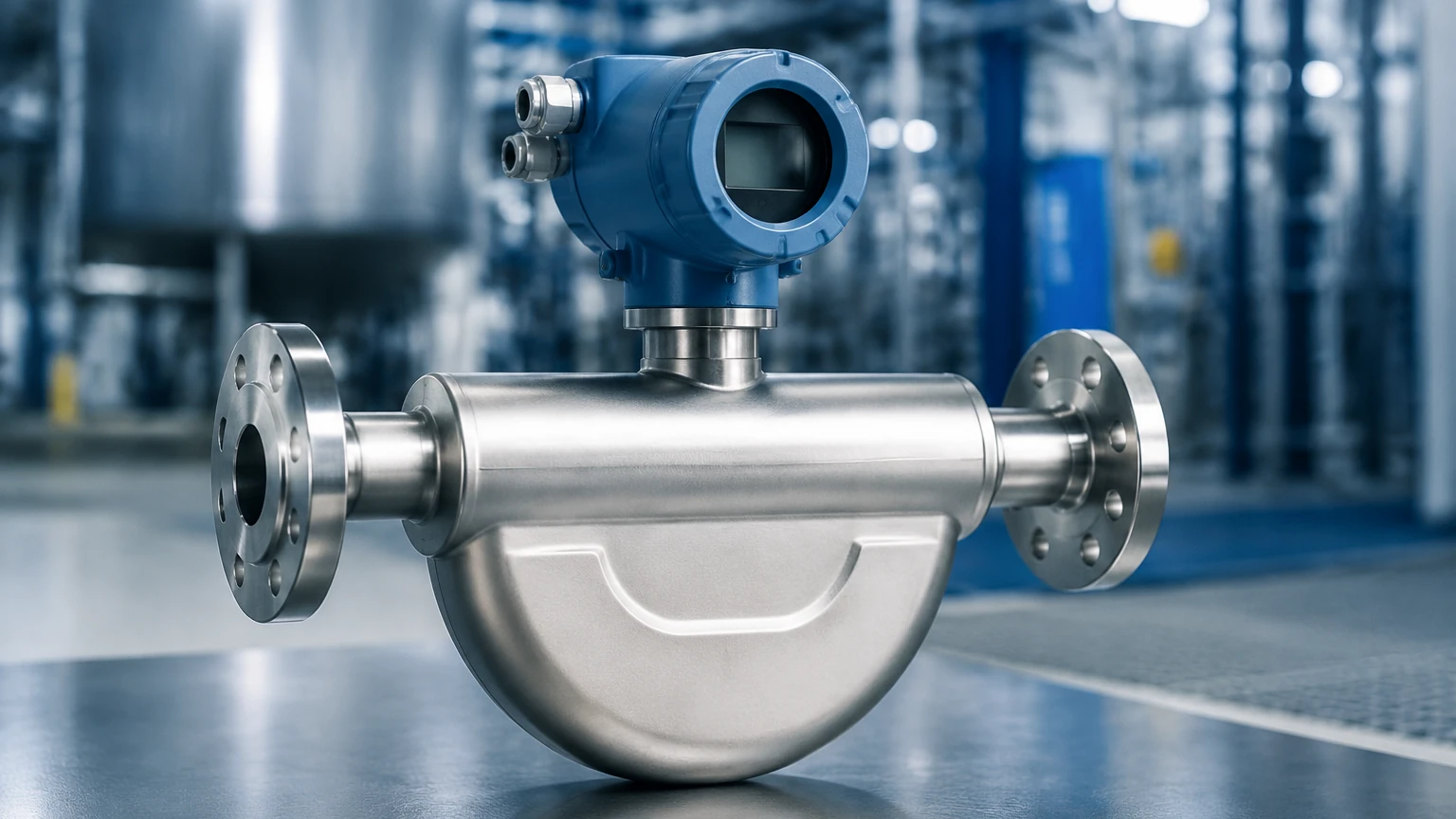
* Liquid Service: For liquids, the meter should ideally be installed with the tubes pointing downward (the "U" shape facing down) in horizontal lines. This ensures the tubes remain full and prevents gas bubbles from being trapped, which can cause measurement errors.
* Gas Service: For gas applications, the tubes should point upward to allow any condensate to drain out of the tubes.
* Slurry Service: For fluids containing solids, vertical installation with upward flow is preferred to prevent solids from settling in the tubes.
Mechanical Support and Vibration
The meter must be securely supported. It is a common misconception that the meter should be "floated" on flexible couplings. In reality, the piping on both sides of the meter should be rigidly anchored to a stable structure. This prevents external pipeline vibrations from being interpreted by the pick-off sensors as flow signals.
Avoiding Aeration and Cavitation
Entrained gas (slug flow) is the most common cause of measurement instability in Coriolis meters. The presence of gas bubbles dampens the tube vibration, leading to "drive gain" issues where the transmitter struggles to maintain the oscillation. To prevent this, maintain sufficient backpressure on the meter to keep gases in solution. The minimum backpressure should be at least 2 times the pressure drop across the meter plus 1.25 times the vapor pressure of the liquid.
Limitations and Operational Risks
Despite their versatility, micro motion coriolis flow meters are not a universal solution for every application. Engineers must be aware of the following limitations:
* Initial Capital Cost: Coriolis meters are significantly more expensive than magnetic, vortex, or ultrasonic flow meters. The ROI must be justified by the need for high accuracy or direct mass measurement.
* Sensitivity to Two-Phase Flow: While modern digital signal processing (DSP) has improved performance in aerated liquids, extreme two-phase flow (high gas void fraction) can still cause the meter to fault or provide inaccurate readings.
* Size and Weight: Large-bore Coriolis meters (above 200 mm or 8 inches) are extremely heavy and bulky, requiring significant structural support and specialized lifting equipment for installation.
* Pressure Limits: Because the vibrating tubes must be thin enough to oscillate, they have lower pressure ratings than heavy-wall piping. High-pressure versions are available but come with a higher pressure drop and cost.
Complementary Technologies: Flow and Level Integration
In many industrial settings, flow measurement is only one part of the process control puzzle. For example, in tank farm management, a micro motion coriolis flow meter may measure the mass of product being pumped into a vessel, while a radar or ultrasonic level transmitter monitors the total inventory.
Integrating these technologies allows for cross-verification of data. If the flow meter indicates that 1,000 kg of fluid has been added, but the level sensor shows an unexpected change in volume, it may indicate a leak, a change in fluid density, or a calibration issue in one of the instruments. For comprehensive process monitoring solutions, including advanced level measurement, engineers often consult the Main Page of specialized manufacturers like Welk to find compatible hardware for their automation stacks.
Frequently Asked Questions (FAQ)
Q: Does a Coriolis meter require straight pipe runs?
A: Generally, no. Unlike orifice plates or turbine meters, Coriolis meters are largely unaffected by flow profile disturbances like elbows or valves. However, it is still good practice to avoid placing valves directly at the inlet to prevent cavitation.
Q: Can a Coriolis meter measure steam?
A: While theoretically possible, it is rarely practical. The high velocities and low densities of steam lead to extremely high pressure drops and potential damage to the vibrating tubes. Vortex meters are usually a better choice for steam applications.
Q: How often should the meter be calibrated?
A: Most manufacturers recommend an annual check. However, many modern meters feature "Smart Meter Verification" (SMV), an on-board diagnostic tool that checks the structural integrity of the tubes and the health of the electronics without removing the meter from the process line.
Q: What is the effect of viscosity on measurement?
A: The Coriolis principle is independent of viscosity. Whether measuring water or heavy crude oil, the mass flow measurement remains accurate, though higher viscosity fluids will result in a higher pressure drop.
Conclusion
The micro motion coriolis flow meter remains the gold standard for high-accuracy mass flow and density measurement in the B2B sector. By understanding the underlying physics of the Coriolis effect and adhering to strict installation protocols regarding vibration and fluid state, process engineers can achieve unparalleled control over their production environments. While the initial investment is higher than alternative technologies, the reduction in maintenance and the elimination of secondary compensation instruments often result in a lower total cost of ownership over the life of the plant.