Ultrasonic Liquid Level Detector
Ultrasonic Liquid Level Detector
In the landscape of industrial process control, the ultrasonic liquid level detector has established itself as a cornerstone technology for non-contact measurement. By utilizing high-frequency sound waves to determine the distance to a liquid surface, these instruments provide a reliable, maintenance-free solution for a vast array of applications, from municipal water treatment to complex chemical processing. This guide examines the fundamental principles, selection criteria, and engineering considerations essential for integrating ultrasonic sensors into modern industrial systems.
Measurement Principles of Ultrasonic Technology
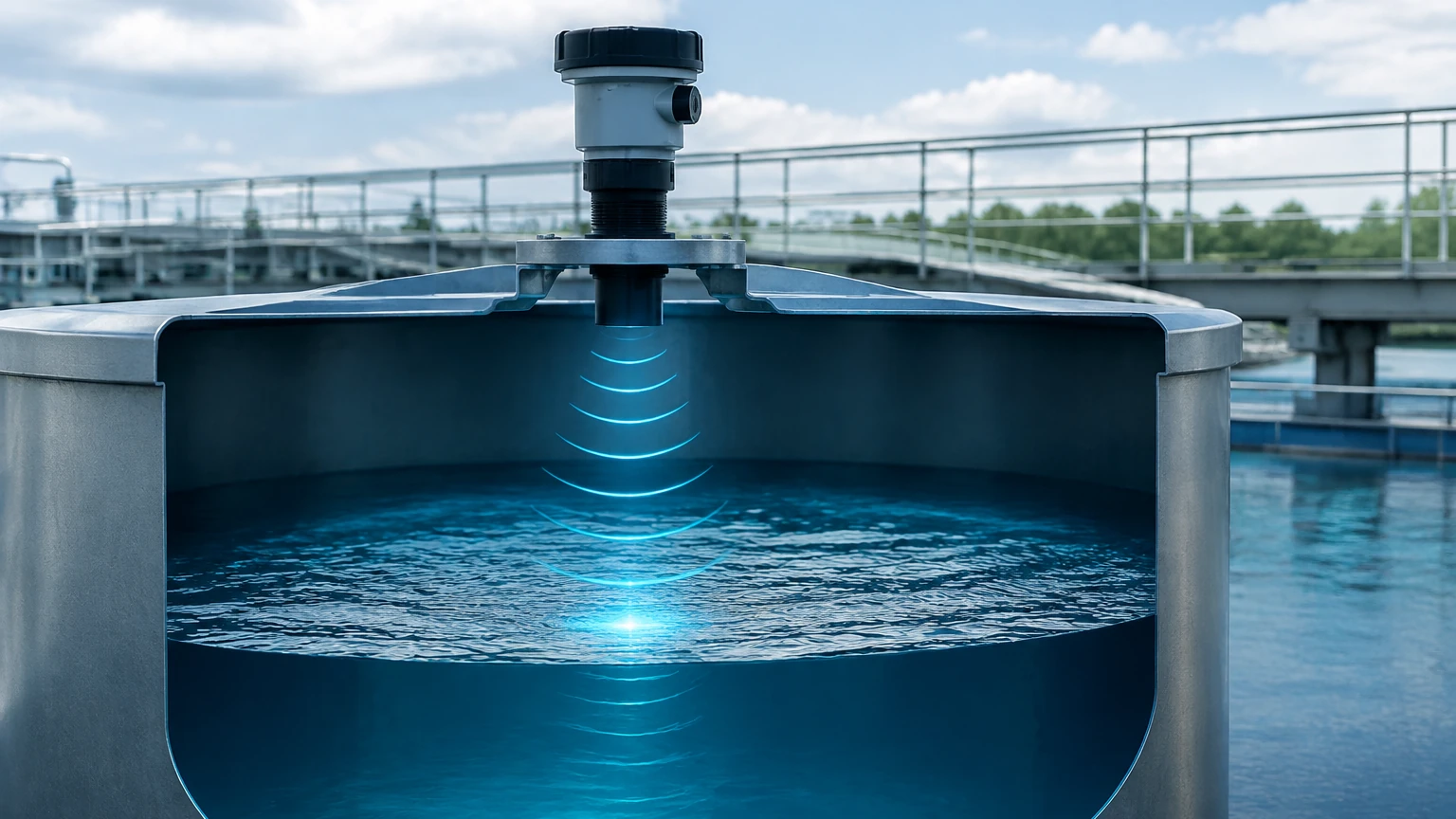
The operation of an ultrasonic liquid level detector is based on the "Time-of-Flight" (ToF) principle. The instrument’s transducer, typically containing a piezoelectric crystal, emits a series of ultrasonic pulses—sound waves at frequencies generally ranging from 20 kHz to 200 kHz, well above the range of human hearing.
The Time-of-Flight Calculation
These sound waves travel through the air or vapor space above the liquid, strike the surface of the medium, and reflect back to the transducer. The electronics within the detector measure the precise interval between the emission of the pulse and the reception of the echo. The distance ($D$) from the sensor to the liquid surface is calculated using the formula:
$$D = \frac{c \times t}{2}$$
Where:
* $c$ is the speed of sound in the medium (typically air).
* $t$ is the measured transit time for the pulse to travel to the surface and back.
Because the total distance traveled is twice the distance to the liquid, the result is divided by two. Once the distance to the liquid is known, the device subtracts this value from the total tank height (the "zero point") to determine the actual liquid level or volume.
Temperature Compensation
The speed of sound in air is not constant; it varies significantly with temperature. For instance, at 0°C, the speed of sound is approximately 331.5 m/s, while at 40°C, it increases to approximately 355 m/s. To maintain accuracy, a high-quality ultrasonic liquid level detector incorporates an integrated temperature sensor. This allows the internal microprocessor to adjust the calculation in real-time, compensating for atmospheric temperature fluctuations within the tank headspace.
Key Evaluation Criteria for Selection
Choosing the correct ultrasonic liquid level detector requires a thorough analysis of the application environment. Engineers must look beyond simple range requirements to ensure long-term reliability.
1. Measurement Range and Dead Zone
Every ultrasonic sensor has a maximum range (often up to 15 or 30 meters) and a minimum distance requirement known as the "dead zone" or "blocking distance." The dead zone is the area immediately in front of the transducer face where the crystal is still vibrating from the initial pulse and cannot yet "listen" for a returning echo. Typical dead zones range from 0.25m to 0.6m depending on the frequency. If the liquid level enters this zone, the sensor will provide erratic or false readings.
2. Beam Angle and Tank Geometry
The ultrasonic pulse spreads out in a conical shape as it travels. The "beam angle" (usually between 5° and 12°) determines the footprint of the signal at the maximum depth. If the beam is too wide, it may reflect off tank walls, ladders, or internal agitators, creating "false echoes." Selecting a sensor with a narrower beam angle is often necessary for tall, narrow silos or tanks with internal obstructions.
3. Output and Communication Protocols
For integration into a PLC or SCADA system, the detector must support standard industrial outputs. Common options include:
* 4-20 mA Analog: The industry standard for continuous level monitoring.
* HART Protocol: Allows for digital communication over the analog loop for diagnostics and remote configuration.
* Modbus RTU/RS485: Ideal for multi-drop networks where multiple sensors are connected to a single controller.
* Relay Outputs: Used for high/low-level alarms and pump control.
4. Material Compatibility
The housing and transducer face must be compatible with the vapors present in the tank. While PVDF (Polyvinylidene fluoride) or PTFE (Polytetrafluoroethylene) are common for corrosive chemical applications, standard ABS or PP may suffice for water storage.
Practical Selection Table
| Feature | Standard Water Application | Chemical Storage (Corrosive) | Deep Well/Large Reservoir |
| :— | :— | :— | :— |
| Measuring Range | 0.4m – 10m | 0.25m – 5m | 0.6m – 30m |
| Transducer Material | ABS / PVC | PVDF / PTFE | Reinforced Polymer |
| Accuracy | ±0.25% of range | ±0.2% of range | ±0.5% of range |
| Output Type | 4-20mA | 4-20mA + HART | Modbus RS485 |
| Ingress Protection | IP65 / IP66 | IP67 / IP68 | IP68 |
Installation Considerations and Best Practices
Correct installation is the most critical factor in the performance of an ultrasonic liquid level detector. Even the most advanced sensor will fail if positioned incorrectly.
Mounting Position
* Avoid the Center: In cylindrical tanks with domed tops, mounting the sensor in the exact center can create a parabolic effect that amplifies unwanted echoes. It is generally recommended to mount the sensor at 1/2 or 1/3 of the tank radius from the wall.
* Perpendicularity: The transducer face must be perfectly parallel to the liquid surface. A tilt of even a few degrees can cause the signal to bounce away from the sensor rather than back to it, resulting in a "loss of echo" error.
* Inflow Avoidance: Never mount the sensor directly above the fill pipe. The turbulence and falling liquid will scatter the ultrasonic signal and cause significant measurement noise.
Obstruction Management
If internal structures like pipes or ladders cannot be moved, many modern detectors offer "False Echo Suppression" or "Echo Mapping." This software feature allows the user to record the echoes from fixed obstructions when the tank is empty. The sensor then ignores these specific signals during normal operation, focusing only on the moving liquid level.
Environmental Factors
In outdoor installations, sun shields should be used to prevent the sensor housing from overheating, which can skew the internal temperature compensation. Furthermore, in areas prone to heavy condensation, selecting a sensor with a self-cleaning transducer face or a specialized coating can prevent water droplets from attenuating the signal.
Limitations and Forbidden Applications
While highly versatile, ultrasonic technology is not a universal solution. Engineers should avoid using an ultrasonic liquid level detector in the following scenarios:
1. Vacuum Conditions: Sound waves require a medium (air or gas) to travel. In a vacuum, the signal cannot propagate.
2. High Pressure: High-pressure environments significantly alter the density of the air, which changes the speed of sound beyond the capabilities of standard temperature compensation.
3. Heavy Foam: Thick, dense foam acts as an acoustic absorber. Instead of reflecting the signal, the foam absorbs it, leading to signal loss. For foaming liquids, a Main Page review of radar or hydrostatic technologies is recommended.
4. Extreme Dust or Steam: While light dust is manageable, extremely heavy dust (in solids applications) or dense steam can attenuate the signal. In these cases, high-frequency radar is often a more robust choice.
Frequently Asked Questions (FAQs)
Q: Can ultrasonic sensors measure the level of solids?
A: Yes, but with caveats. Solids like grain or plastic pellets do not have a flat surface; they form a conical pile. This scatters the signal, effectively reducing the measurable range by 50% or more. Specialized high-power transducers are usually required for solids.
Q: How does wind affect the measurement?
A: In outdoor open-channel flow or reservoir applications, strong winds can "blow" the ultrasonic pulse away or create surface ripples. Using a stilling well (a vertical pipe that stabilizes the liquid surface) can mitigate these effects.
Q: What is the lifespan of an ultrasonic transducer?
A: Since there are no moving parts and the sensor does not contact the liquid, these devices are exceptionally long-lived. In a well-specified environment, a lifespan of 7 to 10 years is common.
Q: Is calibration required frequently?
A: Generally, no. Once the "Empty" and "Full" points are set during commissioning, the sensor remains stable. Recalibration is typically only necessary if the composition of the gas in the tank headspace changes significantly (e.g., switching from air to a heavy CO2 blanket).
Conclusion
The ultrasonic liquid level detector remains a premier choice for industrial level monitoring due to its balance of accuracy, ease of installation, and cost-effectiveness. By understanding the acoustic principles and environmental limitations discussed above, facility managers and systems integrators can ensure precise data collection for their automation needs. For those seeking to compare these sensors with other technologies such as radar or magnetic gauges, you may Review product options and application support to find the optimal fit for your specific process requirements.