Def Fluid Level Sensor
Def Fluid Level Sensor
Diesel Exhaust Fluid (DEF) is a critical component in modern Selective Catalytic Reduction (SCR) systems used to reduce nitrogen oxide (NOx) emissions in diesel engines. As global emissions standards become increasingly stringent, the demand for precise and reliable DEF storage and monitoring has grown. A def fluid level sensor is not merely a convenience; it is a functional necessity to ensure environmental compliance and prevent engine derating or shutdown.
DEF is a specific solution consisting of 32.5% high-purity urea and 67.5% deionized water. Because of its chemical composition, it presents unique challenges for level measurement, including a tendency to crystallize, a relatively high freezing point (-11°C / 12°F), and corrosivity toward certain metals like carbon steel, copper, and brass. This article explores the engineering principles, selection criteria, and installation best practices for monitoring DEF levels in industrial and mobile applications.
Measurement Principles for DEF Level Sensing
Before selecting a sensor, it is essential to understand the physics behind the most common measurement technologies used for DEF. Each principle offers distinct advantages depending on the tank geometry and environmental conditions.
1. Ultrasonic Level Measurement (Non-Contact)
Ultrasonic sensors operate on the Time-of-Flight (ToF) principle. The sensor emits a high-frequency sound pulse that travels through the air, reflects off the surface of the DEF, and returns to the transducer. The distance is calculated based on the time interval and the speed of sound.
* Advantages: Since the sensor does not touch the fluid, it is immune to the corrosive effects of urea. It is also easy to install on the top of plastic or stainless steel tanks.
* Considerations: The speed of sound changes with air temperature. High-quality ultrasonic sensors include integrated temperature compensation to maintain accuracy. However, heavy vapor or extreme crystallization on the transducer face can interfere with the signal.
2. Hydrostatic Pressure Measurement
Hydrostatic sensors measure the pressure exerted by the liquid column at the bottom of the tank. The pressure is directly proportional to the liquid height according to the formula: $P = \rho \cdot g \cdot h$ (where $P$ is pressure, $\rho$ is fluid density, $g$ is gravity, and $h$ is height).
* Advantages: Highly reliable for tall, vented storage tanks. It provides a continuous linear output.
* Considerations: DEF density changes slightly with temperature. Furthermore, the sensor diaphragm must be constructed from compatible materials like 316L stainless steel or specialized fluoropolymers to prevent corrosion.
3. Radar Level Measurement (FMCW or Pulse)
Radar sensors use high-frequency electromagnetic waves. Like ultrasonic sensors, they use ToF, but because they use radio waves instead of sound, they are unaffected by air temperature, vacuum, or high pressure.
* Advantages: Extremely high precision (often within ±2 mm). Radar can penetrate plastic tank lids, allowing for measurement without even opening the tank.
* Considerations: Higher initial cost compared to ultrasonic or hydrostatic methods, though prices have decreased significantly for industrial applications.
4. Magnetic Float and Reed Switch
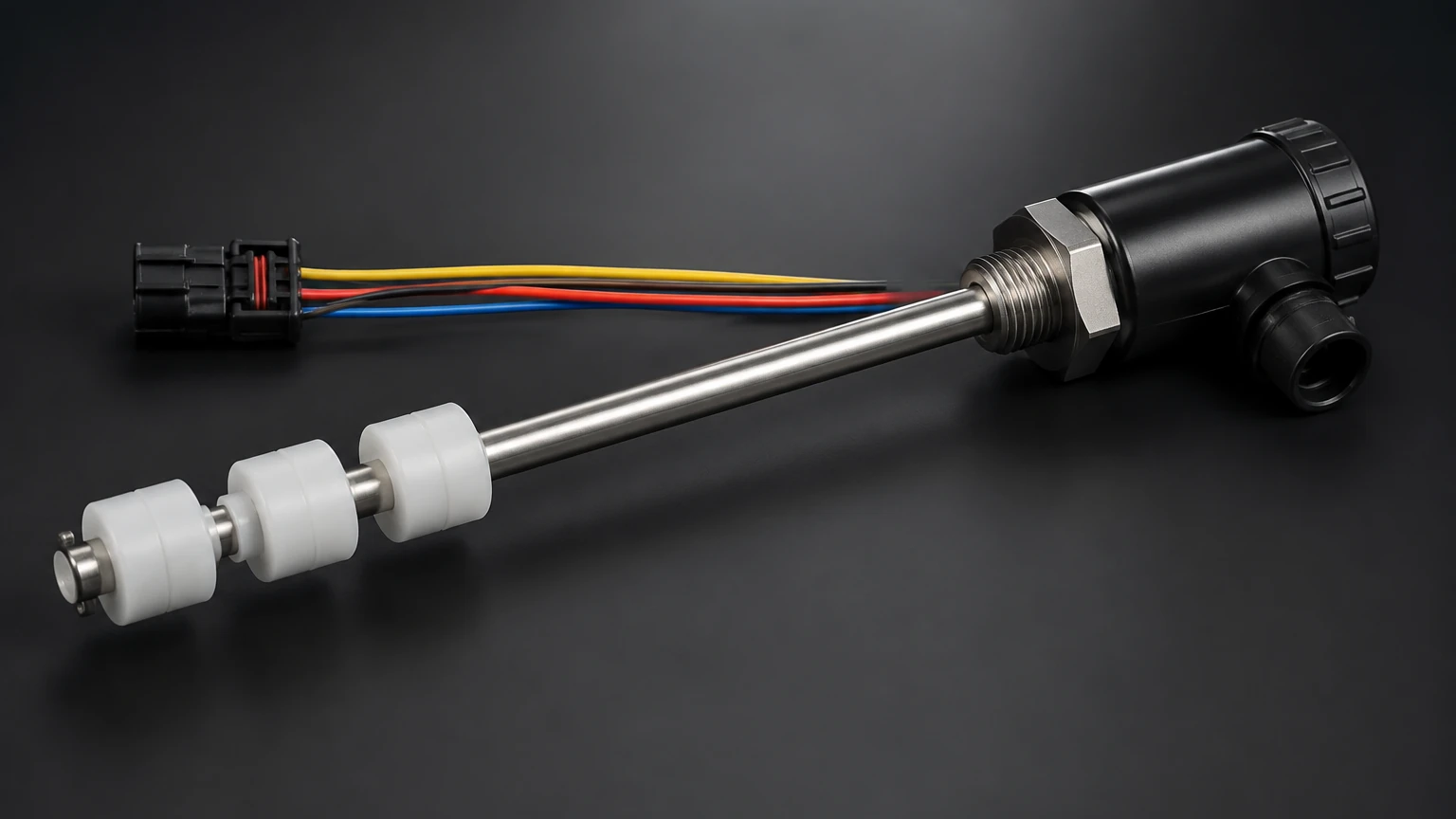
This is a point-level or continuous-level mechanical solution. A float containing a magnet moves up and down a stem. As it passes internal reed switches, it changes the electrical resistance or closes a circuit.
* Advantages: Simple, robust, and requires minimal electronic processing. Often used for basic "low level" or "high level" alarms.
* Considerations: Moving parts are susceptible to jamming if urea crystals build up on the stem.
Selection Criteria for DEF Fluid Level Sensors
Choosing the right def fluid level sensor requires a balance between accuracy requirements, budget, and the specific physical environment of the tank. The following table provides a comparison of these technologies for industrial DEF applications.
Technology Comparison Table
| Feature | Ultrasonic | Hydrostatic | Radar (80GHz) | Magnetic Float |
| :— | :— | :— | :— | :— |
| Contact Type | Non-contact | Contact (Submerged) | Non-contact | Contact |
| Accuracy | ±0.25% of range | ±0.5% of span | ±2 mm | ±5–10 mm |
| Corrosion Resistance | Excellent (if housed) | High (316L/PTFE) | Excellent | Moderate (316L) |
| Crystallization Risk | Low | Medium | Very Low | High |
| Typical Range | 0.1 m to 10 m | 1 m to 20 m | 0.1 m to 30 m | 0.1 m to 4 m |
| Relative Cost | Moderate | Moderate | High | Low |
| Best Use Case | Standard vented tanks | Deep bulk storage | High-precision/Vapor | Basic level alarms |
Material Compatibility and Chemical Resistance
DEF is highly sensitive to contamination. Even trace amounts of metal ions (like chrome, copper, or iron) can poison the SCR catalyst. Therefore, any sensor that comes into contact with the fluid must be made of approved materials.
* Approved Materials: 316L Stainless Steel, PTFE (Teflon), PVDF, PP (Polypropylene), and EPDM gaskets.
* Forbidden Materials: Carbon steel, zinc-coated (galvanized) steel, copper, and brass. These will corrode and contaminate the DEF, leading to expensive SCR system failures.
When reviewing options on a Main Page for level instrumentation, always verify that the wetted parts are certified for ISO 22241 compliance, which governs DEF handling and quality.
Installation Considerations and Best Practices
Proper installation is as important as sensor selection. For a def fluid level sensor to provide accurate data over its lifespan, engineers should adhere to the following guidelines:
1. Avoiding the "Dead Zone"
Ultrasonic and radar sensors have a "dead zone" (or blocking distance) directly beneath the transducer where measurements cannot be taken. Ensure the sensor is mounted high enough so that the maximum liquid level never enters this zone. For example, if a sensor has a 100 mm dead zone, the tank should only be filled to 100 mm below the sensor face.
2. Turbulence and Foam
If the DEF tank is filled from the top at high flow rates, splashing and foam can occur. Foam can absorb ultrasonic signals, leading to "lost echo" errors. In these cases, a stilling well (a vertical pipe that stabilizes the liquid surface) should be used, or a radar sensor should be selected for its superior signal processing.
3. Tank Geometry and Obstructions
Internal tank features such as ladders, heating coils, or agitators can cause false reflections for ultrasonic and radar sensors. Sensors should be mounted away from the tank walls (typically at 1/4 of the tank diameter) and clear of any internal obstructions. Modern digital sensors often include "false echo suppression" software to ignore these fixed objects.
4. Temperature Management
Since DEF freezes at -11°C, many industrial tanks are equipped with heaters. Sensors must be rated for the maximum temperature the heaters might reach. Conversely, in cold climates, the sensor must be able to withstand freezing cycles without damage to the diaphragm or electronics.
Limitations and Common Risks
While modern sensors are highly advanced, certain environmental factors can still pose risks to measurement accuracy:
* Urea Crystallization: When DEF evaporates, it leaves behind white urea crystals. If these form on an ultrasonic transducer or a magnetic float stem, the sensor may fail. Periodic inspection and cleaning with deionized water are recommended.
* Condensation: In humid environments, water droplets can form on the sensor face. While radar can typically see through condensation, ultrasonic signals may be attenuated. Using a sensor with a convex (curved) face can help droplets run off.
* Electrical Interference: Industrial environments are often full of electromagnetic interference (EMI) from pumps and motors. Using shielded cables and ensuring proper grounding is vital for maintaining a stable 4-20mA or Modbus signal.
Frequently Asked Questions (FAQ)
Q: Can I use a standard water level sensor for DEF?
A: Only if the materials are compatible. Many water sensors use brass or low-grade stainless steel, which will corrode in DEF. Always check the material specifications for 316L stainless steel or compatible plastics.
Q: How does the concentration of DEF affect the sensor?
A: For hydrostatic sensors, a change in urea concentration changes the density, which affects the pressure reading. However, since DEF is standardized at 32.5%, the density is relatively stable at approximately 1087 kg/m³ to 1093 kg/m³ at 20°C. For ultrasonic and radar, concentration changes have negligible effects.
Q: What is the best output signal for a DEF sensor?
A: For simple integration with PLCs, a 4-20mA analog signal is standard. For more complex systems or long-distance transmission, digital protocols like RS485 (Modbus RTU) or HART are preferred as they provide diagnostic data (e.g., sensor temperature, signal strength).
Q: Does the sensor need to be recalibrated?
A: Non-contact sensors like radar and ultrasonic generally do not require recalibration after the initial setup unless the tank geometry changes. Hydrostatic sensors may require an annual zero-point check to account for any sensor drift.
Conclusion
Selecting the appropriate def fluid level sensor is a critical decision for any facility managing SCR-equipped machinery or bulk DEF storage. By understanding the measurement principles—ranging from non-contact ultrasonic and radar to contact-based hydrostatic and magnetic systems—engineers can choose a solution that balances accuracy with long-term reliability.
Priority must always be given to material compatibility to prevent urea contamination and subsequent engine damage. For those looking to implement a robust monitoring system, consulting a professional manufacturer ensures that the specific nuances of the application, such as tank height, temperature fluctuations, and connectivity requirements, are fully addressed. For more technical specifications and product comparisons, visiting an engineering resource or a Main Page dedicated to industrial level measurement can provide the necessary data for a successful installation.