Def Sensors
Def Sensors
In the landscape of modern industrial emissions control and heavy-duty transport, Diesel Exhaust Fluid (DEF) sensors have become indispensable components. As environmental regulations like Euro VI and EPA Tier 4 Final mandate significant reductions in nitrogen oxide (NOx) emissions, Selective Catalytic Reduction (SCR) systems rely heavily on the precise monitoring of DEF. A DEF sensor is not a single-purpose device; it is a multi-functional instrument designed to measure fluid level, temperature, and often the chemical concentration of the urea solution.
For engineers and procurement professionals, selecting the right DEF sensor requires a deep understanding of fluid dynamics, material science, and electronic integration. This guide provides a technical overview of the technologies used in DEF monitoring, selection criteria for industrial applications, and practical installation guidance.
The Critical Function of DEF Sensors in Modern Emissions Control
Diesel Exhaust Fluid, commonly known as AdBlue in Europe, is a non-hazardous solution consisting of 32.5% high-purity urea and 67.5% deionized water. When injected into the exhaust stream, it reacts with NOx in the presence of a catalyst to form harmless nitrogen and water vapor.
The DEF sensor serves as the "eyes" of the SCR system. If the DEF tank runs dry, or if the fluid quality is compromised (e.g., diluted with water or contaminated with diesel), the engine's Electronic Control Unit (ECU) will typically trigger a "limp mode," significantly reducing engine power to ensure emissions compliance. Therefore, the reliability of the level and quality sensor is directly tied to the operational uptime of the machinery.
In industrial bulk storage and dispensing systems, DEF sensors ensure that inventory is maintained and that the fluid remains within the required temperature range, as urea begins to crystallize at temperatures below -11°C (12°F).
Comparative Analysis of Measurement Principles
Choosing the appropriate measurement technology depends on the tank geometry, the required accuracy, and the specific environment (stationary vs. mobile). Below are the primary principles employed in modern DEF sensors.
1. Ultrasonic Level Measurement
Ultrasonic sensors are a preferred choice for many DEF applications because they offer non-contact measurement. The sensor emits a high-frequency sound pulse that travels through the air, reflects off the surface of the DEF, and returns to the transducer.
* Principle: Distance is calculated using the formula $D = (v \cdot t) / 2$, where $v$ is the speed of sound and $t$ is the time of flight.
* Advantages: No moving parts to clog or corrode; highly accurate in stable environments.
* Limitations: The speed of sound varies with air temperature and vapors. High-quality ultrasonic sensors for DEF must include integrated temperature compensation to maintain accuracy.
2. Hydrostatic Pressure Sensing
Hydrostatic sensors measure the pressure exerted by the liquid column at the bottom of the tank. This is a common method for large-scale industrial DEF storage tanks.
* Principle: $P = \rho \cdot g \cdot h$, where $P$ is pressure, $\rho$ is the density of DEF (approximately 1,090 kg/m³), $g$ is gravity, and $h$ is the height of the fluid.
* Advantages: Simple to install in deep tanks; provides a direct correlation to the mass of the fluid.
* Limitations: Changes in fluid density (due to temperature or concentration shifts) can introduce small errors if not compensated.
3. Radar (FMCW) Technology
For large-scale industrial applications, 80GHz Frequency Modulated Continuous Wave (FMCW) radar is increasingly common. Radar sensors emit electromagnetic waves that are unaffected by temperature fluctuations or vapors in the tank headspace.
* Principle: The sensor continuously changes the frequency of the signal. The difference between the emitted and received frequency is proportional to the distance.
* Advantages: Extremely high precision (often within ±2mm); works regardless of the dielectric constant of the fluid.
* Limitations: Higher initial cost compared to ultrasonic or reed-switch sensors.
4. Reed Switch and Magnetic Floats
Often found in smaller, mobile DEF tanks, these sensors use a series of reed switches encased in a stainless steel or plastic tube. A magnetic float moves up and down the tube with the fluid level.
* Principle: As the float passes a reed switch, it closes the circuit, indicating a specific level step.
* Advantages: Low cost and simple electrical interface.
* Limitations: Mechanical moving parts are susceptible to wear and can be jammed by urea crystallization if the tank is not properly maintained.
Technical Selection Table for DEF Applications
When evaluating DEF sensors for a project, use the following table to align technology with application requirements.
| Feature | Ultrasonic | Hydrostatic | Radar (80GHz) | Reed Switch |
| :— | :— | :— | :— | :— |
| Measurement Type | Non-contact | Contact (Submerged) | Non-contact | Contact (Float) |
| Typical Accuracy | ±0.25% of range | ±0.5% of span | ±2 mm | Discrete steps |
| Max Tank Height | Up to 10 meters | Up to 100 meters | Up to 30 meters | Limited by rod length |
| Corrosion Resistance | Excellent (Plastic) | Good (Stainless) | Excellent (PTFE/PVDF) | Moderate |
| Maintenance | Low | Medium | Very Low | High (moving parts) |
| Best Use Case | Process tanks | Bulk storage | High-precision industrial | Small mobile tanks |
Engineering Challenges: Corrosion, Crystallization, and Temperature
DEF is a chemically unique fluid that presents several engineering challenges that standard water or fuel sensors cannot handle.
Material Compatibility
Urea is corrosive to many common metals, including copper, brass, and aluminum. Over time, contact with these metals will not only destroy the sensor but also contaminate the DEF, potentially poisoning the SCR catalyst. DEF sensors must be constructed from compatible materials such as:
* Stainless Steel 316L: For sensor bodies and probes.
* HDPE / Polypropylene: For floats and housings.
* Viton / EPDM: For seals and gaskets.
The Freezing Point Problem
As mentioned, DEF freezes at -11°C. Unlike water, which expands uniformly, DEF can freeze in a way that creates localized pressure pockets. Industrial DEF sensors often incorporate heating elements or are designed with "freeze-thaw" resilience to prevent the housing from cracking. Furthermore, the level measurement algorithm must be able to distinguish between a solid frozen surface and a liquid one.
Urea Concentration Sensing
Many modern DEF sensors include a quality sensing element, often using ultrasonic velocity measurement. The speed of sound in the liquid is measured over a fixed distance; since the speed of sound in a 32.5% urea solution is distinct from water or other concentrations, the sensor can detect if the fluid has been tampered with or has degraded.
Installation and Integration Guidelines
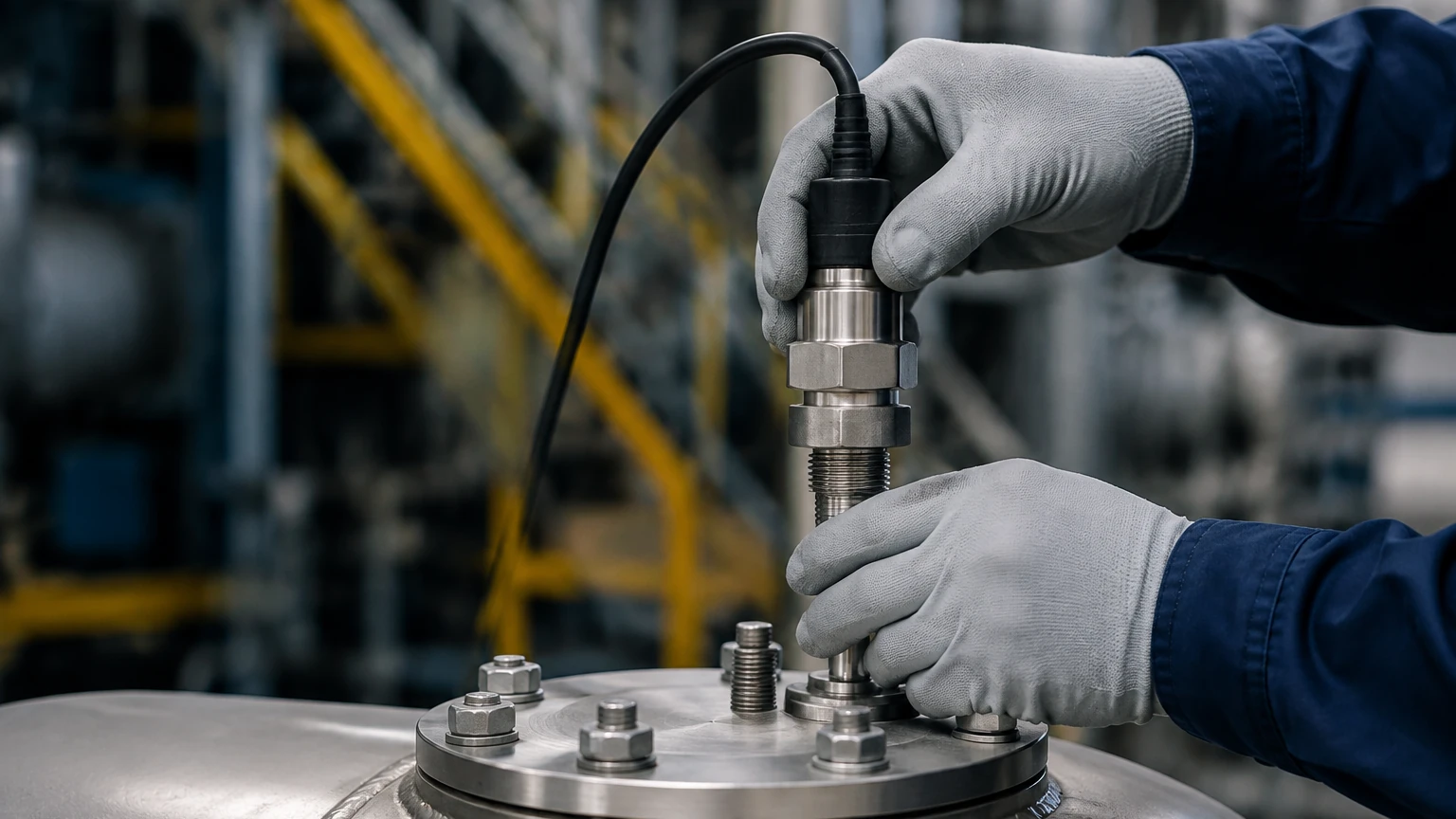
Proper installation is critical to ensuring the longevity and accuracy of a DEF sensor. Engineers should follow these best practices:
1. Avoid Internal Obstructions: For ultrasonic and radar sensors, ensure the signal path is clear of ladders, heating coils, or stay bars. A "dead zone" or "blocking distance" exists near the sensor face where measurements are not possible; ensure the tank's maximum fill level does not enter this zone.
2. Venting: DEF tanks must be properly vented to prevent vacuum or overpressure, which can affect hydrostatic readings. Ensure the vent is equipped with a filter to prevent dust and debris from contaminating the fluid.
3. Mounting Orientation: Sensors should typically be mounted perpendicular to the fluid surface. In mobile applications, the sensor is often placed in the center of the tank to minimize the impact of fluid sloshing on level readings.
4. Electrical Integration: Most industrial DEF sensors provide a 4-20mA or 0-10V analog output. For automotive and heavy machinery, J1939 CAN bus integration is standard, allowing the sensor to communicate level, temperature, and quality data simultaneously to the ECU.
Maintenance and Troubleshooting FAQs
Can I use a standard water level sensor for DEF?
No. Standard sensors often use materials like brass or low-grade plastics that will corrode or degrade in urea. Additionally, the density of DEF (1.09) is higher than water (1.00), which will cause a 9% error in uncalibrated hydrostatic pressure sensors.
How do I deal with urea crystallization on the sensor?
Crystallization usually occurs when the fluid evaporates at the interface of the sensor. For non-contact sensors, a periodic inspection and cleaning with deionized water are recommended. For contact sensors, ensure the tank remains sealed to minimize evaporation.
What is the expected lifespan of a DEF sensor?
In a well-maintained industrial environment, a high-quality ultrasonic or radar DEF sensor can last 5 to 10 years. In mobile applications, the lifespan may be shorter due to extreme vibration and thermal cycling, typically rated for 10,000 to 15,000 operating hours.
Why is my sensor reading "Full" when the tank is half empty?
This is often caused by "ghost echoes" in ultrasonic sensors, where the signal reflects off a tank wall or internal structure instead of the fluid surface. Adjusting the sensor's sensitivity (gain) or using a mapping function to ignore static obstructions can resolve this.
Conclusion
Selecting the right DEF sensor is a balance between technical requirements and environmental constraints. Whether managing a fleet of heavy machinery or overseeing a large-scale chemical storage facility, understanding the nuances of urea measurement ensures both regulatory compliance and mechanical reliability. For comprehensive technical specifications on industrial-grade level measurement hardware, visit the Main Page.
By prioritizing material compatibility and choosing the measurement principle that best fits the tank geometry, engineers can implement a DEF monitoring solution that minimizes downtime and maximizes the efficiency of emissions control systems.