Pond Level
Pond Level
In industrial and municipal water management, monitoring pond level is a fundamental requirement for operational safety, environmental compliance, and process efficiency. Whether managing a cooling water pond, a wastewater lagoon, or a storm-water retention basin, the ability to accurately track liquid volume ensures that facilities avoid overflows, maintain pump prime, and adhere to strict regulatory discharge limits.
Selecting the appropriate instrumentation for pond level measurement requires an understanding of the physical environment. Unlike closed tanks, ponds are subject to fluctuating ambient conditions, including wind, solar heating, surface turbulence, and varying chemical compositions. This guide examines the primary measurement technologies used in these applications, provides selection criteria, and outlines best practices for installation and maintenance.
Core Measurement Principles for Pond Level Sensors
Before selecting a specific instrument, it is essential to understand the physics behind the most common measurement methods. Industrial level sensors generally fall into two categories: contact and non-contact.
Hydrostatic Pressure (Contact)
Hydrostatic level measurement relies on the principle that the pressure at a specific depth in a liquid is proportional to the height of the liquid column above it. The relationship is defined by the formula: $P = \rho \cdot g \cdot h$, where $P$ is pressure, $\rho$ is the liquid density, $g$ is gravity, and $h$ is the height of the liquid.
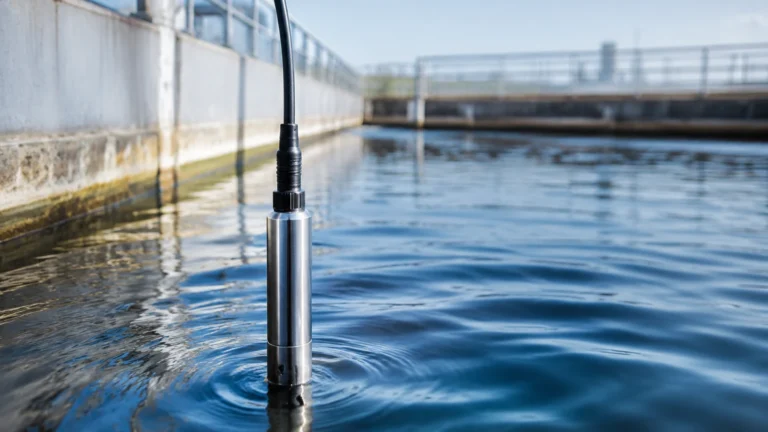
In pond applications, a submersible pressure transmitter is lowered to a fixed point near the bottom. The sensor measures the weight of the water column. To account for changes in atmospheric pressure, these sensors typically use a vented cable that allows the internal reference of the sensor to stay equalized with the air pressure above the pond surface.
Ultrasonic (Non-Contact)
Ultrasonic sensors operate on the "time-of-flight" principle. The device emits a high-frequency sound pulse that travels through the air, reflects off the pond surface, and returns to the transducer. By measuring the time elapsed, the sensor calculates the distance to the liquid.
Because sound speed is affected by air temperature, quality ultrasonic sensors include an integrated temperature sensor to compensate for these changes. However, they can be sensitive to heavy wind, surface foam, or significant temperature gradients across the air gap.
Radar (Non-Contact)
Radar level meters also use time-of-flight but utilize electromagnetic microwave pulses rather than sound waves. These pulses travel at the speed of light and are virtually unaffected by air temperature, pressure, or wind.
Modern 80GHz high-frequency radar sensors offer a narrow beam angle, which is particularly useful in ponds where mounting structures or uneven banks might otherwise cause false reflections. Radar is often preferred for critical pond level monitoring where high accuracy and low maintenance are required across varying weather conditions.
Key Evaluation Criteria for Sensor Selection
Choosing the right technology for pond level monitoring involves more than just selecting a measurement range. Engineers must evaluate the following factors:
1. Media Composition: Is the pond containing clean water, sludge, or corrosive chemicals? Hydrostatic sensors must be chemically compatible with the liquid, whereas non-contact sensors (radar/ultrasonic) are isolated from the media.
2. Surface Conditions: Is the pond prone to heavy foam or floating debris? Foam can absorb ultrasonic signals, potentially leading to signal loss. Radar is generally more resilient to foam, though extremely thick, dense foam may still require careful frequency selection.
3. Environmental Extremes: In regions with freezing temperatures, ice formation on the pond surface will render non-contact sensors unable to measure the actual liquid level beneath the ice. Conversely, hydrostatic sensors must be protected from being crushed by ice expansion.
4. Power Availability: Many ponds are located in remote areas. Low-power sensors (4-20mA loop-powered) or those compatible with solar-powered telemetry systems are often necessary.
5. Accuracy Requirements: While a general retention pond may only require accuracy within 25mm (1 inch), a process-critical cooling pond may require millimeter-level precision to manage heat exchange efficiency.
Practical Selection Table for Pond Level Technologies
The following table provides a comparison of common technologies used by professional manufacturers like Welk to assist in the initial selection process.
| Technology | Typical Accuracy | Max Range | Contact/Non-Contact | Best For |
| :— | :— | :— | :— | :— |
| Hydrostatic Transmitter | ±0.1% to 0.5% | Up to 200m | Contact | Deep ponds, stable density liquids, budget-friendly |
| Ultrasonic Level Sensor | ±0.25% | Up to 15m | Non-Contact | Wastewater lagoons, open channels, non-foaming liquids |
| Radar Level Meter (26GHz) | ±3mm | Up to 30m | Non-Contact | General industrial ponds, turbulent surfaces |
| Radar Level Meter (80GHz) | ±1mm | Up to 120m | Non-Contact | High-precision needs, narrow mounting spaces, foam-prone areas |
| Magnetic Level Gauge | ±5mm | Up to 6m | Contact | Small bypass tanks or sumps associated with ponds |
For a comprehensive overview of available instrumentation and technical specifications, engineers should Review product options and application support at the Welk Main Page.
Installation Considerations and Best Practices
The reliability of a pond level measurement system is often determined by the quality of the installation. Because ponds lack the structured mounting points found on tanks, custom solutions are frequently required.
Mounting Structures
For non-contact sensors (Radar and Ultrasonic), the sensor must be mounted perpendicular to the liquid surface. Common mounting methods include:
* Cantilever Arms: A metal arm extending from the bank or a pier over the water.
* Stilling Wells: A vertical pipe (typically PVC or steel) installed in the pond. The sensor is mounted at the top of the pipe. The pipe protects the sensor from surface waves and wind, providing a stable "target" for the measurement signal.
* Bridge Mounting: Utilizing existing walkways or bridges to center the sensor over the deepest part of the pond.
Hydrostatic Sensor Placement
Submersible transmitters should not be dropped directly onto the pond floor, as silt and sediment can clog the sensing diaphragm. Instead, the sensor should be housed in a perforated "shroud" or stilling well and suspended approximately 30cm to 50cm (12 to 20 inches) above the bottom. This prevents the sensor from becoming buried while ensuring it remains submerged during low-level events.
Lightning and Surge Protection
Since ponds are often in open areas, the sensors are susceptible to lightning strikes. Using surge protection modules and ensuring proper grounding of the sensor housing and cable shield is critical for long-term survival of the electronics.

Limitations and Environmental Challenges
No single technology is perfect for every pond environment. Understanding the limitations helps in designing a redundant or more robust system.
* Vapor and Condensation: In hot industrial ponds, heavy steam or condensation can form on the face of an ultrasonic transducer, blocking the signal. Radar is largely immune to this, but some 80GHz models feature a PTFE lens specifically designed to shed water droplets.
* Build-up and Maintenance: In wastewater ponds, biological growth or grease can build up on contact sensors. Hydrostatic sensors may require periodic cleaning to ensure the pressure port remains open. Non-contact sensors significantly reduce this maintenance burden.
* Wind and Waves: High winds can create significant wave action. This turbulence can cause "jitter" in level readings. Most modern transmitters include software damping or averaging functions to smooth out these fluctuations, but a physical stilling well remains the most effective mechanical solution.
Frequently Asked Questions (FAQs)
Q: Can I use an ultrasonic sensor for a pond that has a lot of wind?
A: Wind can deflect the sound waves of an ultrasonic sensor, leading to intermittent signal loss. If wind is a constant factor, a radar level meter or a hydrostatic transmitter is a more reliable choice. If you must use ultrasonic, a stilling well is required to shield the path of the sound wave.
Q: How do I handle level measurement when the pond freezes?
A: If the pond freezes, non-contact sensors will measure the top of the ice. If you need the liquid level beneath the ice, a hydrostatic sensor installed below the frost line is necessary. However, care must be taken to ensure the cable and sensor are not damaged by the moving ice sheet.
Q: Does the chemical concentration in the pond affect the measurement?
A: For hydrostatic sensors, yes. Since they measure pressure, a change in liquid density (due to high salt or chemical concentration) will change the level reading. For radar and ultrasonic sensors, the chemical concentration generally does not affect the measurement unless it changes the dielectric constant (for radar) or creates heavy vapors.
Q: What is the benefit of 80GHz radar over 26GHz radar for ponds?
A: 80GHz radar has a much narrower beam (often as small as 3 degrees). This allows the sensor to be mounted further back from the water or on a more compact arm without the signal hitting the pond bank or other obstructions. It also provides better performance in the presence of light foam.
Conclusion
Accurate pond level monitoring is a critical component of industrial automation and environmental safety. By evaluating the specific challenges of the site—ranging from chemical composition to weather extremes—and selecting between hydrostatic, ultrasonic, or radar technologies, operators can ensure long-term reliability. For technical assistance in selecting the correct instrument for your specific application, visit the Welk Main Page to explore detailed product specifications and engineering support.