Non Contact Capacitive Liquid Level Sensor
Non Contact Capacitive Liquid Level Sensor
In the landscape of industrial automation and process control, the demand for non-invasive measurement techniques has grown significantly. The non contact capacitive liquid level sensor represents a critical solution for monitoring fluids without direct physical interaction between the sensing element and the medium. This technology is particularly valuable in applications involving high-purity chemicals, corrosive acids, or sterile pharmaceuticals where maintaining the integrity of the container is paramount.
By leveraging the principles of electromagnetism, these sensors detect the presence or level of a liquid through the walls of non-metallic containers. This guide explores the engineering principles, selection criteria, and practical application of non-contact capacitive technology in modern industrial environments.
Measurement Principles of Capacitive Sensing
To effectively implement a non contact capacitive liquid level sensor, it is essential to understand the underlying physics of capacitance. Capacitance is the ability of a system to store an electric charge, defined by the formula:
C = ε (A / d)
Where:
* C is the capacitance.
* ε (Epsilon) is the permittivity of the dielectric material between the plates.
* A is the area of the plates.
* d is the distance between the plates.
0
In a standard contact-based capacitive sensor, the probe acts as one plate and the tank wall (or a second probe) acts as the other. However, in a non-contact configuration, the sensor is mounted to the exterior of a non-metallic vessel (such as plastic, glass, or ceramic).
The Fringing Field Effect
Non-contact sensors utilize what is known as a "fringing field." The sensor head contains two electrodes that generate an electric field. When the sensor is mounted to a tank wall, this field penetrates the wall material. When liquid—which typically has a much higher dielectric constant (ε) than air—rises to the level of the sensor, it enters this electric field. This change in the dielectric environment increases the measured capacitance, triggering the sensor's output.
Because the sensor does not need to penetrate the tank, it eliminates the risk of leaks, contamination, and the need for complex seals or specialized alloys required for corrosive media. For comprehensive technical specifications on various measurement technologies, engineers often consult the Main Page of industrial instrumentation providers to compare capacitive options with radar or ultrasonic alternatives.
Key Evaluation Criteria for Selection
Selecting the right non contact capacitive liquid level sensor requires a detailed analysis of both the container and the liquid properties. Unlike radar or ultrasonic sensors that measure from the top down, capacitive sensors are often used for point-level detection or continuous measurement through a strip.
1. Container Wall Material and Thickness
The container must be non-conductive. Common materials include Polyethylene (PE), Polypropylene (PP), PVC, PTFE, and glass. The thickness of the wall is a limiting factor; typically, these sensors are effective through walls up to 10 mm to 20 mm thick, depending on the dielectric constant of the liquid. If the wall is too thick or contains metallic reinforcements, the electric field cannot effectively penetrate to detect the liquid.
2. Dielectric Constant (ε) of the Liquid
The dielectric constant is the measure of a material's ability to store electrical energy in an electric field.
* Water: ε ≈ 80 (Very easy to detect)
* Alcohol: ε ≈ 24 (Moderately easy)
* Oil/Fuel: ε ≈ 2 (Difficult to detect through thick walls)
Liquids with higher dielectric constants produce a more significant change in capacitance, allowing for more reliable detection through thicker container walls.
3. Conductivity and Coating Trends
If the liquid is highly conductive and prone to leaving a film or "coating" on the inner wall of the tank, the sensor may continue to indicate a "full" state even after the level has dropped. Advanced sensors include compensation circuits to ignore thin films and only trigger when the bulk of the liquid is present.
Technical Comparison Table
| Feature | Non-Contact Capacitive | Ultrasonic (Non-Contact) | Radar (Non-Contact) |
| :— | :— | :— | :— |
| Mounting Position | Side-wall (Exterior) | Top-mount | Top-mount |
| Wall Penetration | Yes (Non-metallic only) | No | No (Usually) |
| Max Wall Thickness | 10 mm – 25 mm | N/A | N/A |
| Media Sensitivity | High (Dielectric dependent) | Low (Surface dependent) | Moderate |
| Cost | Low to Moderate | Moderate | High |
| Ideal Application | Small plastic tanks, medical | Water/Wastewater | Chemical/High-temp |
Installation Considerations
Proper installation is the most critical factor in the performance of a non contact capacitive liquid level sensor. Because the sensor relies on the proximity of the liquid, any air gap between the sensor face and the tank wall can lead to measurement errors.
Mounting Methods
1. Adhesive Mounting: Many sensors are designed with a flat face for 3M adhesive or industrial-grade glue. This ensures there is no air gap between the sensor and the tank.
2. Bracket/Pipe Mounting: For cylindrical containers or sight glasses, curved sensors or specialized brackets are used to maintain a flush fit against the surface.
3. Strap-on Sensors: Flexible capacitive strips can be strapped around a tank to provide continuous level measurement rather than just a single point.
Calibration and Sensitivity Adjustment
Most industrial-grade capacitive sensors feature a sensitivity potentiometer or a "teach" button. This allows the user to calibrate the sensor to the specific wall thickness and liquid type.
* Empty Calibration: Set the sensor to ignore the tank wall and any internal structural components.
* Full Calibration: Set the threshold for the liquid presence.
Limitations and Common Risks
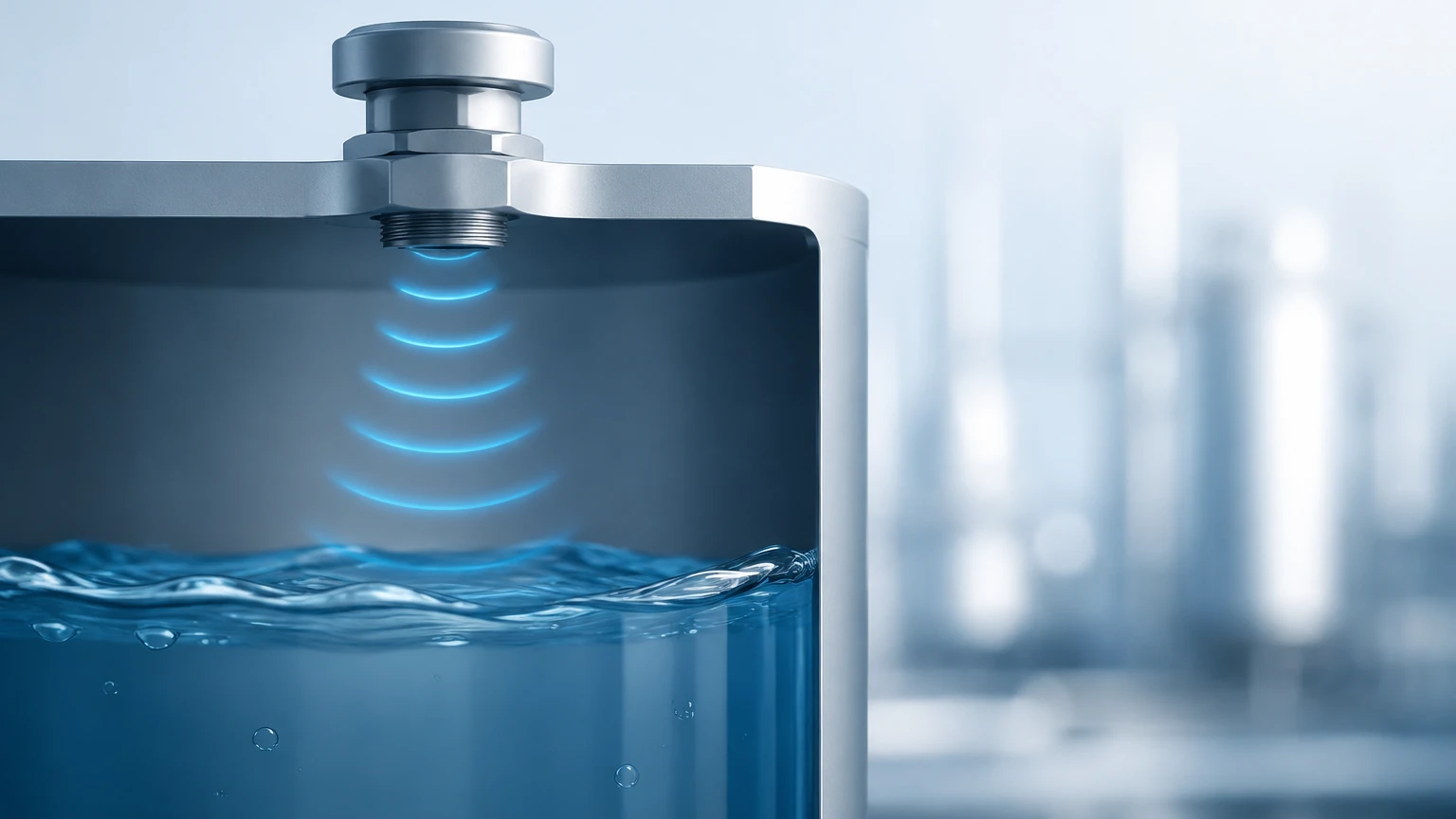
While highly versatile, the non contact capacitive liquid level sensor is not a universal solution for every application. Engineers must be aware of the following limitations:
* Metallic Containers: These sensors cannot function through metal walls (stainless steel, carbon steel, aluminum) because the metal acts as a Faraday cage, blocking the electric field. In such cases, a bypass pipe made of plastic or a sight glass must be installed to facilitate non-contact sensing.
* Ambient Moisture: High humidity or condensation on the exterior of the tank can sometimes be misinterpreted as internal liquid. Using sensors with "active shield" technology helps mitigate this risk by ignoring moisture on the sensor face.
* Temperature Fluctuations: Extreme temperature changes can affect the dielectric properties of the liquid and the physical dimensions of the tank wall, potentially requiring re-calibration or temperature-compensated sensors.
* Bubbles and Foam: Capacitive sensors measure the average dielectric constant in their field. If a liquid is highly aerated or covered in thick foam, the sensor may provide an inconsistent reading, as foam has a much lower dielectric constant than the liquid phase.
Applications in Industrial Automation
Medical and Laboratory Equipment
In medical diagnostics, reagents must remain sterile. Non-contact sensors allow for level monitoring in disposable plastic bags or specialized vials without any risk of cross-contamination.
Chemical Processing
For highly aggressive acids like Hydrofluoric acid, which can etch glass and corrode most metals, a capacitive sensor mounted on the outside of a PTFE-lined or plastic tank provides a safe and maintenance-free solution.
Food and Beverage
In bottling plants, these sensors are used to detect the presence of liquid within a bottle or to monitor the level in small plastic buffer tanks where hygiene is a priority. Since the sensor never touches the product, there is no need for Clean-In-Place (CIP) procedures for the sensor itself.
Frequently Asked Questions (FAQ)
Q: Can a non-contact capacitive sensor work through a stainless steel tank?
A: No. The electric field cannot penetrate metal. You would need to install a non-metallic sight glass or a plastic bypass tube and mount the sensor to that component.
Q: What is the maximum distance the sensor can be from the liquid?
A: For non-contact sensing through a wall, the sensor should be in direct contact with the outer wall. The "sensing distance" usually refers to the maximum wall thickness it can penetrate, which is typically between 5 mm and 25 mm depending on the model and the liquid's dielectric constant.
Q: Does the color of the liquid affect the measurement?
A: No. Capacitive sensing is based on electrical properties (dielectric constant), not optical properties. It works equally well with clear, opaque, or dark liquids.
Q: How do I handle build-up on the inside of the tank?
A: If the liquid is prone to crystallization or heavy scaling, you should select a sensor with "coating rejection" or "active shield" technology. These sensors are designed to ignore the small capacitive change caused by a thin layer of build-up and only trigger when the bulk liquid level reaches the sensor.
Conclusion
The non contact capacitive liquid level sensor is an indispensable tool for modern process industries, offering a blend of reliability, safety, and ease of installation. By eliminating the need for tank penetrations, it reduces the long-term maintenance costs associated with seal failures and chemical corrosion.
When designing a system, engineers must carefully consider the dielectric properties of the medium and the material of the vessel. For those seeking a wide range of industrial measurement solutions, including radar, ultrasonic, and hydrostatic transmitters, visiting the Main Page of an established manufacturer like Welk provides access to the technical data and expert support necessary to ensure the correct technology is selected for the specific application environment.
Download Non Contact Capacitive Liquid Level Sensor as a PDF