Supervisory Control for Municipal Water Systems
Supervisory Control for Municipal Water Systems
In the management of modern urban infrastructure, supervisory control for municipal water systems serves as the central nervous system for ensuring the reliable delivery of potable water and the efficient processing of wastewater. These systems rely on a sophisticated architecture of sensors, programmable logic controllers (PLCs), and supervisory control and data acquisition (SCADA) software to monitor and manage remote assets. At the heart of this automation lies precision level measurement, which provides the critical data points necessary for pump control, chemical dosing, and storage management.
Effective supervisory control requires high-fidelity data from the field. Without accurate level readings from reservoirs, wells, and lift stations, the control system cannot optimize energy consumption or prevent overflows. This article examines the core measurement principles used in municipal water applications, provides selection criteria for engineering professionals, and outlines the integration of these instruments into broader supervisory frameworks.
Measurement Principles in Municipal Water Applications
Before selecting instrumentation for a supervisory control system, it is essential to understand the physics behind the measurement. Municipal water environments present diverse challenges, from the deep, static conditions of groundwater wells to the turbulent, corrosive environments of sewage lift stations.
Ultrasonic Level Measurement
Ultrasonic sensors operate on the "time-of-flight" principle. The sensor emits an ultrasonic pulse that travels through the air, reflects off the liquid surface, and returns to the transducer. By measuring the time taken for the pulse to return, the system calculates the distance to the liquid.
* Advantages: Non-contact measurement, low maintenance, and cost-effective for standard water tanks.
* Limitations: Performance can be degraded by heavy foam, steam, or significant temperature gradients in the air space between the sensor and the liquid.
Radar Level Measurement
Radar level meters also use time-of-flight but utilize high-frequency electromagnetic waves (typically in the 26GHz or 80GHz range) rather than sound waves. These waves travel at the speed of light and are largely unaffected by air temperature, pressure, or vacuum conditions.
* Advantages: Extreme precision (often within ±2mm), unaffected by steam or condensation, and capable of measuring over long distances (up to 30 meters or more).
* Application: Ideal for chemical storage tanks used in water treatment and large-scale reservoirs where high reliability is paramount.
Hydrostatic Pressure Measurement
Hydrostatic transmitters measure the pressure exerted by the liquid column above the sensor diaphragm. This pressure is directly proportional to the height of the liquid (P = ρgh, where P is pressure, ρ is density, g is gravity, and h is height). Submersible pressure transducers are commonly used in deep wells and boreholes.
* Advantages: Simple installation in deep or narrow spaces; unaffected by surface foam or turbulence.
* Limitations: Requires compensation for atmospheric pressure changes (usually via a vented cable) and is sensitive to changes in liquid density.
Magnetic Level Gauges
Magnetic level gauges provide both a visual indication and a remote signal. A float containing a permanent magnet moves with the liquid level inside a bypass chamber. This float actuates external flags for visual monitoring and can be equipped with a reed switch or magnetostrictive transmitter for integration into a supervisory control system.
The Role of Instrumentation in Supervisory Control
Supervisory control for municipal water systems is designed to minimize human intervention while maximizing system resilience. Field instruments act as the primary data source. For example, in a distributed water network, level sensors in a high-service reservoir send a 4-20mA or digital signal (such as HART or Modbus) to a local PLC.
The PLC, governed by the supervisory logic, determines when to activate or deactivate pumps at a remote pumping station. If the level in the reservoir drops below a predefined setpoint (e.g., 3.5 meters), the supervisory system initiates a start command. Conversely, to prevent overflow and energy waste, the system shuts down the pumps when the high-level setpoint (e.g., 8.0 meters) is reached.
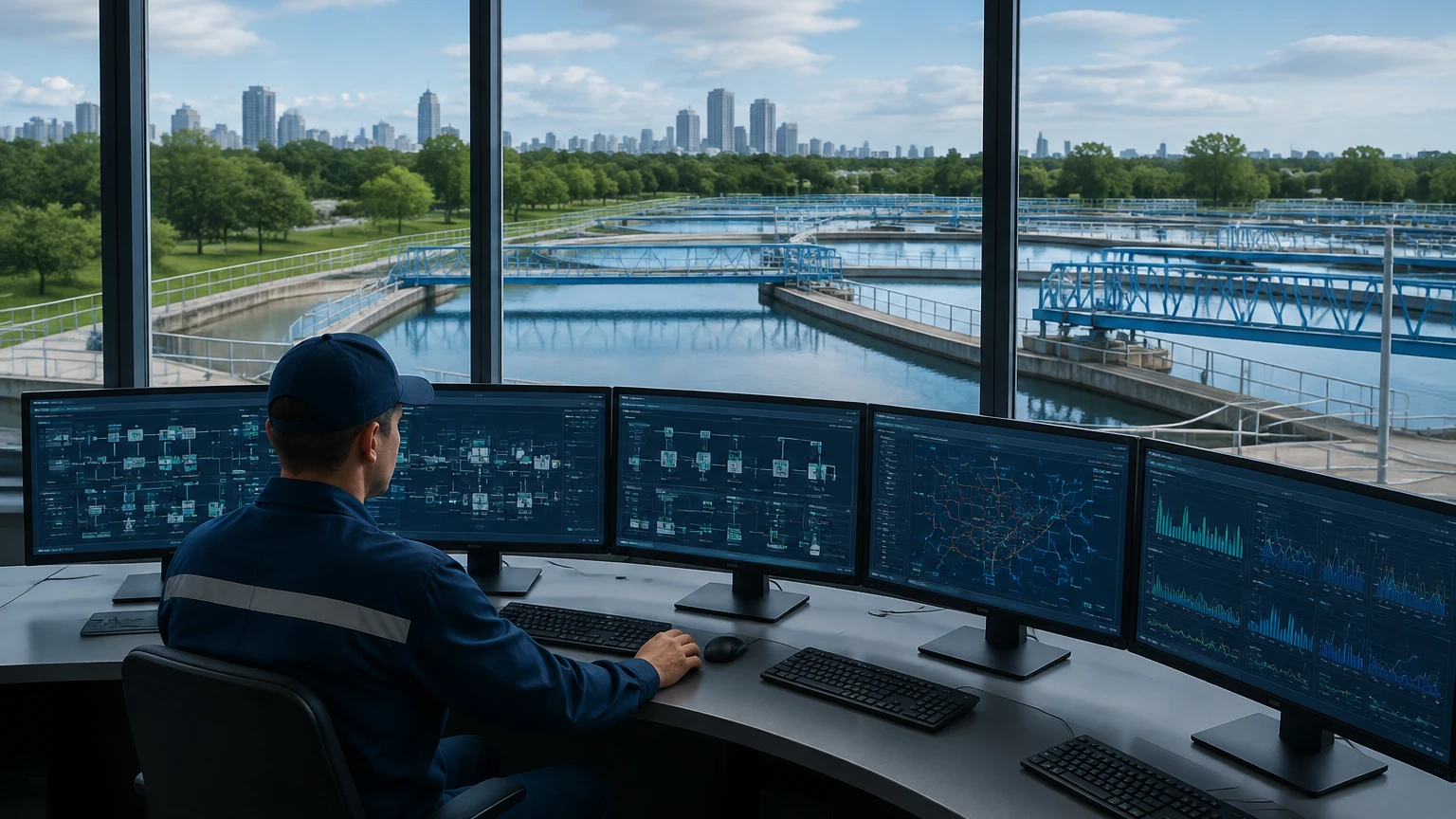
Integration with the Main Page of a facility’s control interface allows operators to visualize these levels in real-time, perform trend analysis, and receive early warnings of potential equipment failure, such as a pump that is running but failing to increase the water level in a tank.
Selection Criteria for Municipal Level Instruments
Choosing the correct technology depends on the specific physical environment and the requirements of the supervisory control architecture. The following table provides a practical reference for common municipal applications.
| Application | Recommended Technology | Primary Selection Driver |
| :— | :— | :— |
| Potable Water Reservoirs | Ultrasonic or Radar | Non-contact prevents contamination; high reliability. |
| Deep Wells / Boreholes | Hydrostatic (Submersible) | Ability to measure at depths of 100m+ in narrow pipes. |
| Sewage Lift Stations | Radar (80GHz) | Unaffected by grease, foam, and high humidity. |
| Chemical Dosing (Alum, Chlorine) | Radar or Ultrasonic | Corrosion resistance (using PVDF or PTFE wetted parts). |
| Open Channel Flow | Ultrasonic | Standardized weir/flume calculations integrated into the sensor. |
| Sludge Holding Tanks | Radar | Penetrates surface crusts and ignores heavy vapors. |
| Boiler Feed Water | Magnetic Level Gauge | High temperature and pressure capability with visual backup. |
Installation Considerations and Engineering Best Practices
Even the most advanced sensor will fail to provide accurate data to a supervisory control system if installed incorrectly. Engineers should adhere to the following guidelines during the design and commissioning phases:
1. Blocking Distance (Dead Zone): All non-contact sensors (ultrasonic and radar) have a minimum distance near the transducer where measurement is impossible. Ensure the maximum high-water level never enters this zone.
2. Internal Obstructions: When installing radar or ultrasonic sensors, avoid placing them directly above ladders, pipes, or agitators. These structures can create "false echoes." Modern Welk instruments often feature "false echo suppression" software to ignore these fixed reflections, but physical clearance is always preferred.
3. Stilling Wells: In applications with high turbulence or surface waves, such as intake structures, installing the sensor inside a vertical stilling well (a pipe with air vents) can stabilize the liquid surface and improve measurement accuracy.
4. Cable Management: For hydrostatic sensors in deep wells, the vented cable must be protected from kinks and moisture. Use a desiccant cartridge at the termination point of the vent tube to prevent internal condensation, which can skew pressure readings.
5. Signal Integrity: Municipal sites are often electrically noisy due to large pump motors and variable frequency drives (VFDs). Use shielded, twisted-pair cabling for 4-20mA loops and ensure proper grounding to prevent signal drift in the supervisory control system.
Limitations and Environmental Constraints
While industrial level meters are robust, they are not universal. Supervisory control for municipal water systems must account for the following limitations:
* Temperature Extremes: In very cold climates, ice formation on the surface of a reservoir can trap an ultrasonic signal or cause a float to seize. Radar is generally more resistant to these conditions but may still require heated enclosures for the electronics.
* Vapor and Vacuum: While radar performs well in vacuum, ultrasonic sensors require a medium (air) to transmit sound. They cannot function in a vacuum.
* Build-up: In wastewater applications, fats, oils, and grease (FOG) can build up on submersible sensors or floats. Non-contact radar is the preferred solution here to reduce the maintenance burden of frequent cleaning.
Frequently Asked Questions (FAQ)
Q: How often should level sensors in a municipal system be calibrated?
A: Most modern digital sensors are highly stable. However, for regulatory compliance and billing purposes (such as effluent discharge), an annual calibration check against a manual reference is recommended. Hydrostatic sensors may require more frequent checks if the liquid density varies.
Q: Can these sensors be used in hazardous areas?
A: Yes. Many municipal wastewater environments are classified as Class I, Div 1 or 2 (ATEX Zone 0 or 1) due to the presence of methane gas. Ensure the selected instrument has the appropriate intrinsically safe or explosion-proof certification.
Q: What is the benefit of 80GHz radar over 26GHz radar?
A: 80GHz radar has a much narrower beam angle. This allows it to be installed in tanks with many internal obstructions or through narrow nozzles without interference, making it a more versatile choice for complex municipal retrofits.
Q: How does the supervisory system handle a sensor failure?
A: Robust supervisory control for municipal water systems should include "fail-safe" logic. If a sensor signal drops below 3.6mA (indicating a wire break) or stays at a fixed value for an improbable duration, the SCADA system should trigger an alarm and potentially switch to a redundant sensor or a timed pumping cycle to prevent system failure.
Conclusion
The efficiency of supervisory control for municipal water systems is fundamentally tied to the quality of the field instrumentation. By selecting the appropriate measurement principle—whether it be the precision of radar, the cost-effectiveness of ultrasonic, or the depth-capability of hydrostatic sensors—engineers can build a resilient data foundation. Proper installation and an understanding of environmental limitations ensure that these systems provide the reliable, long-term service required for essential public infrastructure. For those seeking to specify or upgrade their current instrumentation, a thorough review of available technologies is the first step toward optimized water management. For more information on specific instrument models and technical specifications, professionals should review product options and application support on the Main Page.
Download Supervisory Control for Municipal Water Systems as a PDF