Vibration Level Switch Market
Vibration Level Switch Market
The global vibration level switch market represents a critical segment of the industrial automation and process control landscape. As industries move toward higher levels of safety and efficiency, the demand for point-level detection that is immune to changes in dielectric constant, pressure, temperature, and foam has grown significantly. Vibration level switches, often referred to as tuning fork or vibrating rod sensors, have become the standard for overfill protection and run-dry prevention in liquid and solid applications.
For engineers and procurement professionals, navigating the vibration level switch market requires an understanding of how these devices operate, their specific application strengths, and the technical parameters that differentiate high-performance instruments from entry-level sensors. This guide provides a comprehensive technical overview and market analysis for selecting the right level measurement technology.
Fundamental Measurement Principles
Before evaluating market options, it is essential to understand the physics behind vibration level detection. These instruments operate on the principle of resonant frequency.
The Piezoelectric Effect
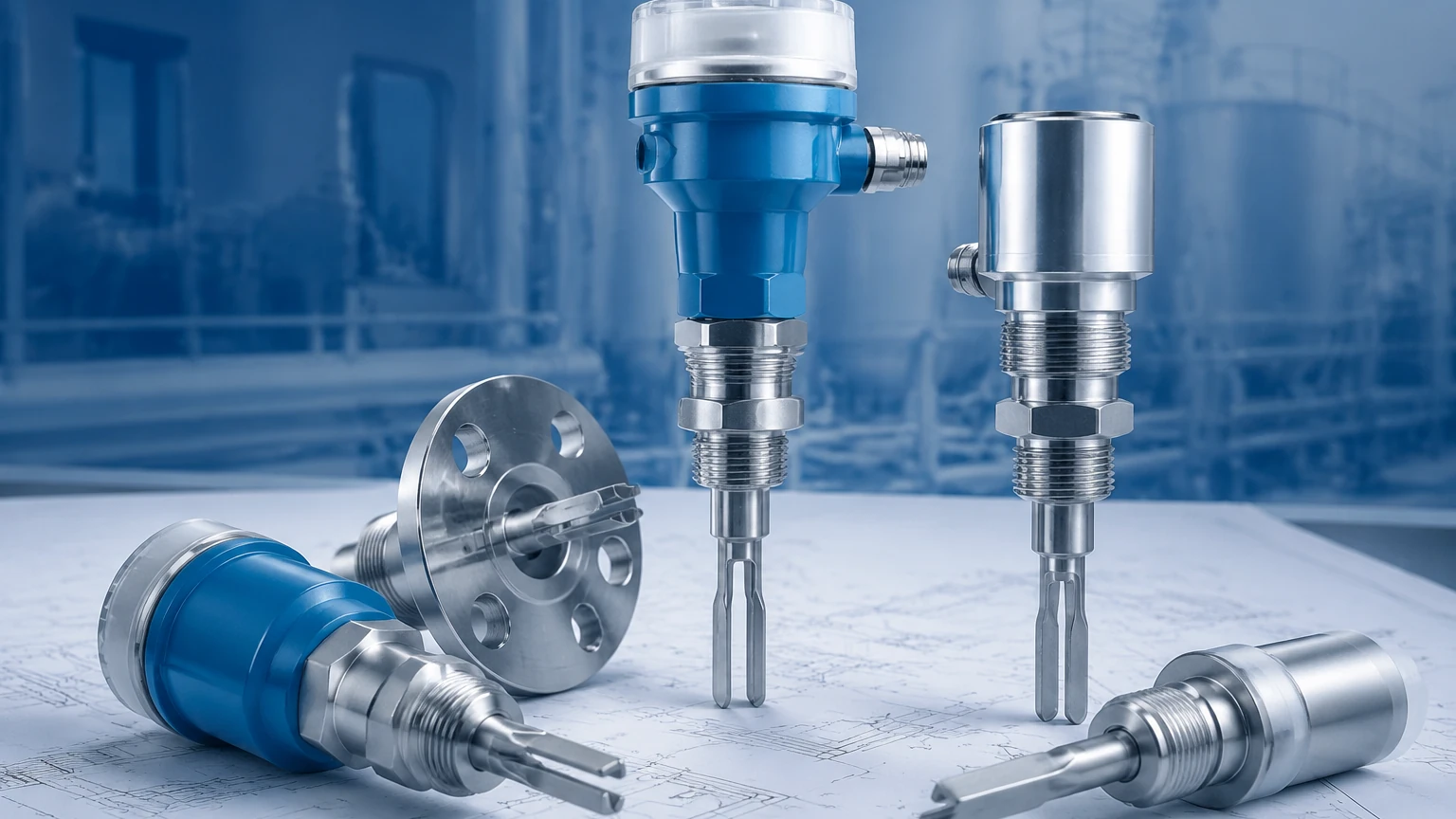
A vibration level switch typically consists of a sensing element—either a pair of forks or a single rod—and an internal electronic housing. Inside the housing, piezoelectric crystals are used to drive the sensing element at its natural resonant frequency. One crystal acts as a transmitter, converting electrical energy into mechanical vibration, while a second crystal acts as a receiver, monitoring the frequency and amplitude of that vibration.
Frequency Shift and Damping
When the sensing element is in free air (or gas), it vibrates at its maximum frequency. As the process medium (liquid or solid) rises and makes contact with the fork or rod, the vibration is dampened. This contact causes a shift in the resonant frequency or a reduction in the amplitude of the vibration. The internal electronics detect this change and convert it into a switching signal, such as a relay output, transistor (PNP/NPN), or a 2-wire signal.
Because this method relies on physical contact and mechanical damping rather than electrical properties, vibration switches are largely unaffected by the chemical or electrical characteristics of the medium, making them more versatile than capacitance or conductivity switches in the broader vibration level switch market.
Market Segmentation by Technology Type
The market is generally divided into two primary sensor geometries: the vibrating tuning fork and the vibrating rod. Each serves distinct industrial needs.
1. Vibrating Tuning Forks (Liquids and Light Solids)
Tuning forks are the most common configuration in the vibration level switch market. They feature two tines that vibrate toward and away from each other.
* Liquid Applications: These are designed with high-frequency vibration (often >1000 Hz) to ignore bubbles and foam. They are ideal for high-level alarms in water treatment and chemical storage.
* Solids Applications: Forks for solids are usually larger and vibrate at a lower frequency. They are used for powders, granulates, and grains where the density is sufficient to dampen the vibration.
2. Vibrating Rods (Coarse Solids)
Vibrating rods consist of a single sensing element. This design is particularly favored in the solids market because it is less prone to material "bridging." In applications involving large granulates or sticky powders, material can sometimes get stuck between the tines of a tuning fork, causing a false high-level reading. The single-rod design eliminates this risk, making it a staple for the food, beverage, and mining sectors.
Key Selection Criteria for Industrial Applications
When sourcing from the vibration level switch market, technical specifications must align with the process environment. The following criteria are essential for a reliable installation.
Medium Density
The sensitivity of a vibration switch is determined by the minimum density it can detect. For liquids, most switches can handle densities down to 0.5 g/cm³ (500 g/l). For very light powders or fumed silica, specialized high-sensitivity switches capable of detecting densities as low as 0.01 g/cm³ are required. Using a standard switch on a very light medium will result in the sensor failing to "feel" the material, leading to overflow.
Temperature and Pressure
Standard industrial switches typically handle temperatures from -40°C to 150°C. However, the vibration level switch market also offers high-temperature variants with cooling fins or ceramic insulators that can withstand up to 250°C or more. Pressure ratings usually range from vacuum up to 40 bar or 64 bar, depending on the flange or thread connection.
Material Compatibility
The wetted parts of the switch must be compatible with the process fluid. While 316L stainless steel is the market standard, aggressive chemicals may require coatings like PFA, ECTFE, or specialized alloys like Hastelloy. For more information on selecting compatible materials for various industrial environments, you can Review product options and application support at the Welk main site.
Comparative Analysis: Vibration vs. Alternative Technologies
Choosing the right technology involves comparing vibration switches against other point-level methods. The following table outlines the performance of vibration switches relative to common alternatives.
| Feature | Vibration Level Switch | Capacitance Switch | Float Switch | Ultrasonic Gap Switch |
| :— | :— | :— | :— | :— |
| Moving Parts | None (Solid State) | None | Yes (Mechanical) | None |
| Immunity to Build-up | High | Low/Moderate | Very Low | Moderate |
| Foam Sensitivity | Low (Ignores foam) | High | Moderate | High |
| Maintenance | Minimal | Moderate | High | Minimal |
| Dielectric Dependency | None | High | None | None |
| Media Type | Liquids & Solids | Liquids & Solids | Liquids Only | Liquids Only |
Installation and Engineering Best Practices
Proper installation is critical to ensure that a vibration level switch performs according to its specifications. Engineering teams should consider the following factors during the design phase:
1. Orientation and Mounting
* Side Mounting: When installed horizontally, the tines of a tuning fork should be oriented vertically (one above the other) rather than side-by-side. This prevents material from resting on the flat surface of the tines, which could cause a false alarm.
* Top Mounting: For high-level detection, the switch is often mounted vertically from the top of the tank. In these cases, extension pipes or cables are used to reach the desired switching point.
2. Avoiding the Flow Stream
The sensor should not be placed directly in the path of the filling stream. The kinetic energy of the falling material can damage the tines or cause intermittent false signals. If placement near the inlet is unavoidable, a protective baffle or shield should be installed above the sensor.
3. Turbulence and Agitation
In tanks with heavy agitation, the mechanical stress on long-fork extensions can be significant. In these environments, shorter forks or reinforced rod designs are preferred to prevent fatigue failure of the sensing element.
4. Nozzle Length
The tines of the fork must extend fully into the vessel. If the tines are partially shrouded by a long mounting nozzle, material can become trapped in the nozzle, causing the switch to remain in the "covered" state even after the tank level has dropped.
Limitations and Operational Constraints
While vibration level switches are highly versatile, they are not universal solutions. There are specific scenarios where the technology may face challenges:
* Extremely High Viscosity: While vibration switches handle moderately viscous fluids well, extremely thick media (like heavy tars or pastes) may not allow the fork to vibrate at all, or the medium may cling to the fork so heavily that it fails to reset when the level drops.
* Large Particle Size: In solids applications, if the particle size is larger than the gap between the tines of a tuning fork, mechanical wedging can occur. In these instances, a vibrating rod or a different technology like a rotary paddle switch is more appropriate.
* Heavy Coating: While designed to ignore some build-up, a significant, hardened coating that bridges the tines will eventually cause a malfunction. Regular inspection is required in "dirty" applications.
Frequently Asked Questions (FAQ)
Q: Can vibration level switches be used in hazardous areas?
A: Yes, the vibration level switch market provides many options with ATEX, IECEx, and North American (UL/CSA) explosion-proof or intrinsically safe certifications for use in flammable gas or dust environments.
Q: Do these switches require calibration?
A: Most modern vibration switches are "plug-and-play." They do not require calibration to the specific medium, provided the medium density is above the sensor's minimum threshold. Some models include a sensitivity adjustment for very light or aerated solids.
Q: How do I test the function of the switch without filling the tank?
A: Many high-quality vibration switches feature a magnetic test point or a local test button on the electronics. Touching a magnet to the designated spot on the housing simulates a "covered" state, allowing the operator to verify the loop and alarm logic.
Q: What is the typical lifespan of a vibration level switch?
A: Because there are no wearing mechanical parts (like bearings or hinges), these switches can last 10 to 15 years or more in clean, non-corrosive applications. The primary failure mode is typically electronic component aging or physical damage to the tines from abrasive media.
Conclusion
The vibration level switch market continues to expand as a result of the technology's reliability and ease of use. Whether protecting a pump from running dry or ensuring a chemical tank does not overflow, these instruments provide a robust layer of protection. By understanding the density requirements, material compatibility, and installation nuances, engineers can select a solution that minimizes downtime and maximizes safety. For a deeper look at specific industrial level measurement instruments, including radar and ultrasonic options that complement vibration switches, visit the Main Page for technical data and product support.