Liquid Level Sensor
Liquid Level Sensor
In industrial process automation, the liquid level sensor serves as a critical component for inventory management, process control, and safety monitoring. Whether managing aggressive chemicals, potable water, or volatile hydrocarbons, selecting the correct sensing technology is fundamental to operational efficiency. This guide examines the primary measurement principles, technical specifications, and selection criteria necessary for engineering professionals to implement reliable level measurement solutions.
Core Principles of Liquid Level Measurement
Before selecting a specific liquid level sensor, it is essential to understand the physical principles that govern how these instruments interact with the media. Industrial level measurement is generally categorized into two methodologies: continuous measurement and point level detection.
Continuous vs. Point Level Measurement
Continuous measurement provides a real-time tracking of the fluid level throughout the entire range of the vessel, typically outputting a 4-20mA or digital signal. This is essential for inventory tracking and precise process modulation. Point level detection, often handled by level switches, identifies when a liquid reaches a specific threshold (high or low), triggering an alarm or starting/stopping a pump.
Contact vs. Non-Contact Sensing
Measurement technologies are further divided by their physical interaction with the liquid:
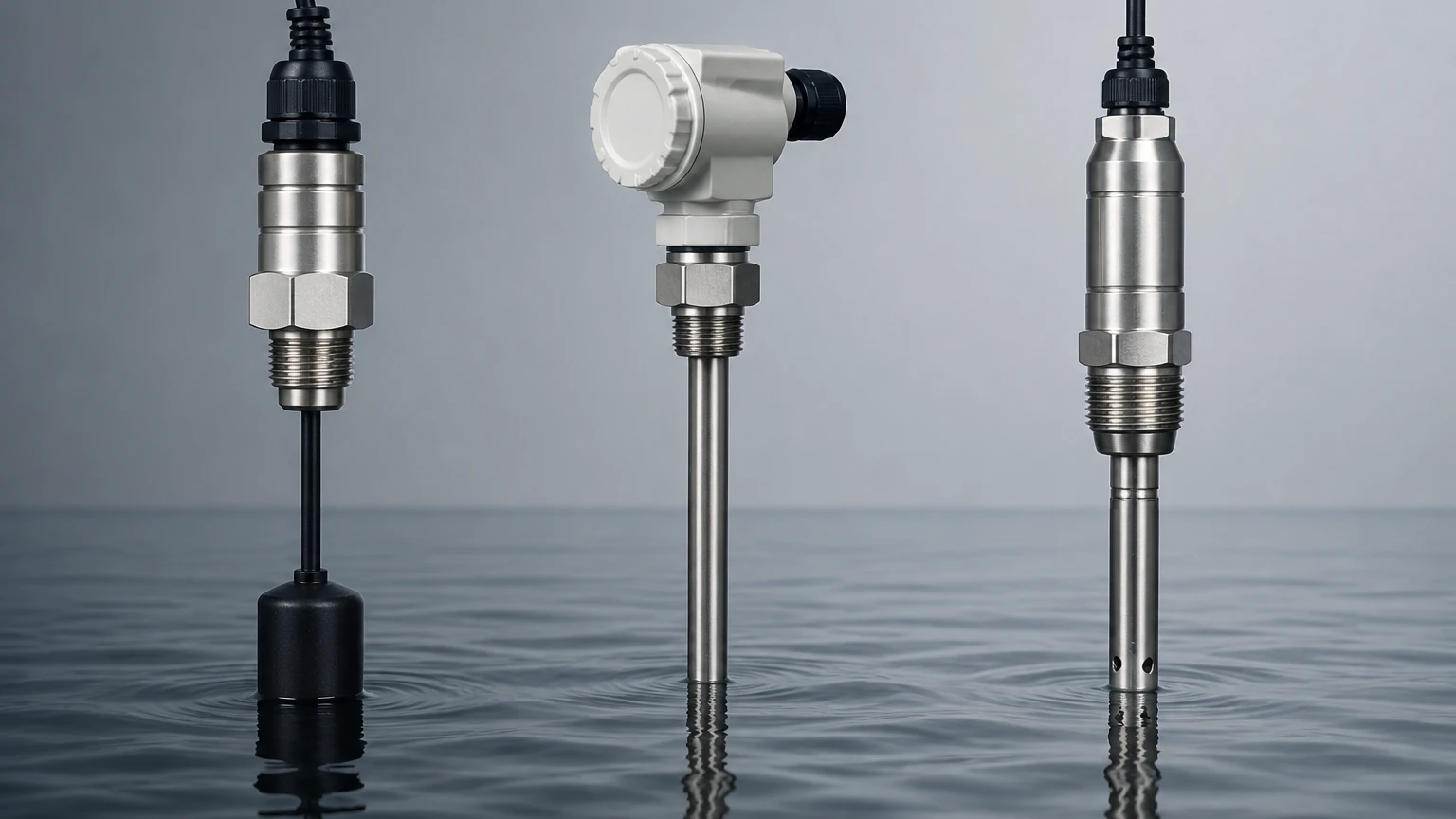
* Contact Sensors: These instruments, such as hydrostatic transmitters or magnetic gauges, are in direct physical contact with the process media. They are often robust but must be compatible with the chemical properties of the fluid.
* Non-Contact Sensors: Technologies like radar and ultrasonic sensors measure the level from a distance, typically mounted at the top of the tank. These are ideal for corrosive, viscous, or sterile applications where minimizing contact is preferred to reduce maintenance and contamination risks.
Radar Level Measurement: High-Precision Non-Contact
Radar technology has become the gold standard for demanding industrial applications. It operates on the Time-of-Flight (ToF) principle. The sensor emits high-frequency electromagnetic waves (typically in the 26GHz or 80GHz range) toward the liquid surface.
The Measurement Principle
The waves travel at the speed of light. When they hit the surface of the liquid, a portion of the energy is reflected back to the sensor. The instrument calculates the distance based on the time delay between transmission and reception.
$$D = \frac{c \times t}{2}$$
Where *D* is the distance, *c* is the speed of light, and *t* is the transit time. Because electromagnetic waves do not require a medium for travel, radar sensors are unaffected by vacuum, high pressure, or temperature fluctuations in the vapor space.
Advantages and Limitations
Radar sensors are exceptionally versatile. They can penetrate heavy steam, dust, and foam, which often baffle other technologies. However, the dielectric constant ($ε_r$) of the liquid is a critical factor; liquids with very low dielectric constants (like certain oils) reflect less energy, requiring high-sensitivity radar units.
Ultrasonic Level Sensors: Cost-Effective Versatility
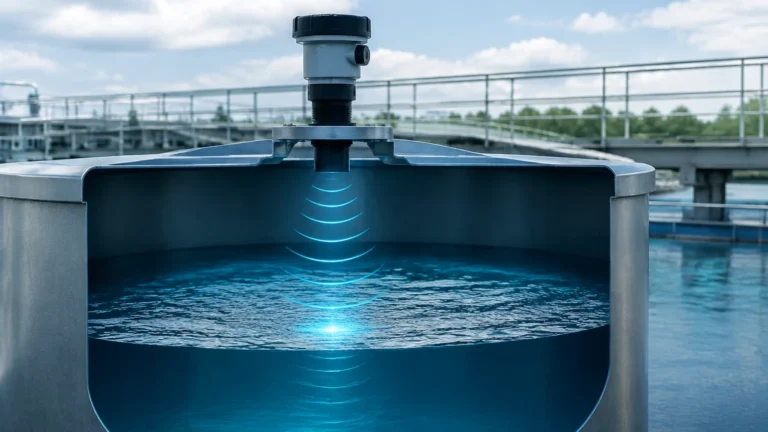
Ultrasonic sensors are widely used in water treatment and general industrial storage. Like radar, they use the Time-of-Flight principle but utilize sound waves instead of electromagnetic waves.
The Measurement Principle
The sensor pulse-generates mechanical sound waves (ultrasound) that bounce off the liquid surface. The speed of sound is approximately 343 m/s (1,125 ft/s) in air at 20°C (68°F). The sensor measures the time it takes for the echo to return.
Environmental Considerations
Unlike radar, the speed of sound is highly dependent on air temperature. Most high-quality ultrasonic sensors include integrated temperature compensation to adjust the calculation. However, they are generally unsuitable for vacuum applications (as sound cannot travel in a vacuum) or high-pressure tanks where the air density significantly alters sound velocity. They are also sensitive to heavy foam, which can absorb the acoustic signal rather than reflecting it.
Hydrostatic Level Transmitters: Pressure-Based Accuracy
Hydrostatic measurement is a contact-based method that relies on the relationship between the height of a liquid column and the pressure it exerts at the base of a vessel.
The Measurement Principle
The pressure at the bottom of a tank is directly proportional to the liquid's height, density, and gravity. The formula used is:
$$P = ρ \cdot g \cdot h$$
Where *P* is pressure, *ρ* (rho) is the liquid density, *g* is the gravitational constant, and *h* is the height of the liquid. By using a pressure transducer at the bottom of the tank (or a submersible probe), the sensor converts the measured pressure into a level reading. For vented tanks, a simple gauge pressure sensor is used. For pressurized tanks, a differential pressure (DP) transmitter is required to subtract the overhead gas pressure from the total bottom pressure.
Practical Selection Table for Liquid Level Sensors
Choosing the right technology requires balancing environmental factors against budget and accuracy requirements. The following table provides a general comparison for common industrial scenarios.
| Technology | Media Type | Max Range (Approx.) | Accuracy | Primary Advantage | Main Limitation |
| :— | :— | :— | :— | :— | :— |
| 80GHz Radar | Corrosives, Slurries, High Temp | 30m – 100m | ±1mm | Unaffected by vapor/dust | Higher initial cost |
| Ultrasonic | Water, Wastewater, Acids | 10m – 15m | ±0.25% | Cost-effective, non-contact | Affected by foam/vacuum |
| Hydrostatic | Fuel, Water, Oils | 200m+ | ±0.1% | Simple installation, deep wells | Requires constant density |
| Magnetic Gauge | Hazardous Chemicals | 6m | ±5mm | Visual & Electronic combo | Mechanical wear possible |
| Capacitance | Conductive/Non-conductive | 3m | ±1% | Good for small tanks | Media buildup on probe |
Installation Considerations and Best Practices
Proper installation is as critical as selecting the right technology. Even the most advanced liquid level sensor will fail if environmental factors are ignored.
1. Dead Zones (Blocking Distance): Both radar and ultrasonic sensors have a "dead zone" directly beneath the sensor face where measurements cannot be taken. Ensure the sensor is mounted high enough that the maximum liquid level never enters this zone.
2. Obstructions: Internal tank structures like ladders, agitators, or heating coils can create "false echoes." Advanced sensors allow for "false signal suppression," where the software is taught to ignore these static reflections.
3. Nozzle Geometry: The mounting nozzle should be short and wide enough to prevent the signal from reflecting off the nozzle walls before it even enters the tank.
4. Turbulence: In tanks with heavy agitation, the liquid surface may be unstable. Using a stilling well (a pipe that surrounds the sensor probe) can provide a calm surface for more accurate readings.
Limitations and Common Risks
When implementing a liquid level sensor, engineers must account for specific risks that could lead to measurement drift or failure:
* Media Buildup: In contact-based systems, viscous liquids can coat the probe or diaphragm, leading to false readings. Non-contact methods are preferred for "sticky" media.
* Density Fluctuations: Hydrostatic sensors assume a constant liquid density. If the process involves mixing different fluids or significant temperature swings that change the density, the level reading will become inaccurate unless compensated for.
* Chemical Compatibility: For contact sensors, the wetted materials (Stainless Steel, PTFE, Hastelloy) must be rated for the specific chemical concentration and temperature of the process.
* Signal Interference: In ultrasonic applications, heavy wind or high-pressure steam can deflect the sound waves, causing a "loss of echo" error.
Frequently Asked Questions (FAQ)
Q: Can a radar level meter work in a vacuum?
A: Yes. Because radar uses electromagnetic waves, it does not require a gaseous medium to transmit the signal, making it ideal for vacuum distillation columns.
Q: How do I measure the level of a liquid that is prone to heavy foaming?
A: Foam can absorb ultrasonic waves and disperse radar signals. In these cases, a guided wave radar (GWR) or a hydrostatic pressure sensor is often the most reliable choice, as they are less affected by surface foam.
Q: What is the difference between 26GHz and 80GHz radar?
A: 80GHz radar has a narrower beam angle and higher resolution. This allows it to avoid internal tank obstructions more easily and provides better accuracy in smaller vessels or through narrow nozzles.
Q: Do ultrasonic sensors work in hazardous (Ex) areas?
A: Yes, many manufacturers like Welk offer intrinsically safe or explosion-proof versions of ultrasonic and radar sensors specifically designed for hazardous environments.
Conclusion
Successful liquid level measurement depends on matching the physics of the sensor to the characteristics of the application. While ultrasonic sensors offer an excellent balance of cost and performance for simple water applications, radar technology provides the precision and robustness required for complex chemical and high-temperature processes. For deep-well or constant-density applications, hydrostatic transmitters remain a reliable staple.
For technical specifications and to compare specific models for your project, you may Review product options and application support at our Main Page to ensure the selected instrumentation meets your local regulatory and operational requirements.