Ultrasonic Db Meter
Ultrasonic Db Meter
In the field of industrial automation, accurate level measurement is a cornerstone of process efficiency and safety. Among the various technologies available, ultrasonic level measurement stands out for its non-contact nature and versatility. However, engineers and technicians often encounter the term "ultrasonic db meter" or "dB gain" when configuring these devices.
Understanding the relationship between decibels (dB) and ultrasonic signal processing is essential for optimizing performance in challenging environments. This guide provides a comprehensive overview of how Ultrasonic Level Meters utilize signal strength, the principles of their operation, and practical selection criteria for industrial applications.
Understanding the Measurement Principle
Ultrasonic level meters operate on the "Time of Flight" (ToF) principle. The device consists of a transducer that serves both as a transmitter and a receiver. The transducer emits a high-frequency ultrasonic pulse—typically between 20 kHz and 200 kHz—which travels through the air or gas space in a vessel.
When the pulse hits the surface of the material (liquid or solid), it is reflected back to the sensor. The meter calculates the distance to the surface using the following formula:
Distance = (Speed of Sound × Time) / 2
Since the speed of sound in air is approximately 340 m/s (at 20°C), the time delay between transmission and reception allows for precise distance calculation. By subtracting this distance from the total tank height, the device determines the level of the material.
The Role of Decibels (dB) in Ultrasonic Sensors
In the context of an ultrasonic level meter, the term "dB" does not usually refer to a sound level meter used for measuring environmental noise. Instead, it refers to the echo strength and the electronic gain applied to the signal.
1. Echo Strength (dB): This is the intensity of the reflected pulse that reaches the transducer. A strong echo (high dB) indicates a flat, reflective surface like water. A weak echo (low dB) occurs when the signal is absorbed by foam, scattered by dust, or dispersed by an agitated surface.
2. Sensitivity/Gain (dB): Ultrasonic controllers allow users to adjust the gain. If the returning signal is weak, the meter increases the gain (measured in dB) to amplify the echo so it can be distinguished from background noise.
3. Signal-to-Noise Ratio (SNR): A critical metric for reliability. If the noise floor in a factory is high, the meter must be able to filter out parasitic echoes to ensure the "true" surface echo is processed.
Key Evaluation Criteria for Ultrasonic Level Meters
When selecting a meter for your facility, several technical factors must be evaluated to ensure the device can handle the specific "dB" challenges of the environment.
1. Measurement Range and Frequency
Lower frequency sensors (e.g., 20-40 kHz) have longer wavelengths and can travel further, making them ideal for long-range measurements (up to 30 or 40 meters). Higher frequency sensors (e.g., 60-100 kHz) offer better resolution and smaller "dead zones" but are limited to shorter distances.
2. Beam Angle
The beam angle determines the spread of the ultrasonic pulse. A narrower beam angle (typically 5° to 12°) is preferable because it minimizes the risk of the signal hitting internal obstructions like ladders, pipes, or agitators, which would create false "dB" peaks.
3. Temperature Compensation
The speed of sound varies with temperature. For every 1°C change, the speed of sound changes by about 0.17%. High-quality ultrasonic level meters from manufacturers like Welk include integrated temperature sensors to automatically correct the distance calculation.
4. Environmental Resistance
In chemical processing or wastewater treatment, the transducer must be resistant to corrosive vapors. Materials like PVDF or PTFE are standard for these applications to prevent degradation of the sensor face.
Practical Selection Table
| Application Type | Recommended Frequency | Typical Range | Key Consideration |
| :— | :— | :— | :— |
| Small Chemical Tank | 60 – 80 kHz | 0.25m – 5m | Chemical compatibility (PVDF) |
| Water Reservoir | 40 kHz | 0.5m – 15m | Weatherproofing (IP68) |
| Large Grain Silo | 20 kHz | 1m – 30m | Dust penetration and high gain |
| Open Channel Flow | 50 kHz | 0.3m – 10m | High accuracy and linear output |
Installation Considerations and Best Practices
Proper installation is the most significant factor in maintaining a high signal-to-noise ratio and ensuring the meter receives a clear "dB" return.
The Dead Zone (Blocking Distance)
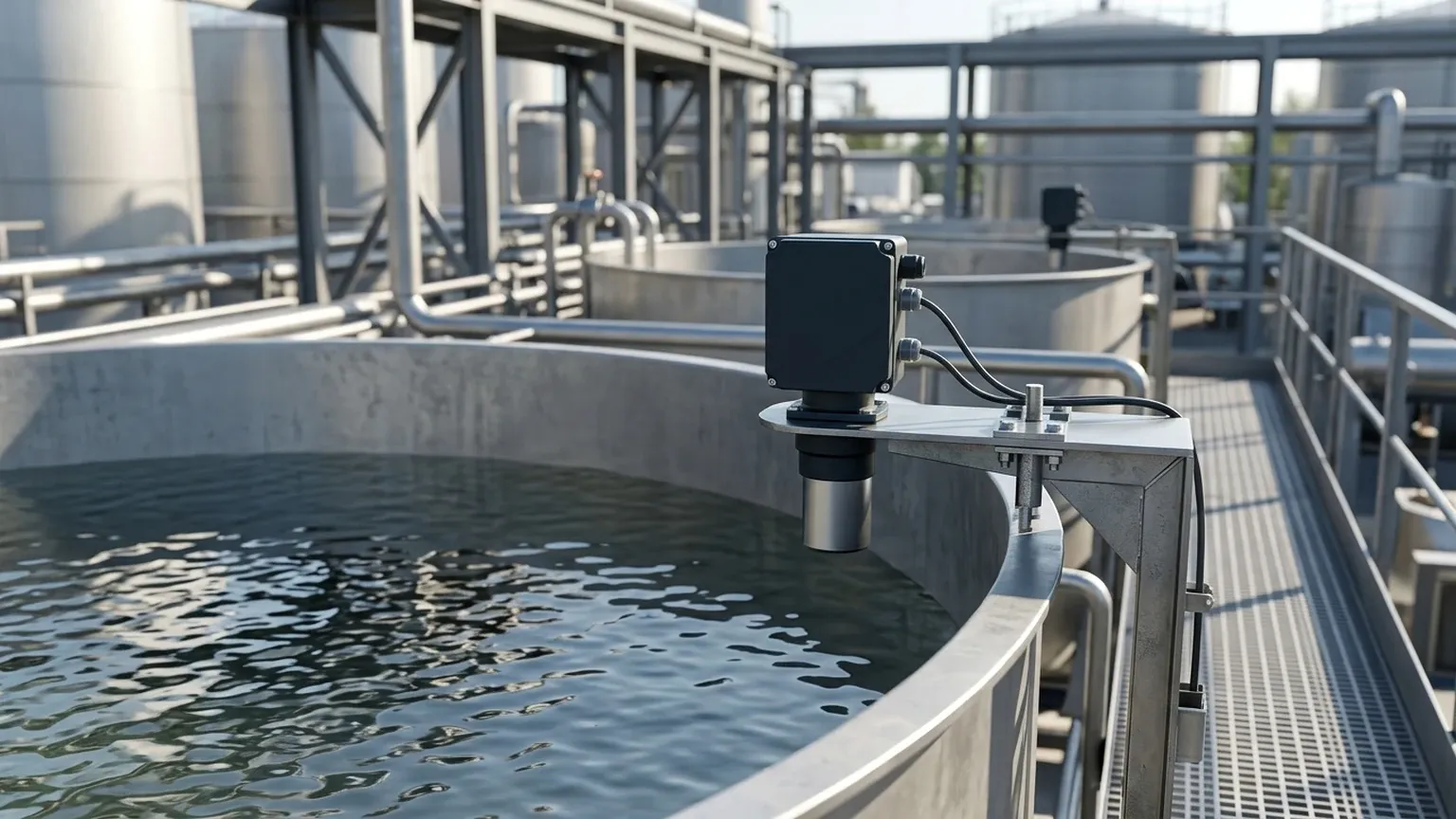
Every ultrasonic sensor has a "dead zone" directly beneath the transducer face where it cannot measure. This is caused by the time required for the transducer to stop vibrating after transmitting a pulse before it can start listening for the return. Always mount the sensor high enough so that the maximum liquid level never enters this zone.
Perpendicular Alignment
The transducer face must be installed perfectly parallel to the product surface. If the sensor is tilted, the ultrasonic pulse will reflect away from the sensor instead of back toward it, resulting in a "Loss of Echo" error.
Avoiding Obstructions
Ensure the path of the ultrasonic beam is clear. If an obstruction is unavoidable, many modern Ultrasonic Level Meters offer "False Echo Suppression" software. This allows the user to map out fixed obstructions, telling the meter to ignore specific dB peaks at known distances.
Stilling Wells
In applications with heavy surface foam or extreme turbulence, installing the sensor inside a stilling well (a vertical pipe) can help. The pipe acts as a guide for the pulse and provides a calm surface for the measurement, though it requires careful cleaning to prevent buildup.
Common Risks and Limitations
While ultrasonic technology is robust, it is not a "one-size-fits-all" solution. Engineers should be aware of the following limitations:
* Vacuum Conditions: Sound waves require a medium (air/gas) to travel. Ultrasonic meters will not work in a vacuum.
* Heavy Foam: Some types of foam are extremely acoustic-absorbent. They act like a sponge for the ultrasonic pulse, reducing the returning dB level to zero. In these cases, a radar level meter or a hydrostatic transmitter may be more appropriate.
* High Pressure: Changes in pressure alter the density of the gas through which the sound travels, which can affect the speed of sound and measurement accuracy if not properly compensated.
* Extreme Dust: In solid level measurement, heavy dust during filling can scatter the signal. This requires a high-power transducer with advanced signal processing to filter out the noise.
Information to Confirm Before Purchase
Before finalizing the specification for an ultrasonic level meter, ensure you have documented the following:
1. Material Properties: Is it a liquid or solid? Is there foam, steam, or dust?
2. Vessel Geometry: What is the total height? Are there internal obstructions?
3. Process Conditions: What are the maximum and minimum temperatures and pressures?
4. Output Requirements: Do you need 4-20mA, Modbus RTU, or simple relay switches for pump control?
5. Mounting Type: Is a flange mount, NPT thread, or bracket mount required?
Frequently Asked Questions (FAQ)
Q: Can an ultrasonic level meter measure through a closed plastic tank lid?
A: Generally, no. While some low-power sensors claim to do this, the interface between the air, the plastic, and the air again causes significant signal loss and refraction. It is always best to install the sensor through a hole in the lid so the transducer has a direct line of sight to the material.
Q: How do I handle condensation on the sensor face?
A: Condensation can attenuate the signal. Many Welk sensors feature a self-cleaning effect where the vibration of the transducer helps shed water droplets. For extreme cases, a sensor with a parabolic shape or a specialized coating can help.
Q: What is the difference between an integrated and a remote ultrasonic meter?
A: An integrated meter has the sensor and the electronics in one housing. A remote meter has a separate transducer connected via cable to a controller. Remote versions are preferred for hazardous areas or when the display needs to be mounted at eye level far from the top of a tall tank.
Q: Why is my meter showing a full tank when it is actually empty?
A: This is often caused by a "ringing" effect or a false echo from a nearby obstruction or the tank wall. Check the installation for perpendicularity and ensure the sensor is not mounted too close to the wall (the "beam spread" should not touch the sides).
Conclusion
Navigating the technicalities of an ultrasonic db meter—or more accurately, the dB signal processing within a level meter—requires a balance of theoretical knowledge and practical application. By understanding how signal strength is affected by the environment and following strict installation guidelines, industrial operators can achieve highly reliable, non-contact level measurement.
Welk continues to provide advanced Ultrasonic Level Meters designed to overcome the common challenges of signal attenuation and environmental interference. Whether you are managing water treatment facilities or chemical storage, selecting the right frequency and gain settings is the first step toward process optimization.