Ultrasonic Level Sensor Disadvantages
Ultrasonic Level Sensor Disadvantages: A Comprehensive Engineering Guide
In the landscape of industrial automation, selecting the correct instrumentation is critical for operational efficiency and safety. While non-contact measurement has become a standard in many sectors, understanding the specific limitations of various technologies is essential for process engineers. This guide provides a technical analysis of ultrasonic level sensor disadvantages, offering a balanced view to assist in the selection of Ultrasonic Level Meters for specific industrial applications.
Understanding the Measurement Principle
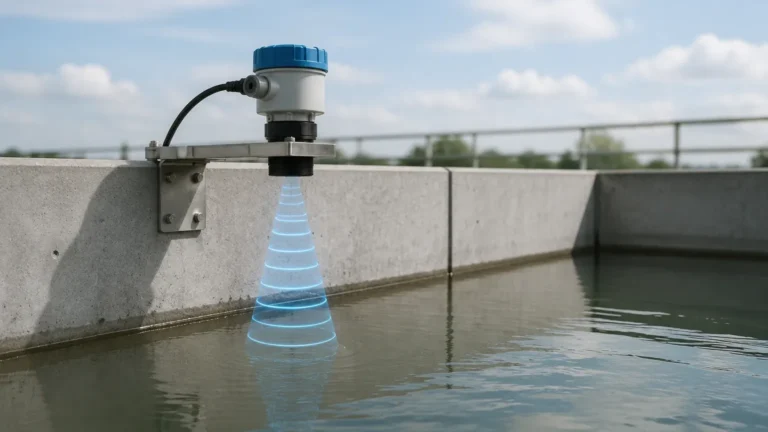
Before examining the limitations, it is necessary to understand how these instruments function. Ultrasonic level measurement is based on the Time-of-Flight (ToF) principle. The sensor’s transducer emits a high-frequency acoustic pulse—typically between 20 kHz and 200 kHz. This sound wave travels through the air (or vapor space), strikes the surface of the material being measured, and reflects back toward the transducer.
The instrument calculates the distance to the material using the formula:
Distance = (Speed of Sound × Time) / 2
Because the speed of sound in air is approximately 344 m/s at 20°C, the electronics can determine the level with high precision, provided the environment remains stable. However, because this technology relies on a mechanical wave traveling through a physical medium (usually air), its performance is susceptible to any factor that alters the properties of that medium or the characteristics of the reflection.
Primary Ultrasonic Level Sensor Disadvantages and Limitations
While ultrasonic technology is cost-effective and easy to install, engineers must account for several physical and environmental constraints that can lead to measurement errors or total signal loss.
1. Atmospheric and Environmental Constraints
Temperature Fluctuations
The speed of sound is highly dependent on the temperature of the medium it travels through. A change in temperature directly affects the time it takes for the pulse to return, leading to inaccurate level readings. While most modern Ultrasonic Level Meters include integrated temperature compensation, these sensors only measure the temperature at the transducer. If there is a significant temperature gradient within the tank (e.g., a hot liquid with cold air at the top), the compensation may be inaccurate.
Pressure Limitations
Ultrasonic waves require a medium to travel. Consequently, they cannot function in a vacuum. Furthermore, these sensors are generally unsuitable for high-pressure applications. Most standard units are rated for atmospheric pressure or a maximum of 0.3 MPa (3 bar). High pressure increases the density of the air, which can attenuate the signal or change the acoustic impedance of the transducer, leading to poor performance.
Vapor and Gas Composition
The calculation of distance assumes the medium is standard air. If the headspace contains heavy vapors, steam, or different gases (such as CO2, methane, or nitrogen), the speed of sound will change significantly. For example, sound travels much slower in carbon dioxide than in air. Without specialized calibration for the specific gas mixture, the sensor will report a level that is physically impossible.
2. Surface and Media Characteristics
Heavy Foam and Turbulence
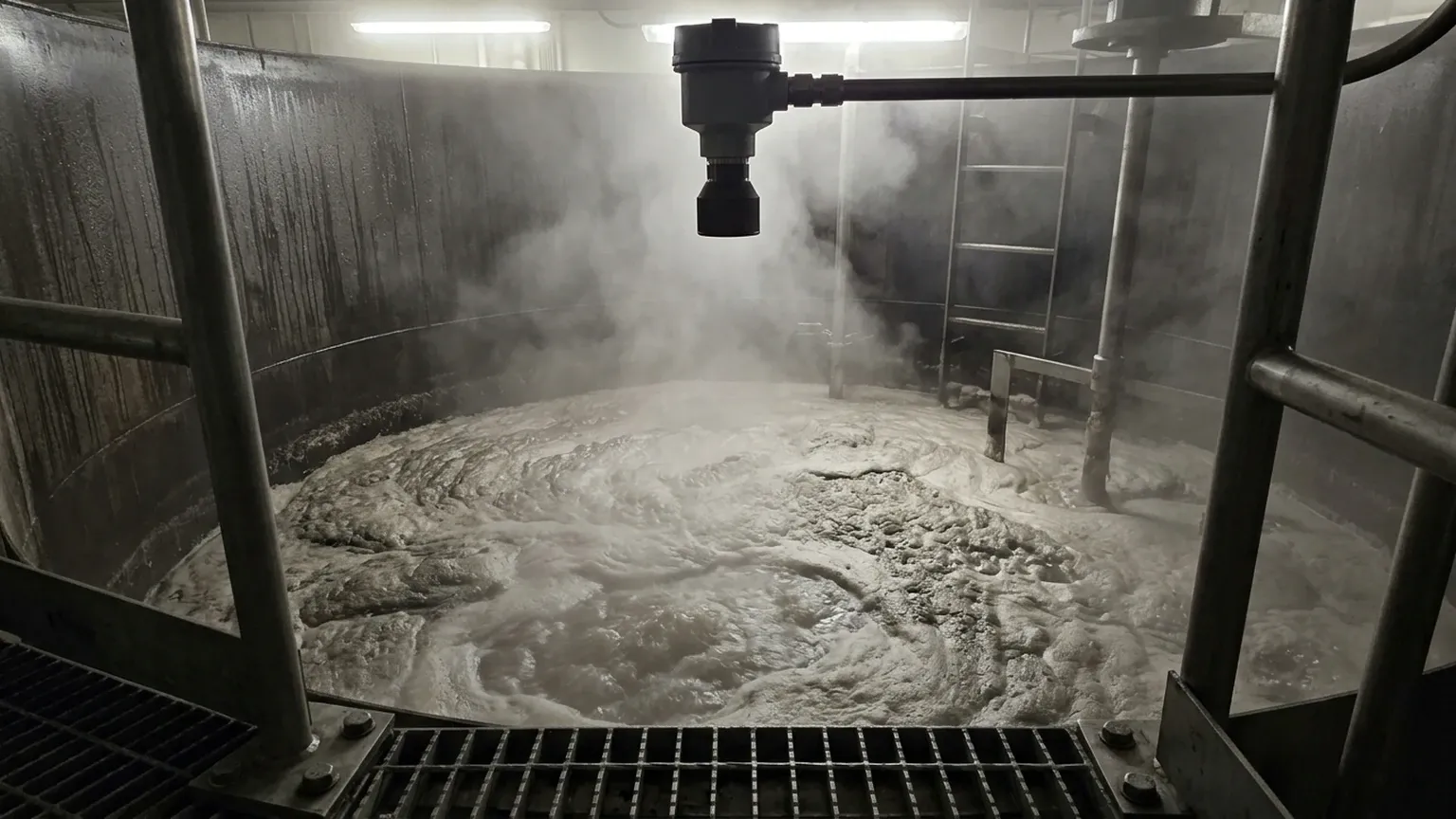
One of the most significant ultrasonic level sensor disadvantages is the inability to measure through foam. Foam acts as an acoustic absorber, soaking up the sound energy rather than reflecting it. If the foam is thick and "dry," the sensor may receive no echo at all. If the surface is highly turbulent or agitated, the sound waves may scatter in different directions, resulting in an inconsistent or "jumping" signal.
Dust and Acoustic Absorption
In solid level measurement, such as in grain silos or cement bunkers, heavy dust clouds can attenuate the high-frequency sound waves. Additionally, certain materials have low reflective properties (low acoustic impedance). If the material surface is angled or extremely porous, the returned echo may be too weak for the sensor to process reliably.
3. Physical and Mechanical Constraints
The Dead Zone (Blocking Distance)
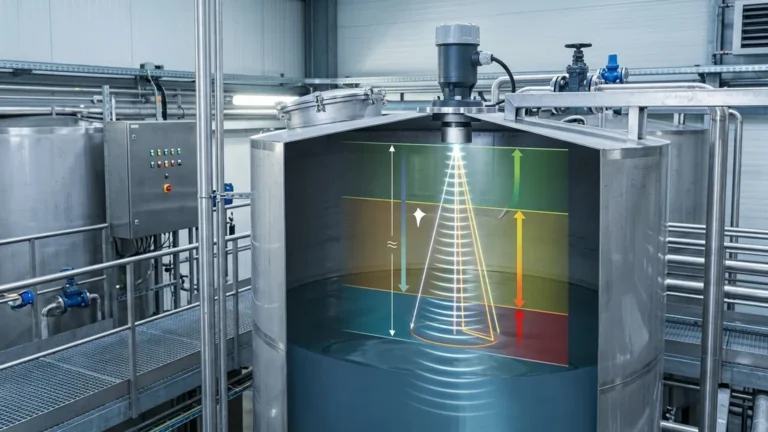
Every ultrasonic transducer has a "dead zone" or blocking distance—a region immediately in front of the sensor face where it cannot measure. This occurs because the transducer cannot emit and receive simultaneously; it needs a few milliseconds for the mechanical vibration (ringing) to stop before it can listen for the echo. Typically, this zone ranges from 10 cm to 80 cm depending on the frequency. If the material level enters this zone, the sensor will provide an error or an incorrect reading.
Beam Angle and Obstructions
Ultrasonic pulses do not travel in a perfectly straight line; they spread out in a cone shape, usually between 5° and 15°. If the tank is narrow or contains internal obstructions such as ladders, agitators, or heating coils, the sound wave may hit these objects and return a false "high level" echo. This requires careful positioning or the use of software-based "false echo suppression," which can complicate commissioning.
Comparative Analysis: Selecting the Right Technology
To determine if an ultrasonic solution is appropriate, it is helpful to compare it against alternative technologies like Radar (FMCW) or Hydrostatic transmitters.
| Feature | Ultrasonic Level Meters | Radar (Non-contact) | Hydrostatic |
| :— | :— | :— | :— |
| Medium | Liquids & Solids | Liquids & Solids | Liquids Only |
| Vacuum Support | No | Yes | Yes |
| Foam Resistance | Poor | Moderate to Good | Excellent |
| Max Pressure | Typically < 3 bar | Up to 100+ bar | Dependent on sensor |
| Cost | Low to Moderate | High | Moderate |
| Accuracy | ±0.25% to ±0.5% | ±1mm to ±3mm | ±0.1% to ±0.5% |
| Maintenance | Low (Non-contact) | Lowest (Non-contact) | Moderate (Contact) |
Installation Guidelines to Mitigate Performance Risks
Despite the ultrasonic level sensor disadvantages mentioned above, many issues can be mitigated through proper engineering and installation. When deploying Ultrasonic Level Meters, adhere to the following best practices:
1. Avoid the Fill Stream: Never mount the sensor directly above the point where the tank is being filled. The falling material or liquid will interfere with the acoustic pulse.
2. Vertical Alignment: The transducer face must be perfectly parallel to the product surface. Even a few degrees of tilt can cause the reflected signal to miss the receiver in liquid applications.
3. Nozzle Geometry: If mounting on a standpipe or nozzle, ensure the nozzle is short and wide enough so the beam does not hit the edges. The inner surface of the nozzle should be smooth.
4. Stilling Wells: In applications with heavy turbulence or surface foam, installing the sensor inside a stilling well (a vertical pipe) can provide a calm surface for measurement, though this requires regular cleaning to prevent buildup.
5. Sun Shielding: For outdoor installations, use a sun shield to prevent the sensor housing from heating up significantly more than the ambient air, which can skew temperature compensation.
Frequently Asked Questions (FAQ)
Q: Can ultrasonic sensors be used for boiling liquids?
A: Generally, no. Boiling liquids create heavy steam and surface turbulence, both of which are primary ultrasonic level sensor disadvantages. Steam changes the speed of sound and attenuates the signal, while turbulence scatters the echo. Radar is a better choice for these conditions.
Q: What is the maximum range for an ultrasonic level meter?
A: Standard industrial units typically range from 5 meters to 30 meters. While some specialized long-range sensors can reach up to 60 meters for solids, the accuracy and reliability decrease as the distance increases due to air signal attenuation.
Q: How does humidity affect the measurement?
A: High humidity increases the density of the air, which slightly increases the speed of sound. At room temperature, the difference between 0% and 100% humidity can cause an error of about 0.35%. In most industrial applications, this is negligible compared to temperature effects, but it should be considered in high-precision requirements.
Q: Can I use an ultrasonic sensor in a pressurized tank?
A: Only if the pressure is low (typically under 2-3 bar) and constant. If the pressure fluctuates, the speed of sound will change, and the sensor will require recalibration or will provide inaccurate data. For high-pressure vessels, radar or guided wave radar is recommended.
Conclusion
Ultrasonic level sensors remain a premier choice for water treatment, chemical storage in vented tanks, and open-channel flow measurement due to their non-contact nature and cost-efficiency. However, the inherent ultrasonic level sensor disadvantages—specifically regarding temperature gradients, foam, and pressure—mean they are not a universal solution.
By understanding the physics of acoustic measurement and conducting a thorough site survey, engineers can determine whether to proceed with Ultrasonic Level Meters or opt for more robust technologies like radar or hydrostatic pressure. For complex applications involving volatile vapors or extreme temperatures, consulting with a manufacturer like Welk can ensure that the selected instrument meets the long-term reliability requirements of the facility.