Ultrasonic Level Sensor Switch
Ultrasonic Level Sensor Switch: A Technical Guide for Industrial Applications
In the realm of industrial automation and process control, the ability to accurately detect the presence or absence of a liquid or solid at a specific height is critical for safety, efficiency, and inventory management. The ultrasonic level sensor switch has emerged as a versatile, non-contact solution for point-level detection across diverse sectors, including water treatment, chemical processing, and food production. Unlike mechanical float switches, these electronic devices utilize high-frequency sound waves to monitor levels, eliminating concerns regarding moving parts, clogging, or material buildup.
This guide provides a comprehensive technical overview of ultrasonic level sensing technology, focusing on its application as a switch, selection criteria for engineering projects, and best practices for installation and maintenance.
Understanding the Measurement Principle
To effectively implement an ultrasonic level sensor switch, one must first understand the physics of ultrasonic measurement. These devices operate on the "Time of Flight" (ToF) principle.
The Time of Flight Mechanism
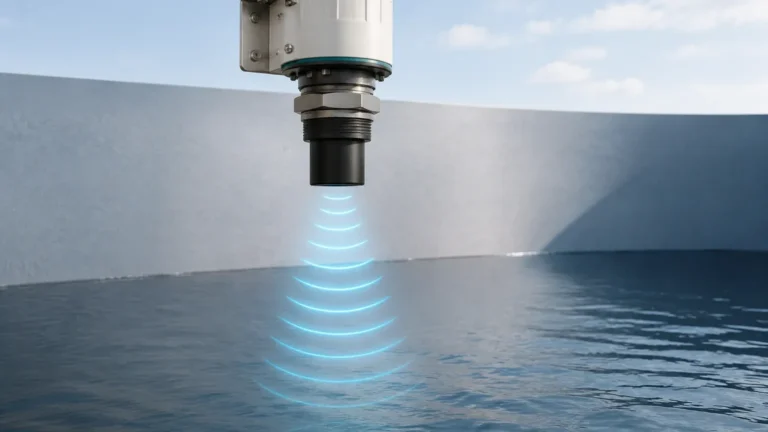
An ultrasonic transducer, typically made of piezoelectric crystals, emits a pulse of high-frequency sound waves (usually between 20 kHz and 200 kHz). These waves travel through the air or gas space in a tank until they strike the surface of the medium (liquid or solid). Upon impact, the sound waves are reflected back to the sensor. The sensor’s internal electronics measure the time interval between the emission of the pulse and the reception of the echo.
The distance ($D$) from the sensor to the material surface is calculated using the formula:
$$D = \frac{v \times t}{2}$$
Where:
* $v$ is the speed of sound in the medium (typically air).
* $t$ is the total time elapsed for the round trip.
In the context of an ultrasonic level sensor switch, the device is programmed with specific switching points. When the calculated distance matches a pre-set threshold (representing a high or low level), the internal relay or transistor output changes state, triggering an alarm, starting a pump, or closing a valve.
Temperature Compensation
The speed of sound in air is highly dependent on temperature, changing by approximately 0.17% per degree Celsius. To maintain accuracy, modern Ultrasonic Level Meters and switches incorporate integrated temperature sensors. This allows the device to automatically adjust the distance calculation based on the ambient air temperature within the vessel.
The Role of the Ultrasonic Level Sensor Switch in Automation
While continuous Ultrasonic Level Meters provide a constant 4-20mA or digital output representing the exact level, a dedicated switch is often preferred for discrete control tasks. The ultrasonic level sensor switch is primarily utilized for:
1. Overfill Protection: Acting as a redundant safety layer to prevent tank overflows in chemical or wastewater applications.
2. Dry-Run Prevention: Protecting pumps from damage by ensuring they do not operate when the liquid level falls below the intake.
3. Pump Control: Managing the "start" and "stop" cycles of pumps in sumps or lift stations.
4. Leak Detection: Monitoring secondary containment areas for the presence of spilled fluids.
Technical Specifications and Selection Criteria
Selecting the correct ultrasonic level sensor switch requires a detailed analysis of the application environment. Engineers should consult the following selection table to align device capabilities with process requirements.
Table 1: Key Selection Parameters for Ultrasonic Switches
| Parameter | Requirement | Engineering Consideration |
| :— | :— | :— |
| Measurement Range | 0.1m to 15m (typical) | Ensure the "Dead Zone" (blocking distance) is accounted for at the top of the tank. |
| Output Type | Relay, PNP/NPN, or MOSFET | Must match the input requirements of the PLC or control system. |
| Operating Temperature | -40°C to +80°C | High temperatures can affect transducer longevity and sound speed accuracy. |
| Process Pressure | Atmospheric to 3 bar | Ultrasonic waves do not travel well in vacuums or high-pressure environments. |
| Wetted Materials | PVDF, PP, or PTFE | Must be chemically compatible with the stored medium. |
| Beam Angle | 5° to 12° | Narrower beam angles are better for narrow tanks or tanks with internal obstructions. |
| Ingress Protection | IP65 to IP68 | Determined by whether the sensor will be exposed to wash-downs or submersion. |
Installation Guidelines and Best Practices
The reliability of an ultrasonic level sensor switch is heavily dependent on proper physical installation. Incorrect positioning is the leading cause of signal loss or false triggering.
1. Avoiding the Dead Zone
Every ultrasonic sensor has a "Dead Zone" (also known as the blocking distance) directly beneath the transducer face. In this zone, the sensor cannot process the return echo because it is still vibrating from the emission pulse. If the liquid level enters this zone, the switch may provide an erratic or "full" error signal. Always mount the sensor high enough so that the maximum liquid level remains below the dead zone (typically 10cm to 50cm, depending on the model).
2. Positioning and Orientation
* Perpendicularity: The sensor must be mounted perfectly perpendicular to the liquid surface. A tilt of even a few degrees can cause the echo to bounce away from the transducer rather than back to it.
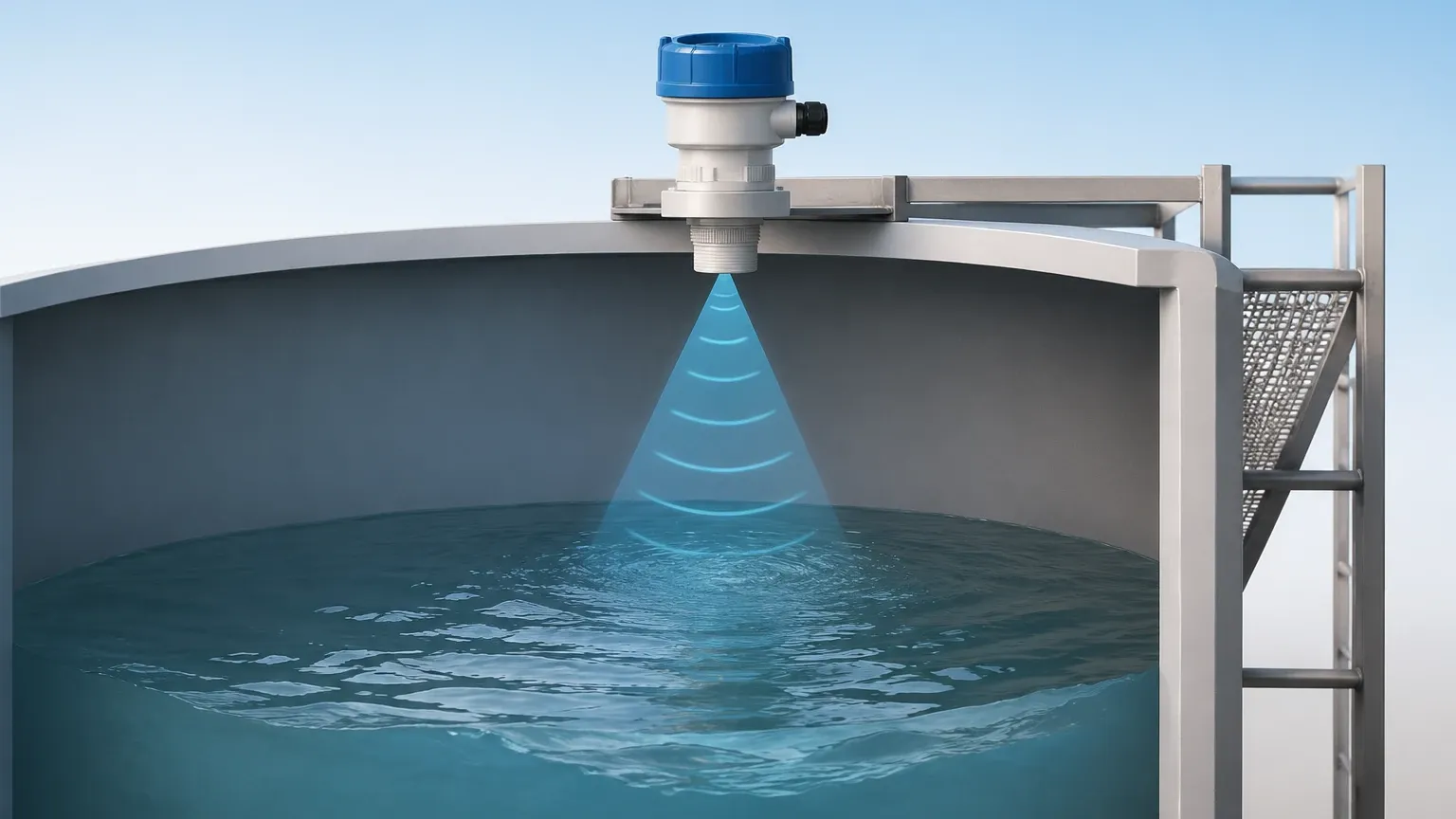
* Wall Clearance: Avoid mounting the sensor too close to the tank wall. The sound waves expand in a cone shape; if the cone hits the wall, it can cause false echoes. A general rule is to maintain a distance from the wall of at least 1/10th of the total tank height.
* Obstructions: Ensure the signal path is clear of ladders, pipes, or agitators. If obstructions are unavoidable, many modern Ultrasonic Level Meters offer "false echo suppression" software to ignore these static reflections.
3. Environmental Considerations
* Turbulence: Heavy surface turbulence can scatter the ultrasonic signal. In such cases, a standpipe (stillwell) can be used to provide a calm surface for measurement.
* Foam: Foam is a significant challenge for ultrasonic technology. Light, airy foam tends to absorb the sound pulse, leading to signal loss. If heavy foam is present, a radar level meter or a contact-based switch may be more appropriate.
* Vapor and Dust: Dense vapors or heavy dust can change the medium through which the sound travels, potentially affecting accuracy. In pressurized chemical tanks, the vapor composition must be considered.
Comparative Analysis: Ultrasonic vs. Other Technologies
When designing a level control system, engineers must decide between ultrasonic switches and alternative technologies. The following table highlights the strengths and weaknesses of common point-level solutions.
Table 2: Technology Comparison for Point Level Detection
| Technology | Advantages | Disadvantages |
| :— | :— | :— |
| Ultrasonic Switch | Non-contact, no moving parts, suitable for corrosive liquids, easy to clean. | Sensitive to foam, heavy dust, and high-pressure/vacuum environments. |
| Tuning Fork (Vibratory) | Highly reliable, unaffected by foam or bubbles, very compact. | Contact-based; prone to coating/buildup with viscous or sticky fluids. |
| Float Switch | Simple, low cost, no power required (for basic models). | Moving parts can jam; prone to mechanical wear and clogging in dirty liquids. |
| Radar (Non-contact) | Unaffected by vapor, dust, or temperature; extremely accurate. | Generally higher cost than ultrasonic solutions. |
| Capacitive Switch | Good for solids and liquids; can detect through non-metallic walls. | Requires calibration for different dielectric constants; sensitive to coating. |
| Hydrostatic Pressure | Excellent for deep tanks and underground sumps. | Contact-based; density changes in the liquid affect accuracy. |
Troubleshooting and Maintenance
While an ultrasonic level sensor switch is virtually maintenance-free due to its lack of moving parts, periodic inspections are recommended to ensure long-term performance.
* Transducer Cleaning: In applications with high humidity or splashing, condensate or material buildup can form on the transducer face. This should be gently cleaned with a soft cloth and water. Avoid abrasive cleaners or sharp tools that could damage the piezoelectric surface.
* Signal Strength Monitoring: Many digital ultrasonic switches provide a signal strength or "echo quality" metric. A gradual decline in this value may indicate increasing foam, vapor, or transducer degradation.
* Wiring Integrity: Check cable glands and terminal connections for signs of moisture ingress or corrosion, particularly in outdoor installations.
Frequently Asked Questions (FAQs)
Q: Can an ultrasonic level sensor switch be used for solids like grain or plastic pellets?
A: Yes, but with limitations. Solids do not reflect sound as efficiently as liquids and often have an irregular surface (angle of repose). A sensor with a higher power output and a narrower beam is typically required for solids.
Q: How does wind affect an ultrasonic switch installed on an open tank?
A: Strong winds can "blow" the ultrasonic pulse away, causing signal loss. For outdoor applications, using a sunshade or a protective shroud can help stabilize the air column beneath the sensor.
Q: Is it possible to use an ultrasonic switch in a vacuum?
A: No. Ultrasonic waves require a medium (gas or liquid) to travel. In a vacuum, there are no molecules to transmit the sound energy, making the technology non-functional.
Q: What is the difference between a 2-wire and a 4-wire ultrasonic switch?
A: A 2-wire device is loop-powered, meaning the power and the signal share the same pair of wires. A 4-wire device has separate wires for power supply and signal output, which is often necessary for sensors requiring higher power for long-range measurement or those with heavy-duty relay outputs.
Conclusion
The ultrasonic level sensor switch represents a highly effective balance of reliability and cost-efficiency for modern industrial processes. By providing non-contact detection, it bypasses many of the maintenance headaches associated with traditional mechanical switches. However, successful implementation requires careful consideration of the process environment—specifically the presence of foam, the tank geometry, and the chemical compatibility of the sensor materials.
For engineers seeking a robust solution for tank management, Welk offers a range of high-performance Ultrasonic Level Meters and switches designed to withstand the rigors of industrial automation. By following the installation and selection guidelines outlined in this guide, facilities can ensure accurate level detection and enhanced operational safety.