3 Ultrasonic Water Meter
Understanding the 3 Ultrasonic Water Meter: Selection and Implementation in Industrial Systems
In modern industrial water management, the transition from mechanical measurement to electronic sensing has significantly improved data accuracy and system longevity. Among the various sizes utilized in commercial and industrial piping, the 3 ultrasonic water meter (typically referring to the DN80 or 3-inch nominal diameter) has emerged as a critical component for monitoring medium-flow branch lines, cooling towers, and irrigation systems.
Unlike traditional turbine or Woltman-style meters, ultrasonic technology utilizes acoustic waves to determine velocity without any moving parts in the flow stream. This article explores the engineering principles, selection criteria, and installation requirements for 3-inch ultrasonic flow measurement, while also examining how these devices integrate with Ultrasonic Level Meters to provide a comprehensive view of industrial fluid dynamics.
Measurement Principles: How Ultrasonic Technology Works
To effectively select a 3 ultrasonic water meter, engineers must first understand the underlying physics of ultrasonic measurement. In industrial water applications, two primary ultrasonic methods are employed: Transit-Time and Doppler Effect. For clean water applications, Transit-Time is the industry standard.
Transit-Time Ultrasonic Flow Measurement
Transit-time meters utilize a pair of transducers, both acting as transmitters and receivers. These transducers are mounted on the 3-inch pipe, either internally (wetted) or externally (clamp-on). The device sends an ultrasonic pulse from the upstream transducer to the downstream transducer and vice-versa.
* Downstream Pulse: Travels with the flow of the water, moving faster.
* Upstream Pulse: Travels against the flow, moving slower.
The meter calculates the time difference ($Δt$) between these two pulses. This difference is directly proportional to the velocity of the water. Since the cross-sectional area of the 3-inch pipe is known, the meter can calculate the volumetric flow rate ($Q = A × v$) with high precision.
Synergy with Level Measurement
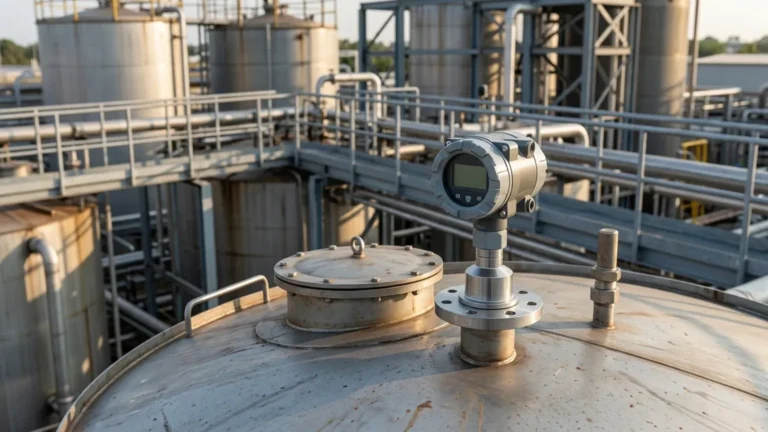
While a flow meter measures the rate of movement through a pipe, Ultrasonic Level Meters measure the volume of water held in tanks or reservoirs. In a B2B context, these two technologies are often used in tandem for "mass balance" calculations. By comparing the inflow recorded by a 3 ultrasonic water meter with the level changes in a storage tank, operators can identify hidden leaks or unauthorized water usage within a facility.
Key Features of 3-Inch (DN80) Ultrasonic Meters
A 3-inch pipe diameter is a "sweet spot" for many industrial applications, balancing high flow capacity with manageable installation footprints. When evaluating a 3 ultrasonic water meter, several technical features define its performance:
1. Turndown Ratio: Ultrasonic meters often feature a high turndown ratio (e.g., R250 or R400), meaning they can accurately measure very low flow rates that mechanical meters would miss.
2. No Pressure Drop: Because there are no rotors or obstructions in the bore, the pressure loss is negligible. This reduces the energy requirements for pumping systems.
3. Battery Longevity: Most industrial-grade ultrasonic meters are designed for 10 to 15 years of battery life, making them ideal for remote locations where external power is unavailable.
4. Digital Communication: Modern units include Modbus RTU, M-Bus, or LoRaWAN outputs, allowing for seamless integration into SCADA systems.
Selection Criteria and Technical Specifications
Selecting the right meter requires a comparison of process conditions against the instrument's capabilities. Below is a practical selection table for a standard industrial DN80 (3-inch) application.
Selection Table: Ultrasonic vs. Mechanical (3-Inch / DN80)
| Feature | Ultrasonic Water Meter (3") | Mechanical Woltman Meter (3") |
| :— | :— | :— |
| Moving Parts | None | Yes (Turbine/Rotor) |
| Accuracy | ±1% to ±2% | ±2% to ±5% (wears over time) |
| Low-Flow Sensitivity | Excellent (starts at 0.01 m/s) | Poor (requires minimum torque) |
| Pressure Loss | Δp < 10 kPa | Δp > 30 kPa |
| Maintenance | Minimal (no wear) | Periodic recalibration/replacement |
| Installation Orientation | Horizontal, Vertical, or Inclined | Primarily Horizontal |
| Lifespan | 10-15 Years | 5-7 Years (in hard water) |
Installation Considerations for 3-Inch Systems
To maintain the accuracy specified by the manufacturer, the installation of a 3 ultrasonic water meter must adhere to strict hydraulic guidelines. Ultrasonic waves are sensitive to turbulence caused by pipe fittings.
Straight Pipe Requirements
Flow profiles must be stable for the transit-time calculation to be accurate. The standard rule of thumb is the "10D Upstream / 5D Downstream" rule:
* Upstream: Provide at least 10 diameters (30 inches or 750 mm) of straight pipe before the meter.
* Downstream: Provide at least 5 diameters (15 inches or 375 mm) of straight pipe after the meter.
If the installation involves high-turbulence components like pumps or partially open valves, the upstream requirement may increase to 20D or 30D.
Orientation and Air Pockets
The meter should always be installed in a position where the pipe is completely full of liquid.
* Horizontal Installation: This is the most common. Ensure the transducers are not at the very top or bottom of the pipe to avoid air bubbles (top) or sediment (bottom) interfering with the signal.
* Vertical Installation: Upward flow is preferred to ensure the pipe remains full. Downward flow should be avoided unless there is sufficient backpressure to prevent the pipe from running partially empty.

Limitations and Challenges
While highly reliable, the 3 ultrasonic water meter is not a universal solution for every fluid. Engineers should be aware of the following limitations:
* Entrained Air: Large bubbles or foam can scatter ultrasonic signals, leading to "signal loss" errors. If the water contains significant air, an air eliminator must be installed upstream.
* High Solid Content: While transit-time meters can handle some turbidity, high concentrations of suspended solids (slurry) may require a Doppler-style meter instead.
* Acoustic Short-Circuiting: In some metallic pipes, the ultrasonic signal can travel through the pipe wall rather than the fluid. High-quality industrial meters use sophisticated signal processing to filter this out.
* Scaling: Heavy mineral scaling on the internal pipe wall can change the effective diameter and attenuate the signal, though this is less of a problem than it is for mechanical meters.
Integration with Industrial Automation
In a B2B environment, a 3 ultrasonic water meter is rarely a standalone device. It is typically part of a larger automation architecture.
For example, in a chemical processing plant, the water meter monitors the intake of process water. Simultaneously, Ultrasonic Level Meters monitor the chemical storage tanks. Both sets of data are fed into a central PLC (Programmable Logic Controller). If the level meter shows a drop in chemical volume but the water meter does not show a corresponding flow into the mixing tank, the system can trigger an alarm for a potential blockage or pump failure.
Frequently Asked Questions (FAQ)
Q: Can a 3 ultrasonic water meter measure flow in both directions?
A: Yes, most ultrasonic meters are inherently bi-directional. They can track both forward and reverse flow, which is particularly useful in distribution networks where backflow may occur.
Q: Does the water temperature affect the accuracy?
A: Ultrasonic velocity changes with temperature. However, industrial-grade meters include an integrated temperature sensor and automatically compensate the flow calculation based on the fluid's thermal properties.
Q: How do I know if my water is too "dirty" for an ultrasonic meter?
A: If the total suspended solids (TSS) exceed 10,000 ppm or if there is more than 2% aeration by volume, a standard transit-time meter may struggle. In these cases, electromagnetic meters or Doppler ultrasonic meters are recommended.
Q: Is a 3-inch ultrasonic meter suitable for steam or gas?
A: No. Water meters are specifically calibrated for the acoustic properties of liquids. Steam and gas require specialized high-frequency transducers and different housing materials to handle the pressure and temperature.
Summary of Best Practices
When implementing a 3 ultrasonic water meter in an industrial facility, the following checklist ensures long-term reliability:
1. Verify Pipe Material: Ensure the meter is compatible with the pipe material (PVC, Ductile Iron, Stainless Steel, etc.) for proper acoustic coupling.
2. Confirm Flow Range: Check that the expected minimum and maximum flow rates fall within the meter's R-value (turndown ratio).
3. Plan for Connectivity: Determine if the site requires pulse output, 4-20mA, or digital protocols like Modbus or LoRaWAN.
4. Environmental Protection: If the meter is installed outdoors or in a pit, ensure it has an IP68 rating to protect against submersion.
By following these engineering guidelines and considering the total system—including both flow and Ultrasonic Level Meters—operators can achieve a high degree of precision in their water management strategies, leading to reduced waste and improved operational efficiency.