Gems Level Switch 01950
Gems Level Switch 01950
In the landscape of industrial automation and fluid management, point-level detection remains a cornerstone for safety, efficiency, and process control. Among the diverse array of sensing technologies, the float-actuated magnetic switch is one of the most reliable and widely implemented solutions. The Gems Level Switch 01950, a specific iteration within the broader LS-3 series and related compact float switch families, represents a standardized engineering solution for high-volume OEM applications and localized tank monitoring.
Understanding the technical nuances of the 01950 model requires a deep dive into the physics of buoyancy, the mechanics of reed switches, and the material science that dictates its compatibility with industrial fluids. For engineers and procurement specialists, selecting the right Level Switches involves balancing precision with environmental durability.
Measurement Principles of Float-Type Level Switches
Before evaluating the specific performance of the Gems 01950, it is essential to understand the underlying physical principles that govern its operation. Float-type level switches operate on the principle of buoyancy and magnetic coupling.
The Buoyancy Principle
According to Archimedes' principle, any object, wholly or partially immersed in a fluid, is buoyed up by a force equal to the weight of the fluid displaced by the object. In a level switch, the float is designed with a specific gravity lower than that of the target liquid. As the liquid level rises, the float moves upward along a stationary stem.
Magnetic Actuation and the Reed Switch
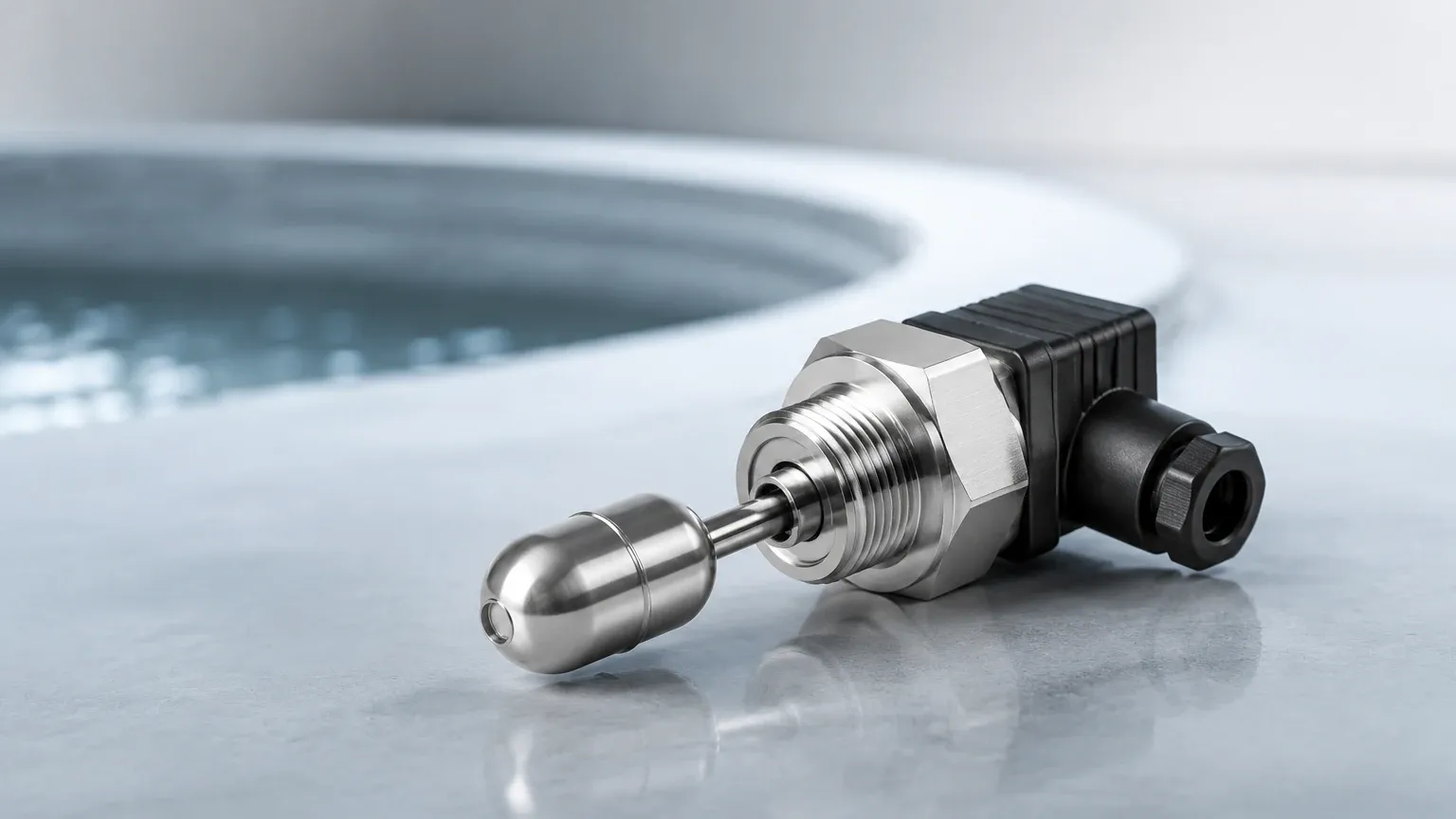
Inside the stationary stem of the Gems level switch 01950 is a hermetically sealed reed switch. This switch consists of two ferromagnetic blades (reeds) enclosed in a glass envelope filled with inert gas. The float contains a permanent magnet.
1. Interaction: As the float moves into proximity with the internal reed switch, the magnetic field pulls the two reeds together (closing the circuit) or allows them to separate (opening the circuit).
2. Logic Reversal: Most compact float switches, including the 01950 series, allow for "logic reversal." By removing a retaining clip and flipping the float 180 degrees, the user can change the switch from Normally Open (NO) to Normally Closed (NC) relative to the liquid level.
This mechanical simplicity ensures that the device does not require external power to operate the sensing element itself, making it an intrinsically robust component in complex electrical systems.
Technical Specifications of the Gems Level Switch 01950
The 01950 model is characterized by its compact form factor and specific material composition, typically designed for water, oils, and certain chemicals. While specific part configurations can vary slightly by production run, the core engineering specifications for this class of switch are as follows:
Material Composition
* Stem and Mounting: Usually constructed from Noryl (a blend of polyphenylene ether and polystyrene) or similar high-performance thermoplastics. This provides excellent hydrolytic stability.
* Float: Often manufactured from Buna-N (nitrile rubber). Buna-N is highly buoyant and resistant to many oils and fuels but is limited in high-temperature or highly corrosive acidic environments.
Operating Parameters
* Temperature Range: Typically rated for operation between -40°C to 82.2°C (-40°F to 180°F) in water, and up to 100°C (212°F) in certain oils.
* Pressure Rating: Designed for moderate pressures, often rated up to 10.3 bar (150 psi) at room temperature.
* Switching Capacity: Usually rated for 20 VA (Volt-Amps). It is critical to note that these switches are designed for pilot duty—signaling a PLC or a relay—rather than driving high-current loads like pumps or heaters directly.
Selection Criteria and Engineering Table
When specifying a level switch for a new project or replacement, engineers must verify that the physical properties of the media align with the switch's design. The following table provides a selection framework for the Gems level switch 01950 and similar float-based Level Switches.
| Criteria | Requirement for 01950 | Engineering Consideration |
| :— | :— | :— |
| Specific Gravity | Min. 0.45 to 0.80 | The float must be lighter than the liquid to ensure displacement. |
| Viscosity | Low to Medium | High-viscosity fluids (e.g., heavy syrups) can impede float movement. |
| Media Compatibility | Water, Oils, Dilute Acids | Buna-N floats are ideal for petroleum but fail in concentrated nitric acid. |
| Mounting Orientation | Vertical (± 30°) | Float switches rely on gravity; excessive tilt causes friction and sticking. |
| Tank Depth | Shallow to Medium | Best for localized high/low sensing in tanks under 2 meters (6.5 ft). |
Installation Considerations
Proper installation is the primary factor in the longevity of a Gems level switch 01950. Failure to follow mechanical and electrical best practices often leads to premature switch failure or intermittent signaling.
Mechanical Mounting
1. Vertical Alignment: The switch should be mounted vertically. While some tolerance exists (usually up to 30 degrees from vertical), significant deviation increases the friction between the float and the stem, which can lead to the float getting "stuck" in the up or down position.
2. Clearance: Ensure there is adequate clearance from tank walls and internal baffles. Turbulence near the switch can cause "chatter," where the switch rapidly opens and closes, potentially damaging downstream electronics.
3. Torque: When installing the 1/8" NPT or similar threaded versions, avoid over-torquing. Plastic threads can stress-crack over time if tightened beyond the manufacturer's specification.
Electrical Wiring and Protection
Because the reed switch inside the 01950 is a precision component, it is sensitive to electrical surges.
* Inductive Loads: If the switch is connected to a relay coil or a solenoid, a back-EMF (electromotive force) spike occurs when the switch opens. A diode (for DC) or an RC snubbing circuit (for AC) must be installed across the load to protect the reed contacts from welding together.
* Current Limits: Never exceed the VA rating. For the 01950, this is typically 20VA. Exceeding this will cause the contacts to arc and eventually fail in a closed position.
Limitations and Risks
While the Gems level switch 01950 is a versatile tool, it is not a universal solution. Engineers should be aware of the following limitations:
1. Particulate Accumulation: In fluids with high suspended solids or metallic filings, particles can accumulate on the magnetic float or inside the stem clearance. This can jam the mechanism.
2. Coating and Scaling: In water treatment applications, calcium or lime scale buildup can increase the weight of the float, eventually causing it to sink and provide a false "low" reading.
3. Vibration: High-vibration environments (such as those near heavy reciprocating compressors) can cause the reed switch to vibrate, leading to signal noise or mechanical fatigue of the reeds.
4. Non-Contact Requirements: If the media is extremely corrosive, sterile (food grade), or prone to heavy foaming, a non-contact technology like Welk’s ultrasonic or radar level sensors may be more appropriate than a mechanical float switch.
Comparative Analysis: Float vs. Other Technologies
In modern industrial settings, the Gems level switch 01950 often competes with newer technologies. Understanding when to stick with a float switch is key to cost-effective engineering.
* Float Switches (01950): Best for simple, point-level detection (High/Low alarms). They are low-cost, require no power, and are unaffected by vapor or foam.
* Ultrasonic Sensors: Better for continuous level measurement. However, they can be affected by foam and require sophisticated signal processing.
* Conductivity Probes: Useful for conductive liquids but cannot be used with oils or non-conductive hydrocarbons where the 01950 excels.
* Optical Sensors: Very compact but fail if the liquid is opaque or if the sensor tip becomes coated with film.
Maintenance and Troubleshooting
A proactive maintenance schedule for the Gems level switch 01950 can extend its service life to several years of continuous operation.
Routine Inspection
* Visual Check: Periodically inspect the float for signs of pitting or chemical degradation. If the Buna-N float appears "spongy," it may be absorbing fluid and should be replaced.
* Manual Actuation: During tank cleaning, manually slide the float up and down to ensure smooth movement and verify that the control panel receives the correct signal.
Troubleshooting Common Issues
* Switch Always Closed: This often indicates welded contacts due to an electrical surge. The switch must be replaced, and a protection circuit (diode/snubber) should be added.
* Intermittent Signal: Check for loose wiring or check if the float is being buffeted by high-velocity fluid entering the tank.
* No Signal: Verify that the float has not been installed upside down if the logic was recently changed.
Frequently Asked Questions (FAQ)
Q: Can the Gems level switch 01950 be used in drinking water?
A: This depends on the specific material certifications (such as NSF/ANSI standards). While Noryl and Buna-N are often used in water systems, always verify the specific part number's compliance with local potable water regulations.
Q: How do I change the switch logic from Normally Open to Normally Closed?
A: For most 01950 models, you remove the retaining clip at the end of the stem, slide the float off, flip it over, and reinstall it. The magnet's position relative to the reed switch changes, effectively reversing the logic.
Q: What is the maximum wire length for these switches?
A: Reed switches can handle long wire runs, but long cables have inherent capacitance. For runs exceeding 15 meters (50 feet), it is recommended to use a current-limiting resistor to prevent the initial capacitive discharge from damaging the switch contacts.
Q: Is the 01950 suitable for explosive environments?
A: As a simple mechanical switch, it can often be used in hazardous areas if connected to an intrinsically safe (IS) barrier. Without an IS barrier, it is not inherently explosion-proof.
Conclusion
The Gems level switch 01950 remains a staple in the industry due to its balance of simplicity and reliability. By adhering to strict installation guidelines and understanding the material limitations of Buna-N and Noryl, engineers can implement these Level Switches as effective safeguards in a wide variety of fluid management systems. For applications involving more complex media or requiring continuous data, exploring the broader catalog of ultrasonic and radar solutions from professional manufacturers like Welk is recommended to ensure the highest levels of process accuracy.