Best Pump Technologies for Flood Control
Best Pump Technologies for Flood Control
Effective flood control is a critical requirement for municipal infrastructure, industrial facilities, and large-scale agricultural operations. When water levels rise due to heavy precipitation, storm surges, or rapid snowmelt, the ability to move vast quantities of water quickly determines the extent of property damage and safety risks. Selecting the best pump technologies for flood control requires an integrated approach that considers not only the pump's mechanical design but also the automation systems that trigger and monitor its operation.
In modern flood mitigation, pumps do not operate in isolation. They are part of a larger ecosystem that includes level sensors, control panels, and discharge infrastructure. This guide explores the primary pump technologies used today, the measurement principles that ensure their timely activation, and the selection criteria essential for engineering resilient flood response systems.
The Role of Level Measurement in Flood Control
Before a pump can begin discharging water, the system must accurately detect the level of the fluid. In flood control applications, automated activation is mandatory because manual intervention is often impossible during extreme weather events. The reliability of the pump system is directly tied to the accuracy of the level measurement technology employed.
Ultrasonic Level Measurement
Ultrasonic sensors are widely used in open-channel flood control and wet wells. The principle involves emitting high-frequency sound pulses that reflect off the water surface. By measuring the time-of-flight—the duration it takes for the pulse to travel to the surface and return—the sensor calculates the distance.
* Advantages: Non-contact measurement prevents sensor fouling from debris or corrosive runoff.
* Limitations: Performance can be affected by heavy foam, extreme wind, or significant temperature gradients in the air column.
Radar Level Measurement
Radar technology, specifically non-contact 80GHz or 26GHz radar, is increasingly preferred for critical flood infrastructure. It operates on the same time-of-flight principle as ultrasonic sensors but uses microwave pulses instead of sound.
* Advantages: Microwaves are unaffected by air temperature, steam, or wind. They provide millimeter-level accuracy over long distances (up to 30 meters or more), making them ideal for monitoring river levels under bridges or deep pump stations.
* Integration: For those designing high-reliability systems, consulting a Main Page for specialized radar and ultrasonic sensors is a standard step in the engineering process.
Hydrostatic Pressure Measurement
Hydrostatic transmitters are submersible sensors that measure the weight of the water column above them. Based on the principle that pressure increases linearly with depth ($P = \rho gh$), these sensors provide a continuous signal. They are particularly useful in deep sumps where surface turbulence might interfere with non-contact sensors.
Leading Pump Technologies for Flood Mitigation
Identifying the best pump technologies for flood control depends on the specific hydraulic requirements: the volume of water (flow rate) and the height it must be lifted (head).
1. Axial Flow Pumps (Propeller Pumps)
Axial flow pumps are the workhorses of large-scale flood control. In these units, the impeller pushes water in a direction parallel to the pump shaft.
* Performance Profile: They excel at moving massive volumes of water at low head (usually under 10 meters).
* Applications: Ideal for draining low-lying polders, pumping water over levees, and managing large stormwater basins. They are often installed vertically to minimize the footprint of the pumping station.
2. Mixed Flow Pumps
As the name suggests, mixed flow pumps combine the characteristics of axial and centrifugal designs. The fluid experiences both radial and axial acceleration.
* Performance Profile: These pumps offer a middle ground, providing higher head capabilities than axial pumps while maintaining a higher flow rate than standard centrifugal pumps.
* Applications: Suitable for flood control scenarios where water must be moved through longer discharge pipes or over higher elevations.
3. Submersible Stormwater Pumps
Submersible pumps are designed with an integrated motor that is hermetically sealed. The entire unit is lowered into the wet well or sump.
* Performance Profile: Extremely versatile. Because they are submerged, they do not require priming and are less prone to cavitation if the intake is properly designed.
* Applications: Common in urban underpass drainage, basement flood protection, and smaller municipal lift stations. Many are designed with "vortex" impellers to handle solids and debris without clogging.
4. Self-Priming Centrifugal Pumps
While standard centrifugal pumps require the suction line to be filled with water to start, self-priming versions can evacuate air from the line and pull water from a source below the pump level.
* Performance Profile: These are typically surface-mounted, making maintenance easier as the mechanical components are not underwater.
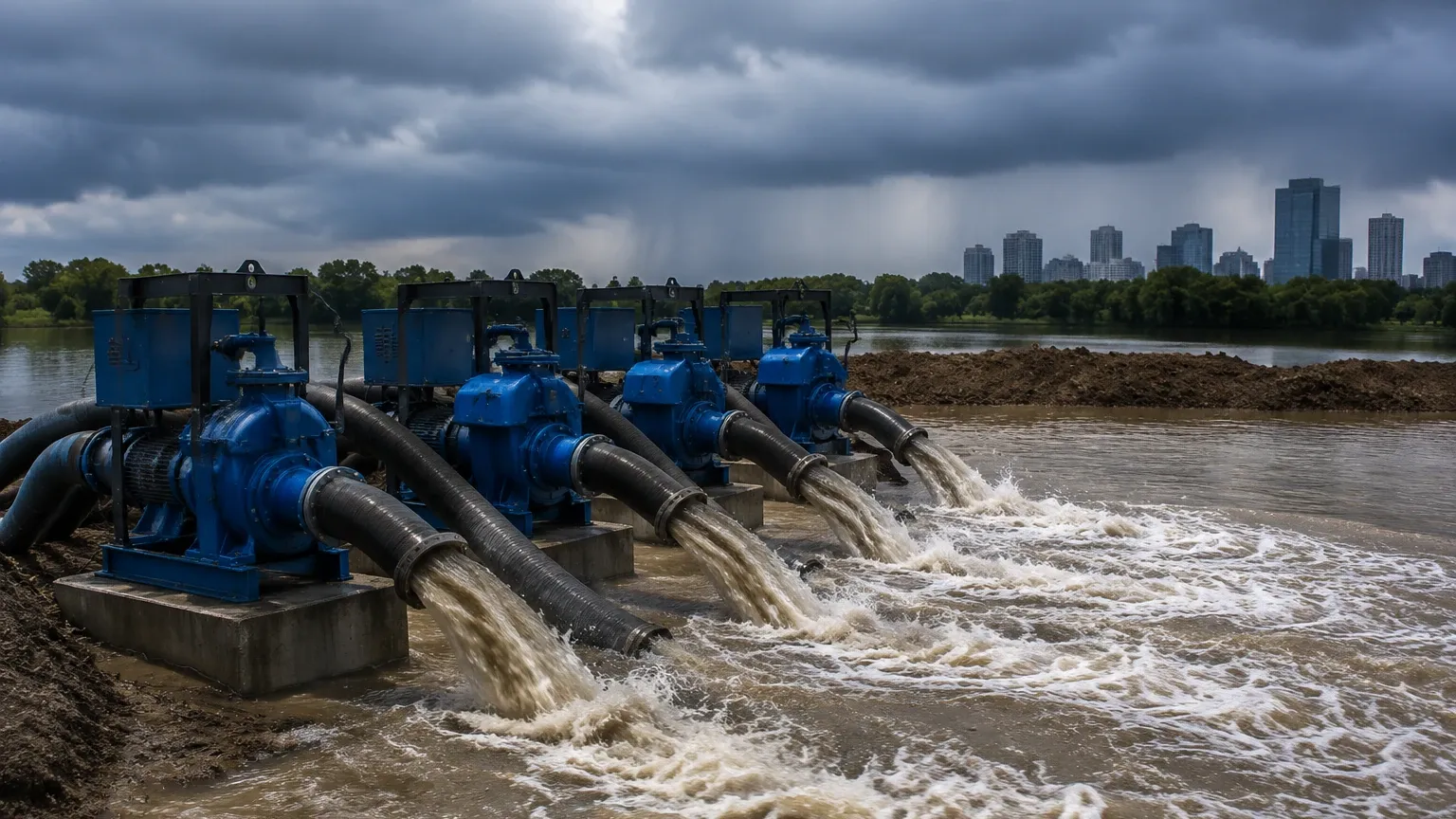
* Applications: Often used for temporary flood response or in mobile pump units driven by diesel engines during power outages.
Technical Selection Criteria
When evaluating the best pump technologies for flood control, engineers must use a multi-variable matrix to ensure the system remains operational under duress.
| Criterion | Requirement for Flood Control | Recommended Technology |
| :— | :— | :— |
| Flow Rate | High (e.g., >5,000 $m^3/h$) | Axial or Mixed Flow |
| Total Dynamic Head (TDH) | Low to Medium (2m – 15m) | Axial or Mixed Flow |
| Solids Handling | High (Debris, silt, plastic) | Submersible with Vortex Impeller |
| Response Time | Instantaneous/Automated | Submersible with Radar Level Control |
| Maintenance Access | Easy access preferred | Self-priming Surface Mounted |
| Power Reliability | Redundancy required | Diesel-driven or Dual Electric/Diesel |
Capacity and Head
The capacity is measured in cubic meters per hour ($m^3/h$) or liters per second ($l/s$). In flood control, the goal is often to match or exceed the peak inflow rate calculated from historical 100-year storm data. The Total Dynamic Head (TDH) includes the vertical lift plus the friction losses in the piping. Axial pumps lose efficiency rapidly if the head increases beyond their design limit, so accurate hydraulic modeling is essential.
Solids and Debris Handling
Floodwater is rarely clean. It carries silt, sand, vegetation, and urban refuse. Pumps used in these environments must have large internal clearances or be equipped with macerators/grinders if the discharge pipe diameter is small. For large-scale axial pumps, trash racks and mechanical screens are installed at the intake to protect the impellers.
Installation and Engineering Considerations
Even the best pump technologies for flood control will fail if the installation environment is poorly designed.
1. Intake Design: To prevent vortices (which can draw air into the pump and cause damage), the intake must be submerged at a minimum depth. The use of benching in the wet well helps direct solids toward the pump intake, preventing the accumulation of stagnant sludge.
2. Power Redundancy: Flood events are often accompanied by power grid failures. Critical stations should utilize dual power feeds or on-site backup generators. Variable Frequency Drives (VFDs) are also recommended to allow pumps to ramp up slowly, reducing hydraulic shock (water hammer) in the system.
3. Sensor Redundancy: In high-stakes applications, it is common practice to use two different measurement principles. For example, a non-contact radar sensor serves as the primary trigger, while a float switch or hydrostatic pressure sensor acts as a high-level alarm and secondary trigger.
4. Corrosion Resistance: Floodwater can be brackish or contaminated with industrial chemicals. Pump housings and impellers should be constructed from materials like duplex stainless steel or epoxy-coated cast iron to ensure a service life of 20+ years.
Limitations and Operational Risks
While modern pumps are highly reliable, several factors can compromise flood control efforts:
* Clogging: Despite screens, fine debris can accumulate on impellers, reducing flow and increasing power consumption. Regular "auto-reverse" cycles on modern pump controllers can help shed debris.
* Cavitation: If the pressure at the pump suction falls below the vapor pressure of the liquid, vapor bubbles form and collapse. This causes significant mechanical damage. Proper level sensing ensures the pump never runs in a "low-level" state where cavitation is likely.
* Stationary Siltation: In systems that only run during floods, silt can settle in the pump volute during dry periods. Periodic "exercise" runs are necessary to ensure the equipment is ready for an emergency.
Frequently Asked Questions (FAQs)
Q: How do I choose between an ultrasonic and a radar sensor for flood monitoring?
A: Choose ultrasonic for cost-effective, short-range measurements in stable environments. Choose radar for long-range measurement, high precision, or environments where wind, fog, or temperature fluctuations are present. You can find detailed specifications for both at the Main Page.
Q: Can axial flow pumps handle large solids?
A: While they have relatively large clearances, they are sensitive to fibrous material (like rags or long weeds) which can wrap around the propeller. Trash racks are almost always required for axial flow installations.
Q: What is the benefit of a submersible pump over a surface-mounted pump?
A: Submersible pumps do not require a separate pump house (saving on civil costs), are naturally primed, and operate more quietly. However, they require a crane or hoist for maintenance removal.
Q: How often should flood control pumps be tested?
A: Most municipal standards require a monthly test run. This ensures the seals remain lubricated, the motor windings stay dry, and the control logic is functioning correctly.
Conclusion
Selecting the best pump technologies for flood control requires balancing high-volume hydraulic performance with sophisticated automation. Axial and mixed flow pumps remain the standard for large-scale water movement, while submersible units offer versatility for urban and industrial applications. By integrating these pumps with reliable level measurement technologies like radar and ultrasonic sensors, engineers can build resilient systems capable of protecting infrastructure against the increasing frequency of extreme weather events. For further technical details on level instrumentation and pump control integration, refer to the resources available on the Welk Main Page.