Open Pit Mine Dewatering
Open Pit Mine Dewatering
Open pit mine dewatering is a critical engineering process required to lower the groundwater table within a mining area. By managing the inflow of water, mining operations can ensure slope stability, maintain a dry working environment for heavy machinery, and improve the overall safety of the site. Effective dewatering is not merely a matter of pumping water out; it requires a sophisticated monitoring system to track water levels in real-time across boreholes, sumps, and peripheral drainage networks.
In the context of industrial automation, the selection of level measurement technology is the foundation of a successful dewatering strategy. Accurate data allows for the automation of pump stations, prevents dry-running of expensive submersible pumps, and provides the necessary documentation for environmental compliance. This guide explores the technical principles, selection criteria, and installation requirements for level instrumentation used in open pit mine dewatering.
The Role of Level Measurement in Open Pit Mine Dewatering
In an open pit mine, water enters the excavation through various channels, including direct precipitation, surface runoff, and groundwater seepage from surrounding aquifers. If left unmanaged, this water can lead to several operational hazards:
1. Slope Instability: Pore water pressure within the rock or soil mass reduces the shear strength of the pit walls, increasing the risk of catastrophic landslides.
2. Operational Inefficiency: Wet pit floors hinder the movement of haul trucks and loading equipment, leading to increased fuel consumption and maintenance costs.
3. Safety Risks: Flooding of the pit floor can submerge electrical infrastructure and create hazardous conditions for personnel.
To mitigate these risks, engineers implement dewatering systems that typically consist of peripheral deep wells (to intercept groundwater before it reaches the pit) and in-pit sumps (to collect surface runoff). Monitoring the water level in these locations is essential. For comprehensive technical specifications on monitoring equipment, engineers often consult the Main Page of specialized instrument manufacturers to match sensor capabilities with site-specific demands.
Measurement Principles for Mine Water Monitoring
Before selecting a device for open pit mine dewatering, it is essential to understand the physical principles governing different level measurement technologies. Each method has distinct advantages depending on the depth of the well, the presence of solids, and environmental conditions.
Hydrostatic Pressure Measurement
Hydrostatic level transmitters operate on the principle that the pressure at a specific depth in a liquid is proportional to the height of the liquid column above it. The relationship is defined by the formula:
P = ρ · g · h
Where *P* is the pressure, *ρ* (rho) is the density of the liquid, *g* is the gravitational constant, and *h* is the height of the liquid.
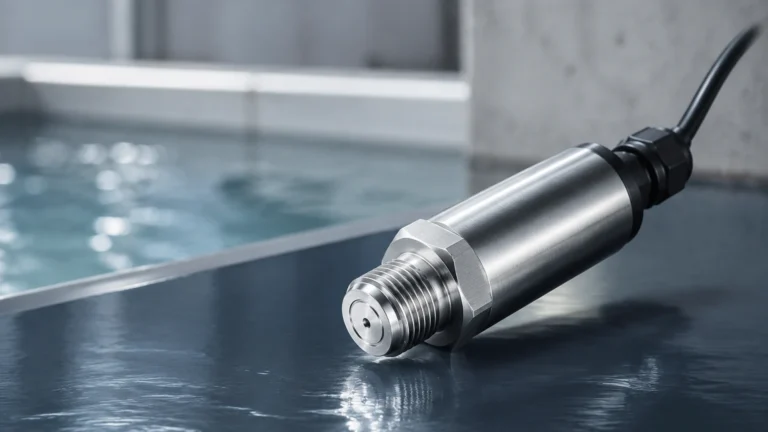
In mining, submersible hydrostatic sensors are lowered into boreholes. They feature a sensitive diaphragm that detects the pressure of the water column. To account for changes in atmospheric pressure, these sensors use a vented cable that connects the back of the diaphragm to the surface. This ensures that the measurement reflects only the weight of the water.
Ultrasonic (Time-of-Flight)
Ultrasonic sensors are non-contact devices that emit high-frequency sound pulses. These pulses travel through the air, reflect off the water surface, and return to the sensor. The distance is calculated based on the time it takes for the pulse to return and the speed of sound in air.
Because sound speed is affected by air temperature, most industrial ultrasonic sensors include integrated temperature compensation. These are ideal for open sumps where the water may contain debris that could damage a submerged sensor.
Radar (Microwave)
Radar level meters also use the time-of-flight principle but utilize electromagnetic waves rather than sound. Radar waves travel at the speed of light and are virtually unaffected by air temperature, pressure, or the presence of dust and steam.
High-frequency radar (such as 80GHz) is particularly effective in mining because it offers a narrow beam angle, allowing it to measure water levels in narrow pipes or deep wells without interference from the side walls.
Selecting the Right Level Sensor for Mining Applications
Selecting the appropriate technology for open pit mine dewatering depends on the specific installation environment. The following table provides a comparison of common technologies used in mining operations.
| Technology | Typical Range | Accuracy | Pros | Cons |
| :— | :— | :— | :— | :— |
| Hydrostatic | 0–500m | ±0.1% to ±0.5% | Simple installation in deep, narrow boreholes; cost-effective for high depths. | Sensitive to density changes; cable can be damaged by shifting ground. |
| Ultrasonic | 0–30m | ±0.25% | Non-contact; no moving parts; low maintenance for surface sumps. | Affected by heavy dust, foam, and extreme temperature fluctuations. |
| Radar | 0–120m | ±1mm to ±5mm | Extremely accurate; unaffected by environmental conditions; non-contact. | Higher initial cost; requires clear line-of-sight to the water surface. |
| Level Switches | Point Detection | N/A | High reliability for pump start/stop control and overflow prevention. | Only provides point data, not continuous level measurement. |
Application-Specific Recommendations
* Deep Peripheral Wells: Hydrostatic transmitters are generally preferred due to their ability to be lowered hundreds of meters into narrow casings.
* Surface Sumps and Catchments: Ultrasonic or Radar sensors are recommended to avoid contact with potentially corrosive or sediment-heavy water.
* Automated Pump Control: A combination of a continuous level sensor (Radar/Ultrasonic) and a secondary high-level float switch provides redundancy for critical pumping stations.
Installation Best Practices and Environmental Considerations
In the harsh environment of an open pit mine, the longevity of a level sensor is often determined by the quality of the installation rather than the sensor itself.
Hydrostatic Sensor Installation
When installing hydrostatic sensors in deep dewatering wells, the following steps are critical:
1. Stilling Wells: If the water is turbulent due to pump intake, the sensor should be placed inside a stilling well (a perforated pipe) to protect the diaphragm from mechanical stress.
2. Cable Support: The vented cable should be secured with a proper strain-relief clamp at the wellhead to prevent the weight of the cable from stretching or snapping the internal wires.
3. Moisture Protection: The vent tube must terminate in a dry environment, often using a desiccant cartridge, to prevent moisture from entering the tube and causing sensor drift or failure.
Non-Contact Sensor Installation (Radar/Ultrasonic)
1. Beam Path: Ensure there are no structural obstructions (ladders, pipes, or rock outcrops) within the signal beam's path. For radar, a narrow beam angle is advantageous in confined spaces.
2. Mounting Position: Sensors should be mounted perpendicular to the water surface. In sumps, avoid mounting the sensor directly over the inflow pipe, as the turbulence and foam will cause erratic readings.
3. Sun Shields: In hot climates, installing a sun shield over the sensor housing can prevent internal electronics from overheating and reduce temperature-induced measurement errors in ultrasonic units.

Risks and Operational Limitations
While modern instrumentation is robust, open pit mine dewatering presents unique challenges that can impact measurement accuracy.
* Sediment and Siltation: In sumps, heavy silt can accumulate around submerged sensors. Hydrostatic diaphragms can become clogged, leading to false readings. Regular cleaning or the use of flush-diaphragm sensors is necessary.
* Chemical Corrosion: Mine water is often acidic (Acid Mine Drainage) or highly saline. Sensors must be constructed from compatible materials such as 316L stainless steel, Titanium, or PTFE-coated plastics.
* Lightning and Surges: Mining sites are often prone to lightning strikes. Level transmitters should be equipped with surge protection modules, and cables should be properly shielded and grounded.
* Density Variations: Hydrostatic sensors assume a constant fluid density. If the water becomes heavily laden with dissolved solids or mud, the density increases, and the sensor will over-report the water level. In such cases, non-contact radar is a more reliable alternative.
Project Implementation Checklist
Before procuring equipment for an open pit mine dewatering project, engineering teams should confirm the following technical details:
1. Measurement Range: What is the maximum depth of the well or sump? (e.g., 100 meters / 328 feet).
2. Media Characteristics: Is the water corrosive? What is the expected concentration of suspended solids?
3. Connection Requirements: Is the well casing wide enough for the sensor? What are the flange or thread requirements?
4. Signal Output: Does the site use 4-20mA, Modbus RTU, or wireless transmission (LoRaWAN/NB-IoT) for data logging?
5. Power Supply: Is there grid power available, or will the system run on solar-charged batteries?
6. Accuracy Requirements: Is the data for general pump control or for strict regulatory reporting of groundwater drawdown?
Frequently Asked Questions (FAQs)
Q: How often should hydrostatic sensors be calibrated in a mining environment?
A: In stable conditions, annual calibration is sufficient. However, in mining dewatering where sediment levels are high, a quarterly check against a manual dip-tape measurement is recommended to identify sensor drift.
Q: Can radar level meters see through foam on the surface of a sump?
A: High-frequency radar can penetrate light foam, but thick, dense foam may reflect the signal. In cases of extreme foaming, a guided wave radar or a hydrostatic sensor may be more appropriate.
Q: What is the maximum distance for a vented cable on a hydrostatic sensor?
A: Standard cables can reach up to 500 meters (approx. 1640 feet). Beyond this, the weight of the cable and the resistance in the signal wire become significant factors that require specialized engineering.
Q: Are wireless level sensors suitable for open pit mines?
A: Yes, wireless systems are increasingly common in large-scale open pit mine dewatering because they eliminate the high cost of trenching signal cables across the site. However, line-of-sight for antennas must be maintained between the pit and the central monitoring station.
By selecting the correct measurement technology and following rigorous installation standards, mining operators can ensure that their dewatering systems remain efficient, safe, and compliant with environmental regulations.