Non Contact Ultrasonic Sensor
Non Contact Ultrasonic Sensor
In the field of industrial process control, the non contact ultrasonic sensor has established itself as a cornerstone technology for level measurement. By utilizing high-frequency sound waves to determine the distance to a liquid or solid surface, these instruments provide a reliable, maintenance-free solution for a wide array of applications. Because the sensor never touches the medium being measured, it eliminates risks associated with corrosion, clogging, and contamination, making it a preferred choice for water treatment, chemical processing, and food production.
This guide provides a comprehensive technical overview of non contact ultrasonic sensor technology, covering its operating principles, selection criteria, installation best practices, and inherent limitations.
Measurement Principles of Ultrasonic Technology
To effectively implement a non contact ultrasonic sensor, engineers must first understand the physics of acoustic measurement. The technology relies on the "Time of Flight" (ToF) principle.
The Time of Flight (ToF) Equation
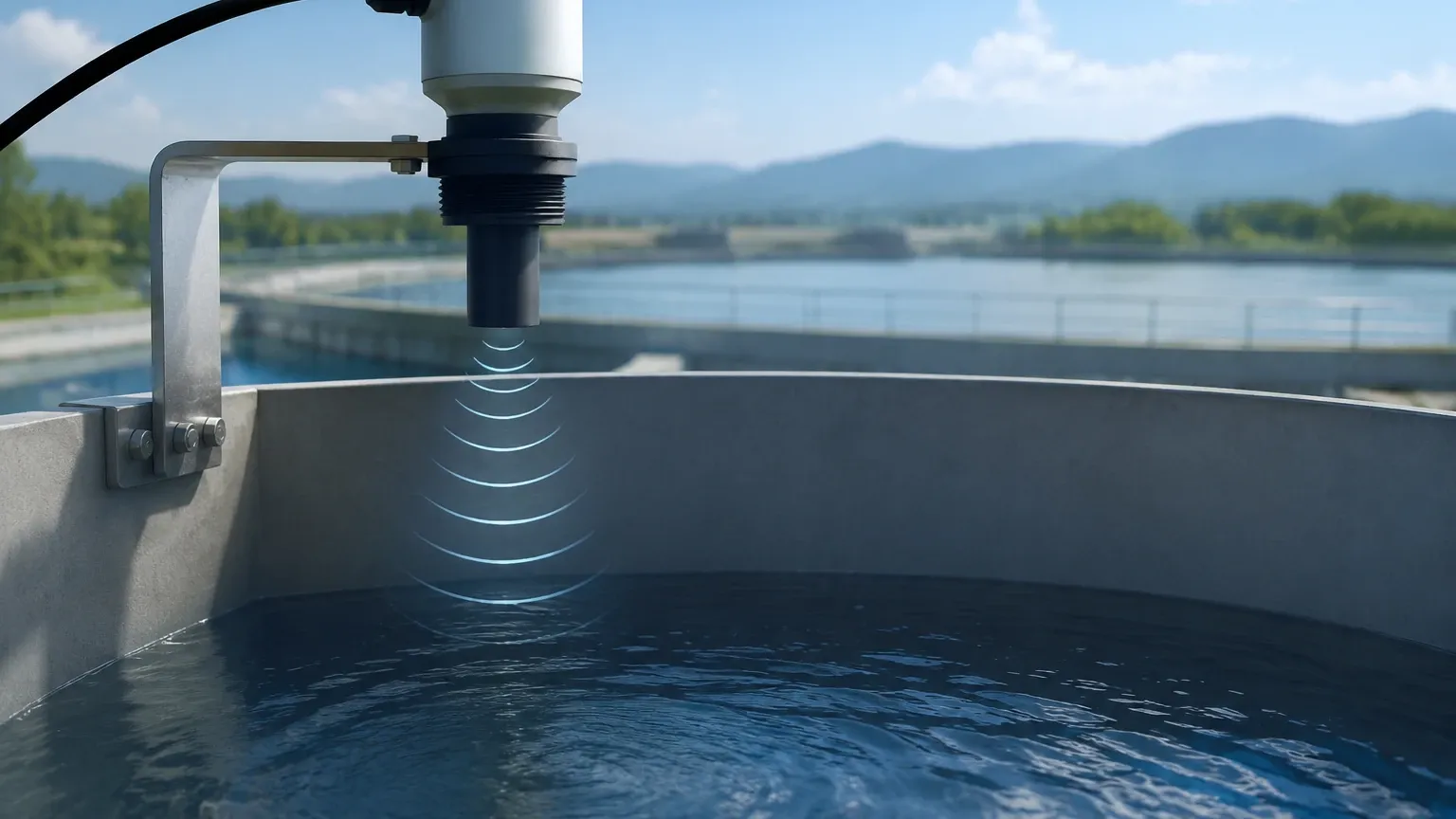
The sensor’s transducer acts as both a transmitter and a receiver. It emits a pulse of ultrasonic energy (typically between 20 kHz and 200 kHz) toward the target surface. This pulse travels through the air, hits the surface of the medium, and reflects back to the transducer. The sensor’s internal microprocessor measures the time interval between the emission of the pulse and the reception of the echo.
The distance ($D$) is calculated using the formula:
$$D = \frac{v \times t}{2}$$
Where:
* $v$ is the speed of sound in the medium (usually air).
* $t$ is the total time elapsed for the round trip.
Since the user usually requires the level of the material ($L$) rather than the distance to the surface, the sensor subtracts the measured distance from the total tank height ($H$):
$$L = H – D$$
The Role of Temperature Compensation
The speed of sound is not constant; it varies significantly with air temperature. In air at sea level, the speed of sound is approximately 331.5 m/s at 0°C and increases by about 0.6 m/s for every degree Celsius increase. Without compensation, a 10°C change in temperature could result in a measurement error of nearly 2%. Most high-quality non contact ultrasonic sensors include an integrated temperature sensor to automatically adjust the calculation based on ambient conditions.
The Dead Band (Blocking Distance)
Every ultrasonic sensor has a "dead band" or "blocking distance" immediately in front of the transducer face. During the emission of the ultrasonic pulse, the transducer vibrates (rings). The sensor cannot accurately process a returning echo until this vibration has stopped. Consequently, any material that enters this zone cannot be measured. Typically, the dead band ranges from 0.1 meters to 0.5 meters, depending on the frequency and power of the sensor.
Key Advantages of Non-Contact Measurement
Choosing a non contact ultrasonic sensor offers several operational benefits over contact-based methods like float switches or displacers:
1. Zero Maintenance: With no moving parts to wear out or mechanical components to clean, these sensors require minimal intervention after commissioning.
2. Chemical Compatibility: Since the sensor does not touch the liquid, it is ideal for measuring aggressive acids, bases, and corrosive slurries, provided the housing material is compatible with the tank's atmosphere.
3. Hygiene: In the food and pharmaceutical industries, non-contact measurement prevents cross-contamination and simplifies CIP (Clean-In-Place) processes.
4. Solids and Liquids: While primarily used for liquids, specialized ultrasonic sensors can measure the level of bulk solids, such as grains or plastic pellets, though surface angles and dust must be considered.
Practical Selection Criteria
Selecting the right instrument requires a detailed analysis of the application environment. For a full range of industrial options, engineers should visit the Main Page to compare specific model capabilities.
1. Measurement Range
Ultrasonic sensors are available for ranges as short as 0.25 meters up to 30 meters. However, as the distance increases, the frequency of the sound wave must decrease to overcome air attenuation. Lower frequency sensors (e.g., 20-40 kHz) provide longer range but have larger transducers and larger dead bands.
2. Process Atmosphere
Ultrasonic waves require a gas medium to travel. They cannot function in a vacuum. Furthermore, if the atmosphere contains heavy vapors or high concentrations of CO2, the speed of sound will change, leading to inaccuracies unless the sensor is calibrated for that specific gas mixture.
3. Tank Geometry and Beam Angle
The ultrasonic pulse spreads out in a cone shape, known as the beam angle (usually between 5° and 12°). It is critical to ensure that no internal obstructions—such as ladders, pipes, or agitators—fall within this cone, as they will create false echoes.
Selection Table for Common Applications
| Application | Typical Range | Recommended Frequency | Housing Material |
| :— | :— | :— | :— |
| Water Storage Tanks | 0.5m – 10m | 50 kHz | Plastic (PP/ABS) |
| Chemical Day Tanks | 0.2m – 5m | 70 kHz | PVDF / PTFE |
| Open Channel Flow | 0.1m – 3m | 80 kHz | Weather-proof Plastic |
| Large Grain Silos | 2m – 30m | 20 kHz | Aluminum / Stainless Steel |
| Wastewater Sumps | 0.5m – 8m | 50 kHz | Corrosion-resistant Polymer |
Installation Considerations
Proper installation is the single most important factor in the performance of a non contact ultrasonic sensor. Follow these engineering guidelines to ensure high signal integrity:
* Perpendicular Alignment: The transducer face must be perfectly parallel to the liquid surface. Even a small tilt can cause the reflected signal to miss the receiver, resulting in a "Loss of Echo" error.
* Wall Clearance: Avoid mounting the sensor too close to the tank wall. Sound waves can reflect off smooth walls or weld seams, creating interference. A general rule is to maintain a distance from the wall equal to at least 10% of the tank height.
* Avoid the Fill Stream: Never install the sensor directly above the point where the tank is filled. The falling liquid or solid will intercept the ultrasonic beam and cause erratic readings.
* Standpipe Usage: In tanks with heavy foam or turbulence, a stilling well or standpipe can be used to provide a calm surface for measurement. However, the pipe must be smooth and the sensor must be configured for the specific pipe diameter to account for wall reflections.
Limitations and Environmental Factors
While versatile, the non contact ultrasonic sensor is not a universal solution. Certain environmental factors can degrade performance:
Foam and Turbulence
Heavy surface foam acts as an acoustic absorber. Instead of reflecting the sound wave, the foam dissipates the energy, leading to a weak or non-existent echo. Similarly, extreme turbulence can scatter the signal. In these cases, radar level meters or hydrostatic transmitters may be more appropriate.
High Pressure and Temperature
Ultrasonic transducers are typically limited to temperatures below 80°C (176°F) and pressures below 3 bar (43.5 psi). High pressure increases the density of the air, which can affect signal propagation, and high temperatures can damage the piezoelectric crystals within the transducer.
Dust and Vapor
While light dust is manageable, heavy dust in solids applications can attenuate the signal. Similarly, thick steam or vapor can create a "fog" that reflects sound prematurely or changes the medium's density, causing measurement drift.
Frequently Asked Questions (FAQs)
Q: Can a non contact ultrasonic sensor measure through a closed plastic tank lid?
A: Generally, no. The ultrasonic pulse will reflect off the lid itself. The sensor requires a hole or a flange to "see" into the tank. While some low-power sensors claim to measure through thin plastic, the accuracy is significantly compromised.
Q: How does the sensor handle agitators or mixers?
A: Most modern sensors include "False Echo Suppression" software. During setup, the user can map the tank while it is empty. The sensor identifies the static echoes from the agitator blades and ignores them during operation, focusing only on the moving echo from the liquid surface.
Q: What is the difference between 2-wire and 4-wire sensors?
A: A 2-wire sensor is loop-powered, meaning the 4-20mA signal and the power share the same pair of wires. These are easier to install but have less power for signal processing. A 4-wire sensor has separate power and signal wires, allowing for higher power pulses and more advanced features, which is often necessary for long-range or difficult applications.
Q: Can these sensors be used for flow measurement?
A: Yes. When paired with a flume or weir in an open channel, the sensor measures the head (level) of the water. The internal electronics then use standard hydraulic formulas (like the Manning equation) to convert that level into a flow rate (e.g., liters per second).
Conclusion
The non contact ultrasonic sensor remains a top-tier choice for industrial level monitoring due to its balance of cost, ease of use, and reliability. By carefully considering the beam angle, temperature compensation, and potential environmental interference, engineers can implement a measurement system that provides years of accurate data. For specific product specifications and to explore customized OEM/ODM options for your facility, please refer to the Main Page for detailed technical documentation and application support.