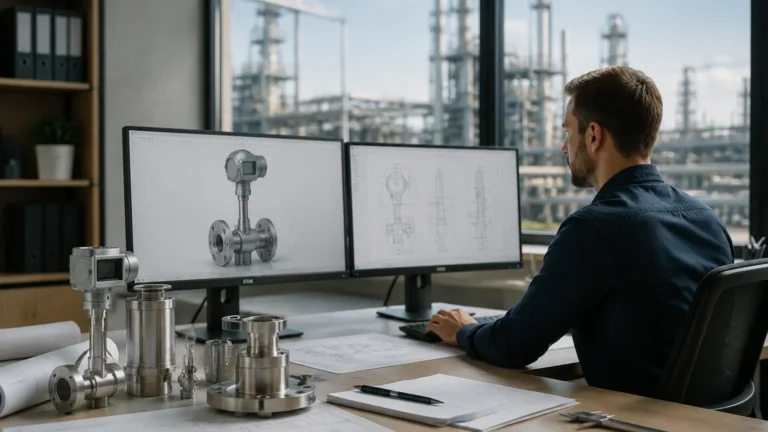
Cleanfit Cpa450
Cleanfit Cpa450
In the landscape of industrial process automation, the ability to maintain sensor accuracy without halting production is a critical requirement for operational efficiency. The Cleanfit CPA450 represents a specialized category of retractable assemblies designed specifically for the insertion and removal of sensors—typically pH, ORP, or conductivity probes—under process conditions. This guide provides a technical overview of the Cleanfit CPA450, its operational principles, selection criteria, and its role within broader industrial measurement frameworks.
The Role of Retractable Assemblies in Process Automation
Process industries, ranging from chemical manufacturing to wastewater treatment, rely on continuous monitoring to ensure product quality and safety. However, sensors are frequently exposed to harsh environments, including corrosive chemicals, high-pressure flows, and fouling agents. Over time, these conditions degrade sensor performance, necessitating cleaning or calibration.
A retractable assembly like the Cleanfit CPA450 functions as a mechanical interface between the process medium and the sensitive instrument. By allowing the sensor to be withdrawn into a separate chamber while the process remains active, these assemblies eliminate the need for tank drainage or bypass lines. This functionality is particularly vital in applications where downtime is costly or where the process medium is hazardous.
Measurement Principles and Operational Logic
The fundamental principle of the Cleanfit CPA450 is the isolation of the measurement point through a retractable mechanism. The assembly operates using a stroke-based system, moving the sensor between two primary positions: the "Service" position and the "Measure" position.
1. Measure Position
In this state, the sensor is extended into the process stream. The assembly ensures a pressure-tight seal, preventing the process medium from leaking into the assembly body or the external environment. Measurement occurs continuously as the medium flows past the sensor tip.
2. Service Position
When maintenance is required, the assembly retracts the sensor into a rinse chamber. A ball valve or a specialized sealing sleeve closes off the process connection, ensuring that the tank or pipe remains sealed even while the sensor is being serviced.
3. Cleaning and Calibration
Once in the service position, the internal chamber can be flushed with water, cleaning agents, or calibration buffers. This allows for automated or manual cleaning without exposing the operator to the process medium. This "in-situ" maintenance capability is what distinguishes retractable assemblies from fixed immersion fittings.
Technical Specifications and Evaluation Criteria
Selecting the correct configuration for a Cleanfit CPA450 requires a detailed understanding of the process parameters. The assembly must withstand the same pressures and temperatures as the vessel or piping it is mounted on.
Material Compatibility
Retractable assemblies are available in various materials to suit different chemical environments. The following table outlines common material choices and their typical applications:
| Material | Chemical Resistance | Typical Applications |
| :— | :— | :— |
| Stainless Steel (1.4404 / 316L) | High | General chemical, water treatment, and food industry. |
| Hastelloy C22 | Very High | Highly corrosive acids and oxidizing media. |
| PVDF / PEEK | High | Applications where metal ions must be avoided or in specific chemical processes. |
Pressure and Temperature Limits
The Cleanfit CPA450 is typically rated for specific pressure-temperature curves. For instance, a stainless steel variant may handle up to 10 bar (145 psi) at 25°C, but this rating decreases as the process temperature rises. It is essential to verify that the assembly’s maximum operating pressure exceeds the process pressure by at least 20% to account for surges.
Selection Considerations for Process Environments
When evaluating the Cleanfit CPA450 for a specific project, engineers must consider the physical characteristics of the installation site and the nature of the medium.
* Immersion Depth: The assembly must be long enough to reach the representative flow area of the pipe or tank but not so long that it creates excessive mechanical stress or vibration.
* Seal Selection: The O-rings and gaskets (EPDM, Viton, or Kalrez) must be compatible with the process chemicals. Failure of these seals is the leading cause of assembly leakage.
* Manual vs. Pneumatic Actuation: Manual assemblies are cost-effective for infrequent maintenance, while pneumatic versions allow for full automation, integrating with a PLC to perform scheduled cleaning cycles.
For facilities looking to optimize their entire measurement loop, integrating these analytical assemblies with robust level monitoring is standard practice. Reliable data from the Main Page of your instrumentation provider can help synchronize level control with sensor maintenance schedules, ensuring that sensors are only retracted when the tank levels are safe for such operations.

Installation and Maintenance Guidelines
Proper installation is paramount to the longevity of the Cleanfit CPA450. Incorrect mounting can lead to sensor breakage or mechanical failure of the retraction mechanism.
Installation Considerations
1. Orientation: The assembly should ideally be installed at an angle (usually 15° to 90° from the horizontal) to ensure that no air bubbles are trapped around the sensor tip, which could lead to erratic readings.
2. Clearance: Sufficient space must be left behind the assembly to allow for the full stroke of the retraction arm and the removal of the sensor for replacement.
3. Process Connection: Common connections include DN50 flanges or 2-inch NPT threads. Ensure that the gasket used at the process flange is of the same material rating as the assembly.
Maintenance Checklist
* Lubrication: The moving parts of the retractable arm should be lubricated periodically with process-compatible grease.
* Seal Inspection: O-rings should be replaced annually or more frequently in aggressive media. Look for signs of swelling, cracking, or hardening.
* Rinse Line Clearing: Ensure that the rinse and drainage lines are not clogged with sediment, as this prevents effective cleaning of the sensor.
Limitations and Operational Risks
While the Cleanfit CPA450 is a robust tool, it is not without limitations. Understanding these risks is essential for preventing process excursions.
* Pressure Limitations During Retraction: Many retractable assemblies have a lower pressure limit for the *act of retraction* than they do for the *static measurement* position. Attempting to retract a sensor at full process pressure without checking the manual's safety limits can damage the internal seals.
* Solid Accumulation: In media with high solids content (slurries), particles can become trapped in the sealing mechanism. This can prevent the assembly from closing fully, leading to leaks when the sensor is removed.
* Mechanical Stress: In high-velocity flows, the extended sensor and assembly arm act as a cantilever. Excessive flow rates can cause vibration, leading to fatigue failure of the assembly or breakage of glass sensors.
Integration with Level Measurement Systems
In modern industrial automation, analytical measurement (like that provided by sensors in a CPA450) and physical measurement (like level) are often interdependent. For example, in a neutralization tank, the pH level determines the chemical dosing, while the liquid level determines the volume of the reaction.
Reliable level measurement instruments, such as radar or ultrasonic meters, provide the necessary context for the analytical data. If a level sensor indicates a low-level alarm, the automation system may trigger the Cleanfit CPA450 to retract the sensor to prevent it from drying out or being damaged by foam. For comprehensive solutions in this area, engineers often consult specialized manufacturers to ensure that level transmitters and analytical assemblies work in harmony. You can explore a wide range of these complementary technologies on the Main Page of industrial instrumentation catalogs.
Frequently Asked Questions (FAQs)
Q: Can the Cleanfit CPA450 be used in hazardous areas?
A: Yes, provided the assembly and the sensors used within it are certified for the specific ATEX or FM zone. The pneumatic versions are often preferred in these environments as they do not require electrical power at the point of measurement.
Q: How often should the O-rings be replaced?
A: This depends entirely on the process. In clean water applications, seals may last 12-24 months. In hot, acidic chemical processes, replacement every 3-6 months may be necessary to prevent leakage.
Q: What happens if the sensor breaks inside the assembly?
A: If a glass sensor breaks, the fragments must be carefully flushed out of the rinse chamber before the assembly is moved back to the measure position. Failure to do so can damage the internal seals of the CPA450.
Q: Can I use any manufacturer's sensor in the CPA450?
A: The CPA450 is designed for standard 12mm diameter sensors with a length of 120mm or 225mm (depending on the version). As long as the sensor meets these physical dimensions and the thread type (typically Pg 13.5), it should be compatible.
Q: Is it possible to automate the cleaning cycle?
A: Yes, by using the pneumatic version of the assembly in conjunction with a control unit or PLC. The system can be programmed to retract, rinse, and return the sensor to the process at set intervals or based on sensor performance diagnostics.