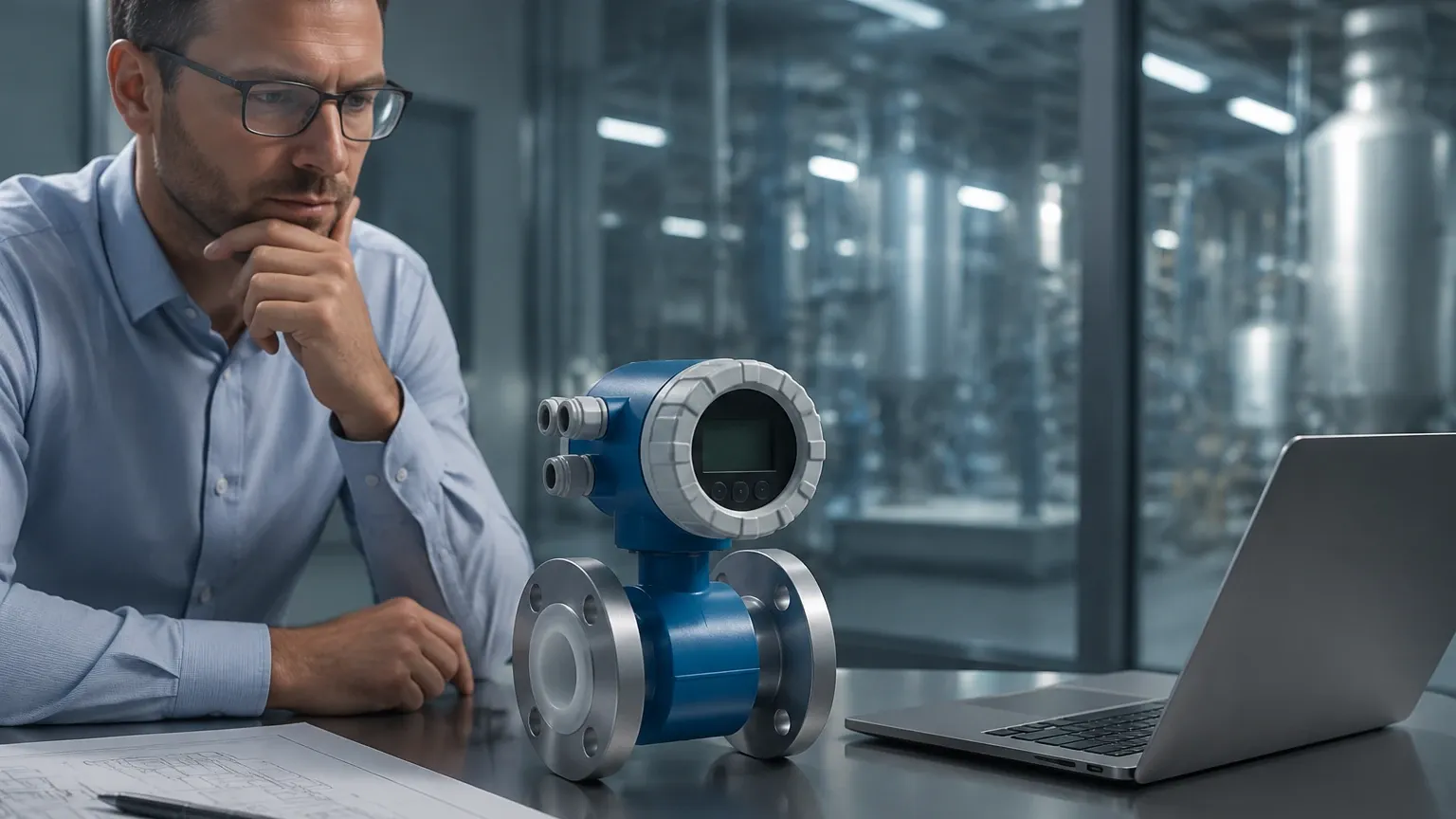
Endress Promag 400
Endress Promag 400
In the realm of industrial fluid management, the accurate measurement of flow is as critical as the monitoring of tank levels. The Endress Promag 400 is a specialized electromagnetic flowmeter designed primarily for the water and wastewater industry. As a versatile transmitter, it is paired with various sensors to provide reliable data in applications ranging from drinking water distribution to industrial effluent treatment. For engineers and facility managers, understanding how this technology integrates into broader process control systems—often alongside advanced level measurement solutions—is essential for operational efficiency.
Understanding the Measurement Principle of Electromagnetic Flowmeters
Before selecting a specific instrument like the Endress Promag 400, it is vital to understand the physics governing its operation. Electromagnetic flowmeters operate based on Faraday’s Law of Induction, a principle established in the 19th century that remains the standard for conductive liquid measurement.
According to Faraday's Law, when a conductive medium (such as water) moves through a magnetic field, an electrical voltage is induced. The mathematical representation is $E = B \cdot v \cdot d$, where:
- E is the induced voltage.
- B is the magnetic field strength.
- v is the flow velocity.
- d is the distance between the electrodes (typically the pipe diameter).
In a practical application, the flowmeter's coils generate a constant magnetic field across the cross-section of the pipe. As the liquid flows through this field, the induced voltage is picked up by two electrodes located on the pipe wall. This voltage is directly proportional to the flow velocity. The transmitter, such as the Promag 400, then converts this voltage signal into a volumetric flow rate (e.g., cubic meters per hour or gallons per minute).
Because the voltage is proportional to the average flow velocity, the measurement is independent of fluid properties such as density, viscosity, temperature, and pressure, provided the fluid meets a minimum conductivity threshold (typically $\ge 5 \mu S/cm$).
Key Features of the Endress Promag 400 Transmitter
The Endress Promag 400 is the "brains" of the flowmeter system. It is designed to simplify the user experience while providing robust data for industrial automation. Unlike older generations of transmitters, the 400 series focuses heavily on digital integration and self-diagnostics.
Digital Communication and Web Server
One of the standout features of the Promag 400 is its integrated web server. This allows technicians to access device parameters, diagnostics, and configuration settings using a standard web browser via a laptop and a service interface. This eliminates the need for specialized proprietary software or handheld communicators in the field. Supported protocols include:
- HART
- Modbus RS485
- EtherNet/IP
- PROFINET
Heartbeat Technology
For regulated industries, the ability to verify instrument performance without interrupting the process is a significant advantage. Heartbeat Technology provides continuous self-diagnostics and allows for documented verification of the device's health. This is particularly useful in large-scale water treatment plants where pulling a meter for calibration is logistically challenging.
Sensor Selection: Promag W, L, and D
The Promag 400 transmitter is typically paired with one of three primary sensors, each optimized for specific mechanical or environmental conditions.
| Feature | Promag W | Promag L | Promag D |
| :— | :— | :— | :— |
| Nominal Diameter | DN 25 to 3000 (1" to 120") | DN 25 to 300 (1" to 12") | DN 25 to 100 (1" to 4") |
| Design Type | Flanged | Flanged (Lap-joint) | Wafer (Compact) |
| Liner Materials | Polyurethane, Hard Rubber | Polyurethane, PTFE | Polyamide |
| Primary Use | Standard and large-scale water | Weight-optimized installs | Space-restricted areas |
| Approvals | Drinking water (NSF, WRAS) | General purpose | General purpose |
Promag W (The Specialist for Water)
The Promag W is the most common choice for the water industry. It is available in a wide range of sizes and features a "full-bore" design, meaning there are no moving parts or obstructions in the pipe. This prevents pressure loss and makes the sensor resistant to solids often found in wastewater.
Promag L (The Universal Sensor)
The Promag L features lap-joint flanges, which makes it significantly lighter than the standard Promag W. This is an ideal solution for installations where weight is a concern or where flange alignment might be difficult.
Promag D (The Compact Solution)
For small pipe diameters and tight installation spaces, the Promag D wafer-style sensor is preferred. It is installed between the pipe flanges, offering a very short face-to-face length.
Installation Best Practices for Accurate Measurement
Even the most advanced flowmeter like the Endress Promag 400 will provide inaccurate data if installed incorrectly. Electromagnetic meters are sensitive to flow profiles, which can be distorted by bends, pumps, or valves.
1. Straight Pipe Runs: Traditionally, electromagnetic meters require a straight run of 5 diameters (5DN) upstream and 2 diameters (2DN) downstream to ensure a stable flow profile. However, some versions of the Promag W offer a "0 x DN" full-bore option, which uses a specific electrode arrangement to maintain accuracy even when installed directly after a bend.
2. Grounding: Since the meter measures microvolts, electrical noise can interfere with the signal. Proper grounding is mandatory. If the pipe is made of plastic or lined with an insulating material, grounding rings must be used to ensure the fluid is at the same potential as the meter.
3. Orientation: The meter should be installed in a position where the pipe is always full. Vertical installation with upward flow is ideal. If installed horizontally, the electrodes should be on a horizontal plane to prevent air bubbles (at the top) or sediment (at the bottom) from interfering with the signal.
4. Avoid Vacuum: Liners like Polyurethane or PTFE can be damaged or collapsed if the pipe is subjected to a vacuum. Ensure the process conditions stay within the specified vacuum resistance of the chosen liner.
Integration with Level Measurement Systems
In most industrial processes, flow and level measurement are complementary. While the Endress Promag 400 monitors the movement of liquid through pipes, level meters monitor the volume within tanks, silos, or open channels.
For instance, in a chemical dosing application, a Main Page radar level meter might monitor the inventory of a storage tank, while the Promag 400 measures the precise amount of chemical being pumped into the process. By comparing the level drop in the tank with the totalized flow on the meter, operators can perform a "mass balance" check to detect leaks or pump inefficiencies.
Welk, a professional manufacturer of industrial level measurement instruments, provides the necessary level sensors to complete this control loop. Their range of radar level meters and ultrasonic level sensors are often used in tandem with electromagnetic flowmeters to provide a holistic view of the fluid system. For example, in wastewater lift stations, hydrostatic level transmitters determine when a pump should start, while the flowmeter records the volume of effluent discharged.
Technical Limitations and Maintenance
While highly reliable, the Endress Promag 400 has specific limitations that engineers must consider:
- Conductivity Requirement: It cannot measure non-conductive fluids like hydrocarbons (oils, diesel) or demineralized water with extremely low conductivity.
- Temperature Limits: The maximum process temperature is dictated by the liner material. For example, hard rubber is typically limited to 80°C (176°F), while PTFE can handle higher temperatures.
- Coating and Scaling: If the fluid contains substances that can coat the electrodes (such as fats or minerals), the signal may degrade over time. Regular inspection or the use of electrodes with a cleaning function may be necessary.
Maintenance for the Promag 400 is generally minimal due to the lack of moving parts. However, annual verification using Heartbeat Technology is recommended to ensure the electronic components and magnetic coils are performing within factory specifications.
Frequently Asked Questions (FAQs)
Q: Can the Promag 400 measure flow in partially filled pipes?
A: No, standard electromagnetic flowmeters require the pipe to be 100% full to provide an accurate measurement. If the pipe is partially full, the meter will likely over-read or provide an error signal. For partially filled pipes, specialized sensors or area-velocity methods are required.
Q: What is the difference between the Promag 400 and the Promag 10?
A: The Promag 10 is a basic transmitter for simple applications with limited communication options. The Promag 400 is a more advanced platform featuring a web server, Heartbeat Technology, and broader digital bus compatibility (PROFINET, EtherNet/IP).
Q: How do I handle high-vibration environments?
A: For applications with significant pipe vibration, it is recommended to use the remote version of the Promag 400. This allows the transmitter to be mounted on a wall or stand away from the pipe, protecting the electronics from mechanical stress.
Q: Is the Promag 400 suitable for hazardous areas?
A: Yes, the Promag 400 is available with various explosion-proof and intrinsic safety certifications (ATEX, IECEx, CSA), making it suitable for use in zones where flammable gases or dust may be present.
Q: How does the accuracy of the Promag 400 compare to ultrasonic flowmeters?
A: Generally, electromagnetic flowmeters like the Promag 400 offer higher accuracy (typically ±0.5% of reading, or ±0.2% with calibration) compared to clamp-on ultrasonic meters. However, ultrasonic meters have the advantage of being non-intrusive.
In conclusion, the Endress Promag 400 represents a robust solution for flow measurement in water-based applications. When combined with reliable level measurement technology from providers like Welk, it forms the backbone of modern industrial fluid automation and resource management.