Capacitive Level Switches
Capacitive Level Switches
In industrial process control, point level detection serves as a critical safeguard for inventory management, overfill protection, and pump protection. Among the various technologies available, capacitive level switches are recognized for their versatility, lack of moving parts, and ability to handle a wide range of materials from liquids to bulk solids. This guide examines the engineering principles, selection criteria, and practical installation requirements for deploying capacitive sensors in modern industrial environments.
Understanding Capacitive Level Measurement Principles
The operation of a capacitive level switch is based on the electrical property of capacitance—the ability of a system to store an electric charge. In a typical industrial level sensing application, the sensor probe and the vessel wall (if conductive) act as the two plates of a capacitor. If the vessel is non-conductive, a secondary ground probe or a reference electrode is used.
The Dielectric Constant
The fundamental factor in capacitive sensing is the dielectric constant ($ε_r$) of the medium. The capacitance ($C$) of the system is defined by the formula:
$$C = ε_0 ε_r (A / d)$$
Where:
* $ε_0$ is the permittivity of free space.
* $ε_r$ is the relative dielectric constant of the material between the plates.
* $A$ is the surface area of the electrodes.
* $d$ is the distance between the electrodes.
In an empty tank, the dielectric between the probe and the wall is air, which has a dielectric constant of approximately 1.0. When a process material—such as water ($ε_r ≈ 80$), oil ($ε_r ≈ 2.0$), or plastic pellets ($ε_r ≈ 1.1$ to $2.0$)—displaces the air, the total capacitance of the system changes. The electronics within the Level Switches detect this change and trigger an output signal (such as a relay or transistor switch) once a predefined threshold is crossed.
Frequency Shift and Sensitivity
Modern capacitive switches often use high-frequency oscillators. As the capacitance changes, the frequency of the circuit shifts. This method allows for high sensitivity, enabling the detection of materials with very low dielectric constants. Advanced sensors also incorporate "Active Shield" or "Guard" technology. This involves an additional energized section of the probe that prevents the sensor from being triggered by material buildup or coating on the probe surface, a common challenge with viscous liquids or damp powders.
Key Components and Design Variations
Capacitive level switches are engineered in various configurations to suit specific vessel geometries and material properties.
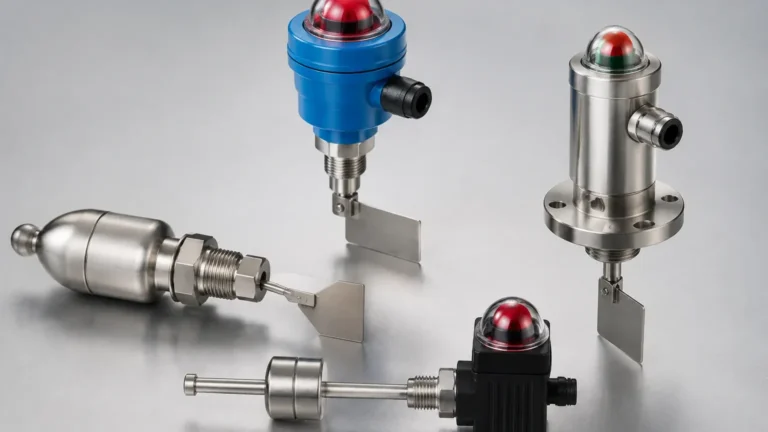
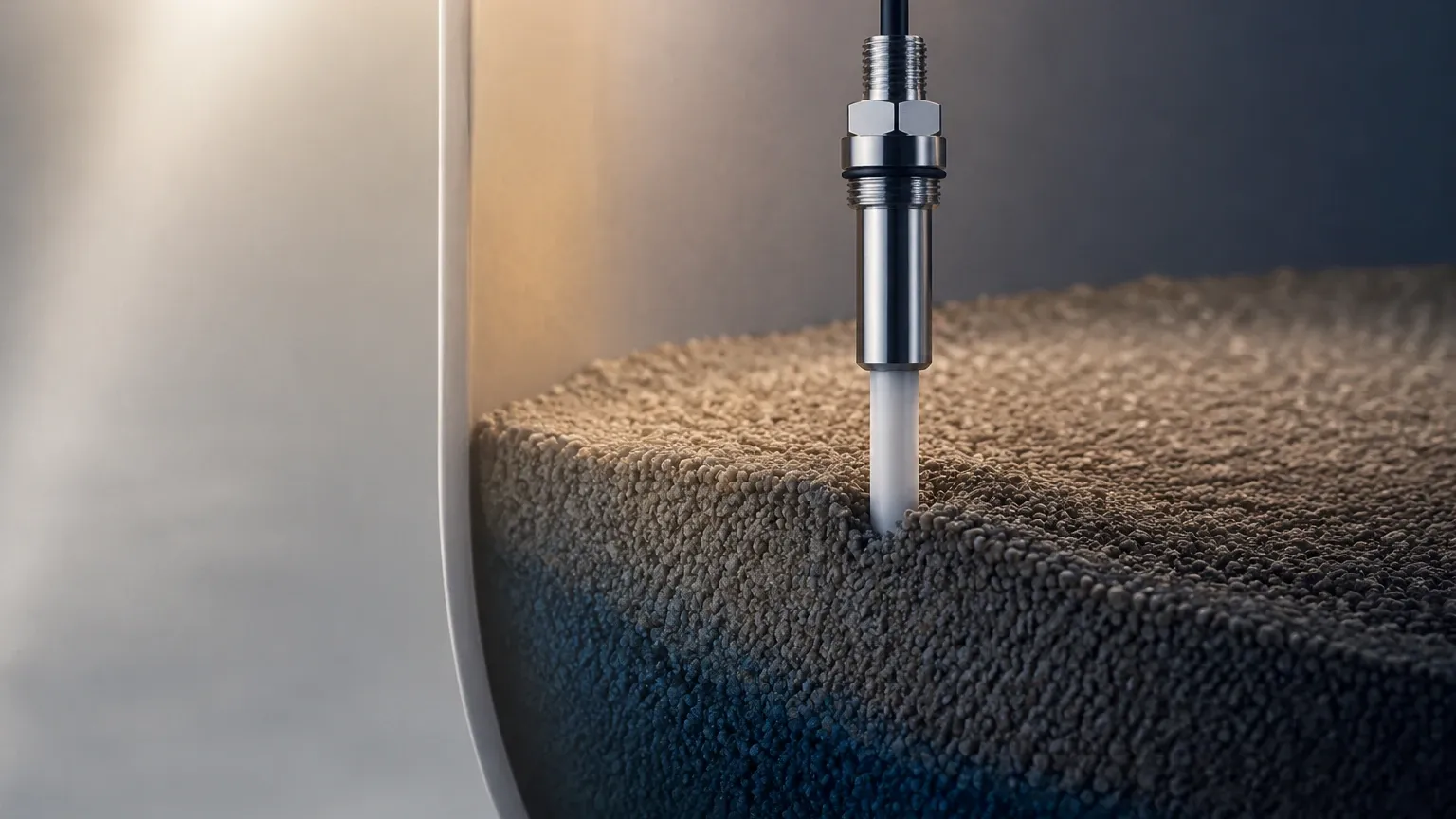
1. Standard Rod Probes: These are rigid probes typically made of stainless steel, often coated with PTFE (Polytetrafluoroethylene) or PFA for chemical resistance and insulation. They are ideal for top-mounting in small to medium-sized tanks.
2. Cable Probes: For very deep silos or large tanks where a rigid rod would be impractical to install or prone to mechanical stress, flexible cable probes are used. These can extend up to 20 or 30 meters and are weighted at the bottom to maintain tension.
3. Non-Contact (Through-Wall) Sensors: Small capacitive sensors can detect levels through the walls of non-metallic containers (like plastic or glass). The sensor is mounted on the exterior, and it detects the change in capacitance through the wall when the liquid rises to the sensor's position.
4. High-Temperature/High-Pressure Variants: For demanding applications like steam boilers or chemical reactors, probes are designed with specialized ceramic-to-metal seals and cooling fins to protect the electronics from temperatures exceeding 200°C or pressures above 40 bar.
Selection Criteria for Capacitive Level Switches
Selecting the correct capacitive level switch requires an analysis of the process medium and the vessel environment. The following table provides a comparison of how capacitive technology performs against other common point-level technologies.
| Feature | Capacitive Level Switches | Vibrating Tuning Fork | Float Switch |
| :— | :— | :— | :— |
| Moving Parts | None | Minimal (Vibration) | Yes (Mechanical) |
| Material State | Liquid, Solid, Slurry | Liquid or Fine Powder | Liquid Only |
| Viscosity Limit | High (with Active Shield) | Low to Medium | Low |
| Coating Tolerance | High (Adjustable) | Moderate | Low |
| Dielectric Dependency | High | None | None |
| Installation | Top or Side | Top or Side | Top or Side |
Critical Evaluation Factors
* Dielectric Constant ($ε_r$): If the material has a dielectric constant below 1.5, standard capacitive switches may struggle to distinguish between the material and air. In such cases, high-sensitivity probes or alternative technologies like radar may be required.
* Conductivity: If the liquid is conductive (e.g., water-based acids), the probe must be fully insulated. For non-conductive liquids (e.g., hydrocarbons), uninsulated probes can sometimes be used, though insulation is generally preferred for durability.
* Tank Material: In plastic or fiberglass tanks, the lack of a conductive wall means a reference electrode (grounding rod) must be installed alongside the sensing probe to complete the circuit.
* Particle Size (for Solids): In bulk solids, the air gaps between particles lower the effective dielectric constant. This must be accounted for during calibration.
Industrial Applications and Use Cases
Capacitive level switches are utilized across diverse sectors due to their robust nature and adaptability.
Water and Wastewater Treatment
In water treatment, these switches are used for high-level alarms in chemical dosing tanks. Because they can be coated in PTFE, they resist corrosion from aggressive chemicals like sodium hypochlorite or sulfuric acid. They are also used in sump pits to control pumps, where the absence of moving parts prevents the clogging issues common with float switches.
Chemical and Petrochemical
Capacitive sensors are frequently used to detect the interface between two immiscible liquids, such as oil and water. Since oil and water have vastly different dielectric constants ($≈2$ vs. $≈80$), the switch can be calibrated to trigger only when the more conductive water layer reaches the probe.
Food and Beverage
In the food industry, hygiene is paramount. Capacitive switches with tri-clamp fittings and polished stainless steel surfaces meet 3A and EHEDG standards. They are effective in detecting syrups, chocolate, and grains. The ability to "tune out" foam is a significant advantage in fermentation tanks or bottling lines.
Mining and Bulk Solids
For silos containing cement, sand, or fly ash, capacitive cable probes provide reliable high-level detection. The rugged design withstands the heavy mechanical loads and abrasive nature of falling bulk materials.
Installation and Configuration Guidelines
Proper installation is essential to ensure the accuracy and longevity of capacitive level switches. Engineering teams should consider the following factors during the design phase:
1. Grounding: The sensor must have a reliable electrical ground reference. In metal tanks, this is usually achieved through the process connection (NPT or Flange). If the tank is lined or made of plastic, a grounding wire must connect the sensor housing to a dedicated ground rod or a large metal plate inside the tank.
2. Mounting Position:
* Side Mounting: The probe should be angled slightly downward (approx. 20 degrees) to allow material to drain off the probe, reducing the risk of false triggers due to buildup.
* Top Mounting: Ensure the probe is far enough from the filling stream to avoid "nuisance tripping" caused by falling material. Use a stilling well if the liquid surface is highly turbulent.
3. Dead Zones: Every capacitive probe has an inactive length near the process connection (the "dead zone"). Users must ensure that the desired switching point is located within the active sensing length of the rod, not within this inactive region.
4. Calibration: Most modern capacitive level switches feature auto-calibration. This typically involves setting the "Empty" state (probe in air) and the "Full" state (probe covered). For materials with low dielectric constants, fine-tuning the sensitivity via a potentiometer or digital interface may be necessary to ensure a stable signal-to-noise ratio.
Limitations and Maintenance
While highly reliable, capacitive technology is not universal. Understanding its limitations prevents field failures.
* Changing Dielectric Properties: If a process involves different fluids with varying dielectric constants in the same tank, the switch may require recalibration. For example, switching from a solvent-based cleaner to a water-based rinse will significantly change the capacitance.
* Conductive Buildup: While active shielding helps, extreme buildup of highly conductive sludge can eventually bridge the probe to the tank wall, causing a permanent "high" signal. Regular inspection is required in such heavy-fouling applications.
* Moisture Content in Solids: In bulk solids applications, a change in the moisture content of the material (e.g., damp sand vs. dry sand) will change the dielectric constant, potentially shifting the switch point.
Maintenance Checklist
* Visual Inspection: Periodically check for physical damage to the probe insulation (cracks or abrasions).
* Seal Integrity: Ensure the cable gland and housing cover are tight to prevent moisture ingress into the electronics.
* Cleaning: In applications with heavy coating, scheduled cleaning of the probe may be necessary, although the frequency is usually much lower than that required for mechanical switches.
Frequently Asked Questions
Q: Can capacitive level switches detect foam?
A: Yes, but it depends on the calibration. They can be tuned to either ignore foam and only detect the liquid, or to detect the foam itself, which is useful in preventing "foam-over" in reactors.
Q: Is it possible to use a capacitive switch in a non-metallic tank?
A: Yes. However, you must provide a ground reference. This can be a second probe installed parallel to the main probe, or a conductive strip applied to the outside of the tank.
Q: How does temperature affect the sensor?
A: Temperature can cause the dielectric constant of some materials to drift. High-quality sensors include temperature compensation circuitry to maintain a stable switching point across the operating range.
Q: What is the difference between a capacitive level switch and a capacitive level transmitter?
A: A switch provides a point-level output (On/Off) at a specific height. A transmitter provides a continuous output (e.g., 4-20mA or Modbus) representing the exact level from 0% to 100% of the probe length.
By understanding the relationship between the dielectric properties of the medium and the sensor geometry, engineers can effectively implement capacitive level switches to provide reliable, low-maintenance level control across a wide spectrum of industrial processes.