Decibel Level Gauge
Decibel Level Gauge
In the landscape of industrial instrumentation, the term "decibel level gauge" often bridges two distinct engineering disciplines: acoustic monitoring and signal-to-noise evaluation in non-contact level measurement. While a decibel level gauge is traditionally associated with sound pressure levels (SPL) in industrial safety, the concept of the decibel (dB) is fundamental to the performance of radar and ultrasonic level sensors. For process engineers, understanding how signal strength—measured in decibels—affects measurement reliability is as critical as selecting the correct physical indicator, such as Magnetic & Local Level Gauges, for redundant visual verification.
This article explores the technical principles of signal attenuation in level measurement, the role of decibel-based diagnostics, and why mechanical local gauges remain the gold standard for high-reliability process monitoring.
Measurement Principles: Decibels in Level Instrumentation
To understand a decibel level gauge in a B2B industrial context, one must first understand how electronic level transmitters use the decibel scale. A decibel is a logarithmic unit used to express the ratio of two values of a physical property, often power or intensity.
Signal-to-Noise Ratio (SNR)
In radar and ultrasonic level measurement, the sensor emits a pulse that reflects off the surface of the medium. The transmitter then evaluates the "echo" or return signal. The strength of this echo relative to the background electrical or mechanical noise is the Signal-to-Noise Ratio, expressed in decibels (dB).
* High SNR (e.g., >20 dB): Indicates a strong, clear signal that the processor can easily distinguish from turbulence or foam.
* Low SNR (e.g., <5 dB): Indicates a weak signal, often caused by low dielectric constants, heavy foam, or extreme distances, which may lead to measurement "loss of echo."
Signal Attenuation
Attenuation refers to the loss of signal strength as it travels through a medium or reflects off a surface. In ultrasonic systems, air temperature, humidity, and dust can attenuate the signal by several decibels per meter. In radar systems, the dielectric constant (εr) of the liquid determines how much energy is reflected back. A low εr liquid reflects less energy, resulting in a lower decibel return signal.
The Need for Local Redundancy: Magnetic & Local Level Gauges
While electronic transmitters provide high-speed data for PLC and SCADA systems, they are susceptible to electronic failure, power loss, and signal attenuation. This is where Magnetic & Local Level Gauges provide a critical safety and operational layer. Unlike an electronic decibel level gauge that may struggle with signal loss in a steaming or foaming tank, a magnetic level gauge relies on the immutable laws of buoyancy and magnetism.
How Magnetic Level Gauges Work
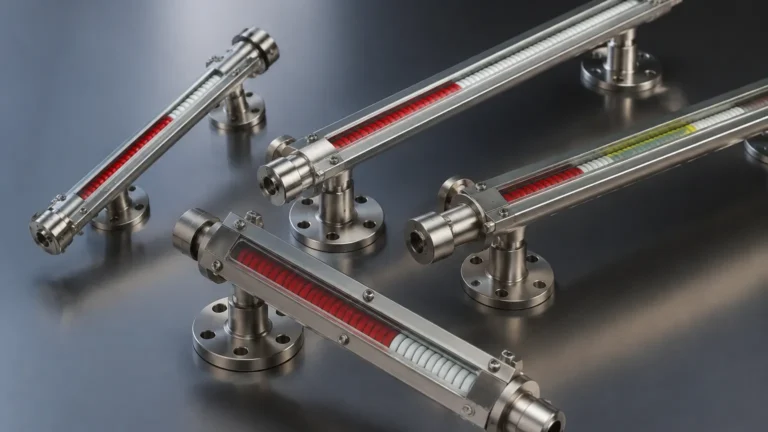
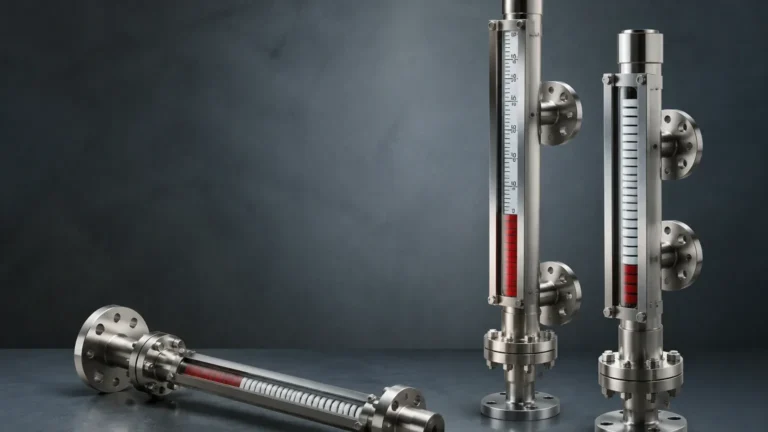
A magnetic level gauge consists of a bypass chamber (a standpipe) mounted to the side of a vessel. Inside this chamber is a float containing a high-intensity permanent magnet. As the liquid level in the vessel rises and falls, the float moves accordingly. Outside the chamber, a visual indicator—typically a series of bi-color magnetic flaps or a follower—rotates or moves in response to the float's magnetic field. This provides a clear, high-contrast visual representation of the level without requiring an external power source.
Technical Comparison: Electronic vs. Local Gauges
When designing a level measurement system, engineers must weigh the benefits of digital signal processing (decibel-based diagnostics) against the reliability of local mechanical indicators.
| Feature | Radar/Ultrasonic (Electronic) | Magnetic Level Gauge (Local) |
| :— | :— | :— |
| Primary Unit | Decibels (Signal Strength) | Millimeters/Meters (Physical Level) |
| Power Requirement | 24V DC / 110V AC | None (Self-powered) |
| Signal Reliability | Affected by foam, dust, and εr | Unaffected by vapor or foam |
| Maintenance | Software calibration, cleaning | Periodic flushing of chamber |
| Data Output | 4-20mA, HART, Modbus | Visual (Optional transmitters) |
| Redundancy | Digital diagnostics | Physical verification |
Practical Selection Criteria
Choosing between a sophisticated electronic decibel level gauge and a magnetic gauge depends on the specific process conditions. Below are the primary factors to consider:
1. Media Characteristics
If the medium has a low dielectric constant (such as liquefied gases or hydrocarbons), a radar sensor may struggle with a low decibel return signal. In these instances, a magnetic level gauge is often preferred because its operation is based on density rather than electrical properties. However, if the medium is highly viscous or contains solids that could jam a float, a non-contact radar sensor is superior.
2. Pressure and Temperature
Modern magnetic gauges are engineered to withstand extreme pressures (up to 320 bar) and temperatures ranging from -196°C to over 450°C. While electronic sensors also have high-temperature variants, the sensitive electronics in a decibel level gauge transmitter often require cooling elements or remote mounting to prevent thermal damage.
3. Visibility and Accessibility
In large-scale industrial plants, operators need to verify levels from a distance. Magnetic level gauges offer high visibility, often readable from 20 to 30 meters away. Electronic gauges require a local display unit or a control room interface to be read.

Installation Considerations for Local Gauges
To ensure the accuracy of local level indicators, proper installation is paramount. Engineers should follow these guidelines:
* Vertical Alignment: The bypass chamber must be installed perfectly vertical. Even a slight tilt can cause the float to rub against the chamber walls, leading to friction and inaccurate readings.
* Venting and Draining: Every magnetic level gauge should be equipped with a vent valve at the top and a drain valve at the bottom. This allows for safe commissioning and the removal of sediment without shutting down the process.
* Magnetic Interference: Ensure that no large ferrous structures or high-voltage cables are located within 200mm of the gauge, as these can interfere with the magnetic coupling between the float and the indicator.
* Center-to-Center Distance: Clearly specify the distance between the process connections (nozzles) in millimeters to ensure the gauge fits the vessel's pre-existing flanges.
Limitations and Challenges
No measurement technology is universal. A decibel level gauge (electronic) and a magnetic level gauge (mechanical) both have limitations:
* Electronic Limitations: Signal "blind zones" at the top of the tank, interference from internal tank structures (agitators, ladders), and the requirement for complex configuration.
* Mechanical Limitations (Magnetic): The float is a moving part and can be damaged by pressure surges (water hammer). Additionally, if the liquid density changes significantly, the float's buoyancy will change, leading to a measurement offset.
Frequently Asked Questions (FAQ)
Can a magnetic level gauge provide a 4-20mA signal like an electronic gauge?
Yes. While the primary function is local visual indication, magnetic level gauges can be fitted with reed chain transmitters or magnetostrictive sensors mounted to the outside of the chamber. This allows the device to provide both a local visual reading and a remote signal to a control system.
Why is my radar sensor reporting a "Low dB" error?
This typically occurs when the return echo is too weak for the sensor to process. Common causes include heavy foam on the liquid surface, the sensor being mounted too close to the tank wall, or the liquid having a very low dielectric constant. Increasing the gain or using a guided wave radar (GWR) can sometimes resolve this.
How often should I calibrate a local level gauge?
Mechanical magnetic gauges do not require "calibration" in the electronic sense. However, they should be inspected annually. The primary maintenance task is flushing the bypass chamber to ensure no sludge or scale is hindering the float's movement.
Is a decibel level gauge the same as a sound level meter?
In general terminology, yes. However, in B2B industrial automation, engineers often use the term to describe the diagnostic tools within a level transmitter that monitor signal strength. Always clarify with your supplier whether you are measuring acoustics or signal integrity.
Conclusion
Whether you are monitoring the acoustic decibel levels for plant safety or evaluating the signal decibels of a high-frequency radar, precision is the cornerstone of industrial automation. While electronic sensors offer advanced diagnostics and integration, Magnetic & Local Level Gauges remain indispensable for their reliability, simplicity, and clear visual communication. By combining both technologies, process plants can achieve a robust measurement strategy that withstands both electronic interference and power fluctuations.
For engineers seeking to enhance their facility's level monitoring capabilities, selecting the right combination of local indicators and digital transmitters is essential. Understanding the strengths of each ensures long-term operational safety and efficiency.