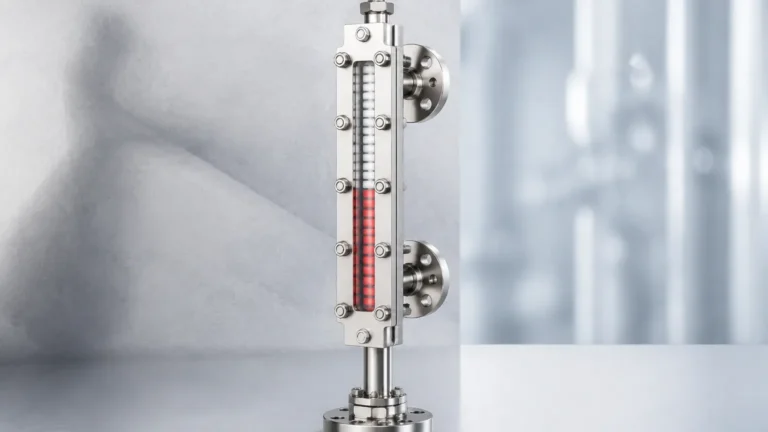
Staff Level Gauges
Staff Level Gauges
In the field of industrial and environmental level monitoring, the staff level gauge remains one of the most fundamental and reliable tools for direct visual measurement. Primarily used in open channels, reservoirs, tanks, and stilling wells, these instruments provide a clear, graduated reference for liquid depth. While modern automation often relies on electronic sensors, the staff level gauge serves as a critical primary reference or a fail-safe manual backup in diverse engineering applications.
Measurement Principles of Staff Level Gauges
The operating principle of a staff level gauge is based on direct visual observation against a fixed, graduated scale. Unlike complex electronic transmitters that convert physical properties into electrical signals, a staff gauge is a passive instrument. It is mounted vertically or at a known angle within a liquid body, allowing an observer to read the level where the liquid surface intersects the markings on the gauge.
For accurate measurement, the gauge must be calibrated to a known datum point. In environmental monitoring, this is often a geodetic datum or a local benchmark. In industrial tank applications, the "zero" point of the staff gauge is typically aligned with the bottom of the vessel or the lowest suction point. The accuracy of the reading depends on the resolution of the graduations—commonly in centimeters or millimeters—and the clarity of the liquid-to-gauge interface.
In applications involving turbulent surfaces, staff gauges are often installed inside a stilling well. A stilling well is a vertical pipe or chamber that dampens surface waves and fluctuations, providing a stable liquid level for more precise manual readings. This setup is frequently used alongside Magnetic & Local Level Gauges in industrial settings to provide a secondary manual verification of automated systems.
Types and Materials of Construction
Staff level gauges must withstand constant immersion in various liquids, ranging from fresh water to corrosive chemical effluents. Consequently, material selection is paramount to ensure long-term legibility and structural integrity.
1. Porcelain Enameled Steel
This is the industry standard for environmental and water treatment applications. The scale is fired onto a heavy-gauge steel plate at high temperatures, creating a glass-like finish that is resistant to rust, fading, and chemical attack. These gauges are highly legible due to high-contrast colors (usually black markings on a yellow or white background).
2. Stainless Steel (304/316)
For industrial tanks containing aggressive chemicals or high-temperature liquids, stainless steel staff gauges are preferred. The graduations are typically etched or engraved into the metal to prevent them from wearing off over time. These are often used in conjunction with magnetic level indicators in chemical processing plants.
3. Synthetic Polymers (Fiberglass/PVC)
In highly corrosive environments where even stainless steel might fail, or where electrical conductivity must be avoided, fiberglass-reinforced plastic (FRP) or high-density PVC gauges are utilized. These are lightweight and resistant to a wide range of acids and alkalis.
4. E-Type and Numerical Graduations
Staff gauges are often categorized by their visual style. "E-type" gauges use a block-pattern scale (resembling the letter 'E') which is easier to read from a distance or through binoculars. Standard numerical gauges feature traditional ruler-style markings for close-range precision.
Selection Criteria for Staff Level Gauges
Choosing the correct gauge requires an evaluation of the installation environment and the required precision. Engineers should consider the following factors:
| Feature | Environmental (River/Reservoir) | Industrial (Process Tank) | Water Treatment (Open Channel) |
| :— | :— | :— | :— |
| Primary Material | Porcelain Enameled Steel | Stainless Steel (316) | Fiberglass or PVC |
| Graduation Interval | 1 cm or 10 cm (E-type) | 1 mm or 5 mm | 2 mm or 5 mm |
| Mounting Style | Wall or Piling Mount | Internal Tank Wall | Bracket or Stilling Well |
| Visibility Requirement | Long-distance (up to 50m) | Short-distance (1-5m) | Medium-distance (5-10m) |
| Chemical Resistance | Low (Freshwater) | High (Acids/Bases) | Medium (Effluent) |
Transitioning from Manual to Industrial Local Gauges
While simple staff level gauges are excellent for open-air and non-pressurized environments, they have significant limitations in modern industrial processes. When dealing with pressurized vessels, hazardous chemicals, or high-temperature fluids, a direct-contact open scale is neither safe nor practical.
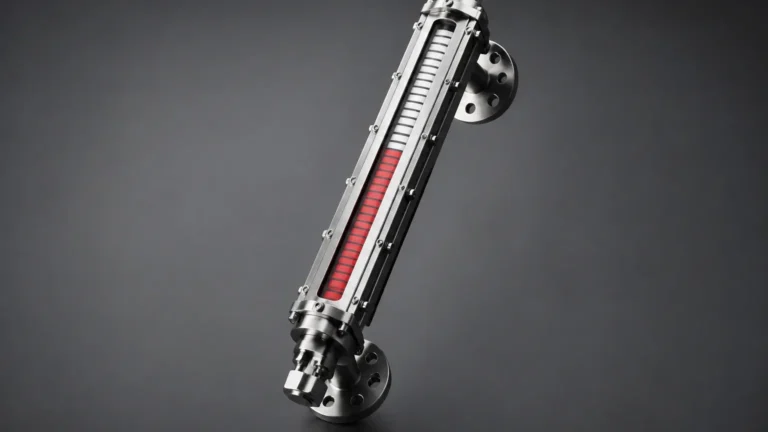
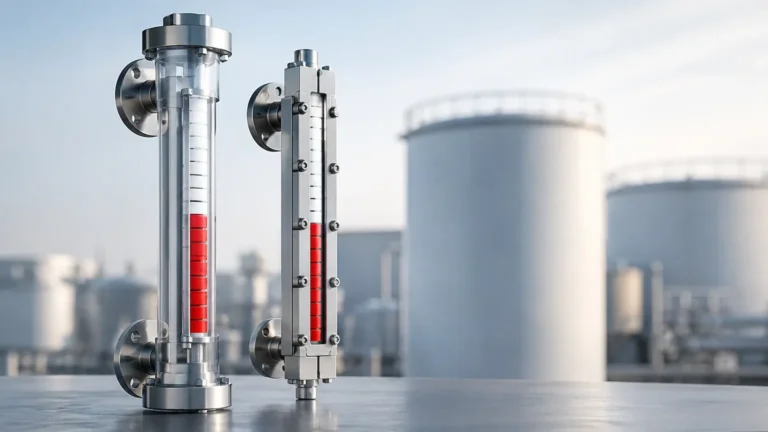
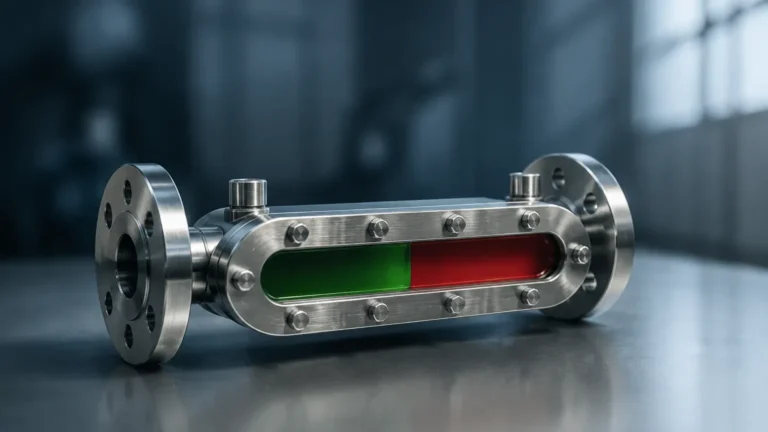
In these scenarios, engineers specify Magnetic & Local Level Gauges. These instruments use a magnetic float inside a bypass chamber to actuate an external visual indicator. This provides the same "local" visual benefit of a staff gauge but keeps the process liquid hermetically sealed within a pressure-rated chamber. For many Welk customers, the staff gauge serves as the external visual scale mounted alongside the magnetic indicator flags, providing a redundant numerical reference for the operator.
Installation and Calibration Considerations
Proper installation is critical to the accuracy of any local level gauge. If the gauge is not perfectly vertical or if the zero point is incorrectly set, the resulting data will be consistently biased.
1. Vertical Alignment: For vertical staff gauges, a plumb line or spirit level must be used during installation. Even a slight tilt can lead to significant measurement errors, especially in deep reservoirs.
2. Datum Setting: The "zero" mark on the gauge must be surveyed against a known reference point. In industrial tanks, this is often the "strike plate" at the bottom of the tank. In environmental monitoring, this relates to the mean sea level or a local benchmark.
3. Tilted Gauges: In some cases, such as on the sloped bank of a canal, gauges are installed at an angle. These "slope gauges" must have their graduations mathematically compensated for the angle of the slope so that the vertical depth is read directly.
4. Secure Mounting: Staff gauges are subject to hydraulic forces, especially in flowing channels. They should be mounted to a rigid structure (concrete wall, steel piling) using corrosion-resistant fasteners. Expansion joints should be considered for very long gauge runs to account for thermal movement.
Limitations and Risks
Despite their reliability, staff level gauges involve several inherent risks and limitations that must be managed:
* Parallax Error: This occurs when the observer's eye level is not perfectly aligned with the liquid surface. Looking down or up at the gauge will result in an incorrect reading.
* Fouling and Algae Growth: In water applications, biological growth can obscure the markings. Periodic cleaning is required to maintain legibility.
* Manual Data Entry: Because these gauges require a human operator to read and record the value, they are prone to transcription errors and cannot be easily integrated into real-time SCADA systems without a secondary electronic sensor.
* Safety Hazards: Reading a staff gauge in a remote or hazardous location may expose personnel to risks. In such cases, upgrading to a magnetic level gauge with a remote transmitter is recommended.
Maintenance Guidelines
To ensure the longevity of a staff level gauge, a routine maintenance schedule should be implemented:
* Visual Inspection: Every 3–6 months, inspect the gauge for physical damage, such as chipping of the porcelain or bending of the metal plate.
* Cleaning: Use a soft brush and mild detergent to remove silt, algae, or chemical scales. Avoid abrasive cleaners that could scratch the graduations.
* Verification: Periodically verify the gauge reading against a manual dip tape or a calibrated portable ultrasonic meter to ensure the mounting has not shifted.
Frequently Asked Questions (FAQs)
Q: Can staff level gauges be used in pressurized tanks?
A: No. Standard staff gauges are designed for open-air or atmospheric pressure applications. For pressurized vessels, you should use Magnetic & Local Level Gauges which isolate the process fluid from the visual scale.
Q: What is the standard length for a staff gauge?
A: Staff gauges are typically manufactured in modular sections, often 1 meter or 1.5 meters in length. These sections can be stacked vertically to reach any required height.
Q: How do I read a staff gauge when the water is choppy?
A: In turbulent conditions, you should observe the high and low points of the wave action over a 30-second period and record the average. For better accuracy, install the gauge inside a stilling well to dampen the surface movement.
Q: Are there staff gauges for measuring both depth and volume?
A: Yes. While most gauges measure height (linear depth), custom gauges can be manufactured with non-linear scales that represent the volume of a specific tank geometry (e.g., horizontal cylindrical tanks).
Conclusion
Staff level gauges remain an indispensable component of level measurement infrastructure. Whether used as a primary tool in environmental monitoring or as a manual backup to Magnetic & Local Level Gauges in industrial plants, their simplicity and reliability are unmatched. By selecting the appropriate materials and ensuring precise installation, engineers can maintain a clear and accurate visual window into their liquid processes.