5h3b22
5h3b22
In the landscape of industrial process control, technical identifiers such as 5h3b22 represent specific configuration standards and performance benchmarks required for high-precision level measurement. As industries move toward more automated and integrated systems, understanding the technical nuances behind these designations becomes critical for engineers and procurement specialists. Welk, a professional manufacturer of industrial level measurement instruments, provides a range of solutions—including radar, ultrasonic, and hydrostatic transmitters—that align with the rigorous demands of the 5h3b22 technical framework.
Selecting the correct level measurement technology requires a deep dive into the physical principles of the media being measured, the environmental conditions of the vessel, and the specific accuracy requirements of the application. This guide explores the foundational measurement principles and provides a practical engineering reference for implementing 5h3b22-compliant systems.
Core Measurement Principles
Before recommending a specific instrument, it is essential to understand how different technologies interact with the process media. Welk’s portfolio is built upon four primary physical principles: electromagnetic wave reflection, acoustic wave reflection, hydrostatic pressure, and magnetic buoyancy.
Radar Level Measurement (Time of Flight)
Radar level meters utilize high-frequency electromagnetic waves, typically in the GHz range. These waves are emitted from the antenna, reflect off the surface of the medium, and return to the receiver. The instrument calculates the level based on the Time of Flight (ToF).
Because electromagnetic waves do not require a medium for travel, radar is highly effective in vacuums and high-pressure environments. In the context of 5h3b22 specifications, radar is often preferred for its immunity to temperature fluctuations and vapor layers. Welk offers both contact (guided wave) and non-contact radar solutions to suit various tank geometries.
Ultrasonic Level Measurement
Ultrasonic sensors function similarly to radar but use sound waves instead of electromagnetic waves. The transducer emits an ultrasonic pulse that bounces off the liquid or solid surface. The time taken for the echo to return is proportional to the distance.
Ultrasonic measurement is a cost-effective, non-contact solution ideal for water treatment and simple chemical storage. However, it is sensitive to air temperature changes (which affect the speed of sound) and can be hindered by heavy foam or dust, which absorbs the acoustic signal.
Hydrostatic Level Measurement
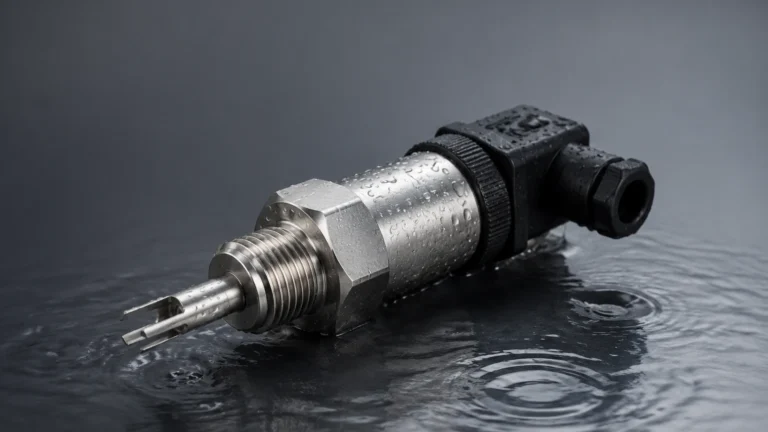
Hydrostatic transmitters measure the pressure exerted by a liquid column at a specific point. Based on the formula $P = \rho gh$ (where $P$ is pressure, $\rho$ is density, $g$ is gravity, and $h$ is height), the level can be determined if the density of the liquid is constant. This is a contact-based method, often used in deep wells, open tanks, and pressurized vessels where the sensor is submerged or mounted at the bottom flange.
Magnetic Level Gauges
Magnetic level gauges utilize a float containing a permanent magnet that moves with the liquid level in a bypass chamber. This magnet flips visual flags or interacts with a reed-chain transmitter to provide a continuous signal. This method is highly valued for high-pressure and high-temperature applications where visual confirmation is required alongside electronic output.
The Role of 5h3b22 in Process Automation
The 5h3b22 designation often appears in technical datasheets to signify a specific level of electromagnetic compatibility (EMC), signal output stability, or housing durability. For engineers managing complex industrial sites, ensuring that instruments meet the 5h3b22 standard ensures that the level meters can operate reliably within a broader SCADA or PLC-controlled environment without signal interference.
Welk’s engineering team focuses on integrating these standards into their OEM and ODM services, ensuring that whether a client requires a radar meter for a chemical reactor or a hydrostatic sensor for a water reservoir, the hardware adheres to the expected 5h3b22 performance parameters. For a detailed look at the specific hardware configurations that meet these standards, users can refer to the Main Page for a comprehensive product overview.
Technical Comparison and Selection Table
Choosing between technologies requires balancing performance against cost and environmental constraints. The following table provides a comparison based on typical 5h3b22 application requirements.
| Technology | Accuracy | Max Range | Media Type | Temperature Range | Pressure Range |
| :— | :— | :— | :— | :— | :— |
| Radar (Non-contact) | ±2 mm | 30m – 120m | Liquids/Solids | -40°C to +250°C | Vacuum to 4 MPa |
| Ultrasonic | ±0.5% FS | 15m – 30m | Liquids/Slurries | -40°C to +70°C | Atmospheric |
| Hydrostatic | ±0.25% FS | 200m+ | Liquids | -20°C to +80°C | Up to 10 MPa |
| Magnetic Gauge | ±5 mm | 6m (standard) | Liquids | -196°C to +450°C | Up to 16 MPa |
Installation Considerations for 5h3b22 Systems
Proper installation is the most critical factor in ensuring the longevity and accuracy of a level measurement system. Even the most advanced 5h3b22-compliant sensor will fail to provide accurate data if mounted incorrectly.
1. Nozzle Geometry and Placement
For radar and ultrasonic sensors, the nozzle height and diameter are vital. If a nozzle is too narrow or too long, it can create internal reflections (ringing) that mask the true level signal. Ideally, the sensor should be mounted such that the antenna or transducer face extends slightly beyond the nozzle opening into the tank.
2. Dead Zone (Blocking Distance)
Every non-contact sensor has a "dead zone" directly beneath the transducer where measurement is impossible. For a standard Welk ultrasonic sensor, this might be 0.25 meters (approx. 10 inches). Engineers must ensure the maximum fill level of the tank never enters this dead zone to avoid signal loss.
3. Avoiding Obstructions
Internal tank structures such as ladders, agitators, and heating coils can reflect signals and cause false readings. When installing a 5h3b22 system, the beam angle of the sensor must be calculated to ensure a clear path to the liquid surface. If obstructions are unavoidable, many Welk radar units offer "false echo suppression" software to ignore these static reflections.
4. Hydrostatic Venting
Hydrostatic level transmitters require a reference to atmospheric pressure to compensate for changes in barometric pressure. This is usually achieved through a small vent tube in the cable. It is essential that this tube remains unobstructed and protected from moisture ingress, which could lead to sensor drift.

Environmental Limitations and Mitigation
While 5h3b22-rated instruments are robust, certain environmental factors can challenge their operation. Understanding these limitations allows for the implementation of secondary measures to maintain accuracy.
* Foam: Heavy, dense foam can absorb ultrasonic and radar signals. In such cases, a guided wave radar (GWR) or a hydrostatic transmitter is often a better choice, as they are less affected by surface conditions.
* Dust and Steam: While radar can penetrate dust and steam easily, ultrasonic waves are often scattered. In high-steam applications, such as boiling water tanks, radar is the industry standard.
* Dielectric Constant (εr): Radar measurement relies on the dielectric constant of the medium. Low-dielectric liquids (like oils or liquid gases) reflect less energy. For these applications, Welk recommends high-sensitivity radar modules or guided wave systems to concentrate the signal.
* Turbulence: Rapidly moving liquid surfaces can cause signal scattering. Utilizing a stilling well or bypass chamber can provide a calm surface for the sensor to measure, ensuring a stable 4-20mA or RS485 output.
Frequently Asked Questions (FAQ)
Q: Can 5h3b22-compliant instruments be used in hazardous areas?
A: Yes, most Welk instruments designed for these applications are available with intrinsically safe (Exia) or flameproof (Exd) certifications, making them suitable for use in explosive atmospheres common in the oil and gas industry.
Q: How often should these sensors be calibrated?
A: While many modern digital sensors are designed for low maintenance, a yearly calibration check is recommended for critical custody transfer or safety-related applications. Hydrostatic sensors may require more frequent zero-point checks if the density of the liquid varies.
Q: What is the benefit of a dual-chamber housing in these instruments?
A: A dual-chamber housing separates the wiring compartment from the electronics compartment. This provides an extra layer of protection against moisture and corrosion during installation and maintenance, which is a hallmark of high-quality 5h3b22 hardware.
Q: Does Welk provide support for custom tank shapes?
A: Yes, Welk offers customized OEM/ODM services. Our software can be programmed with tank strapping tables to convert linear level measurements into volume for horizontal cylindrical tanks, spherical tanks, or other irregular geometries.
Conclusion
Implementing a level measurement system that adheres to the 5h3b22 technical framework requires more than just purchasing a sensor; it requires an integrated approach to engineering, selection, and installation. By understanding the underlying physics of radar, ultrasonic, and hydrostatic technologies, process engineers can select the Welk solution that offers the best balance of accuracy and reliability for their specific application.
Whether you are managing water treatment facilities, chemical processing plants, or industrial automation lines, the goal remains the same: achieving precise, repeatable data to ensure operational safety and efficiency. For further technical specifications, application notes, and to explore the full range of Welk industrial instruments, please visit the Main Page to review product options and application support.