Adm Flow Meter
Adm Flow Meter
In the landscape of industrial process control, the precise measurement of fluid dynamics is essential for operational efficiency, safety, and regulatory compliance. While level measurement provides critical data regarding the volume of inventory within a vessel, flow measurement—specifically through instruments like the ADM flow meter—tracks the rate of movement of gases or liquids through a system. Understanding the intersection of these two technologies is vital for engineers and plant managers who require a comprehensive view of their fluid handling processes.
An ADM flow meter, often categorized as an Advanced Digital Meter or used in specific analytical contexts like gas chromatography, represents a high-precision approach to monitoring flow rates. In industrial automation, these devices are frequently integrated with level measurement systems to provide a complete mass balance of a process. This article explores the principles of flow measurement, the specific utility of ADM-style digital meters, and how to select the right instrumentation for complex industrial environments.
Measurement Principles of Flow Instrumentation
Before selecting a flow meter, it is necessary to understand the physical principles that govern fluid movement. Flow measurement is generally divided into two categories: volumetric flow and mass flow.
Volumetric vs. Mass Flow
Volumetric flow measurement determines the volume of fluid passing through a specific point per unit of time (e.g., cubic meters per hour, m³/h). Mass flow measurement, conversely, determines the actual mass of the fluid (e.g., kilograms per hour, kg/h). Digital meters, such as the ADM flow meter, often utilize advanced algorithms to convert volumetric data into mass flow data by compensating for temperature and pressure fluctuations.
Differential Pressure and Velocity
Many industrial flow meters operate on the principle of differential pressure. By introducing a restriction in the pipe, a pressure drop is created that is proportional to the square of the flow velocity. Other technologies, such as ultrasonic or magnetic flow meters, measure velocity directly. Ultrasonic meters use transit-time or Doppler shift technology—principles closely related to the ultrasonic level sensors manufactured by Welk—to calculate how fast a fluid is moving without obstructing the flow path.
The Role of the ADM Flow Meter in Precision Environments
The term "ADM flow meter" is most commonly associated with high-precision digital flow meters used for gas measurement. These devices are engineered to provide rapid, accurate readings for non-corrosive gases, often used in laboratory settings, pilot plants, or specialized chemical injection systems.
Unlike traditional rotameters, which rely on a physical float and manual visual inspection, an ADM flow meter utilizes solid-state sensors. These sensors detect the displacement of gas molecules or the cooling effect on a heated element (thermal mass flow) to provide a digital output. This digital nature allows for seamless integration into SCADA (Supervisory Control and Data Acquisition) systems, where flow data can be cross-referenced with tank level data to detect leaks or process inefficiencies.
Key Features of Digital Flow Meters
1. NIST Traceability: Most ADM-style meters are calibrated against standards provided by the National Institute of Standards and Technology, ensuring high accuracy (often within ±2% of the reading).
2. Multi-Gas Capability: Advanced digital meters can be programmed to measure various gases, such as Nitrogen, Helium, Air, and Argon, without needing manual recalibration for each change in media.
3. Real-Time Data Logging: Through USB or RS-485 interfaces, these meters provide continuous data streams, which are essential for modern industrial automation.
Integrating Flow and Level Measurement
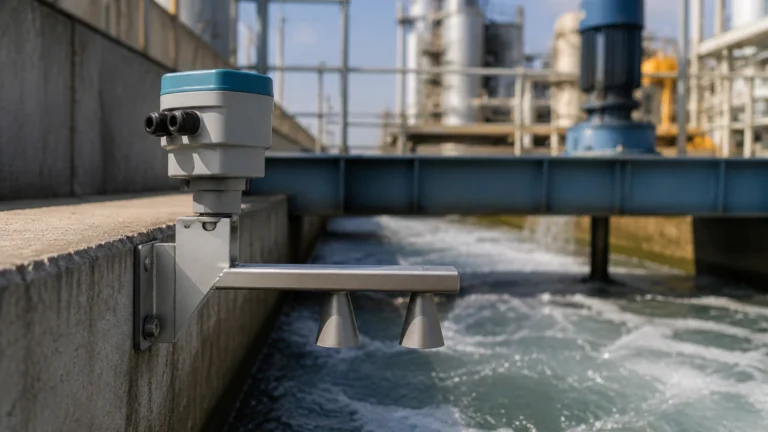
In many applications, flow and level measurement are two sides of the same coin. For instance, in open channel flow measurement (such as in water treatment plants), the flow rate is determined by measuring the level of liquid as it passes through a weir or flume.
By using an ultrasonic level transmitter to monitor the head height of the water, and applying a known mathematical formula for the specific weir geometry, the system can calculate the flow rate in liters per second (L/s) or gallons per minute (gpm). This is a primary example of how the technologies found on the Main Page of a level measurement specialist are utilized to achieve flow monitoring goals.
Selection Criteria for Industrial Applications
When evaluating an ADM flow meter or any industrial flow/level instrument, several factors must be confirmed to ensure long-term reliability.
| Criteria | Description | Importance |
| :— | :— | :— |
| Media Type | Is the fluid a gas, liquid, or slurry? | Determines sensor compatibility and material selection. |
| Flow Range | Minimum and maximum expected flow rates (e.g., 0.5 to 500 mL/min). | Ensures the meter operates within its calibrated accuracy band. |
| Operating Pressure | The maximum pressure the meter body can withstand (e.g., 10 bar / 145 psi). | Safety and structural integrity. |
| Accuracy Requirements | The allowable margin of error (e.g., ±1% FS). | Critical for billing, dosing, or safety-critical reactions. |
| Connectivity | Analog (4-20mA), Digital (HART, Modbus, USB). | Integration with existing control infrastructure. |
Installation Considerations and Best Practices
The performance of a flow meter is heavily dependent on its installation environment. Even the most advanced ADM flow meter will provide inaccurate data if subjected to turbulent flow or improper orientation.
Straight Pipe Requirements
Most velocity-based flow meters require a specific length of straight pipe both upstream and downstream of the sensor. Typically, a rule of thumb is 10 pipe diameters (10D) upstream and 5 pipe diameters (5D) downstream. This ensures that the flow profile is "laminar" (smooth) rather than "turbulent" when it reaches the sensor.
Orientation and Gravity
For liquid flow meters, the pipe must always be full. Installing a meter in a vertical pipe with upward flow is often preferred to ensure the sensor remains submerged and to prevent the accumulation of air bubbles. For gas flow meters like the ADM series, orientation is less critical, but protection from moisture and particulate contamination is paramount.
Calibration and Maintenance
Industrial instruments should undergo periodic calibration. Over time, sensors can "drift" due to electronic aging or physical wear. For ADM meters used in critical gas analysis, annual factory calibration is recommended to maintain NIST traceability. Similarly, level meters used in chemical tanks should be inspected for buildup or scaling on the sensor face, which can attenuate signals.

Limitations and Common Risks
While ADM flow meters and modern level transmitters are highly robust, they are not universal solutions. Engineers must be aware of the following risks:
* Media Compatibility: Using a meter designed for inert gases with corrosive chemicals will lead to rapid sensor failure. Always check the wetted materials (e.g., Stainless Steel 316, PTFE, Viton).
* Particulate Interference: High-precision digital meters often have small internal orifices. If the gas or liquid contains particulates, the meter can become clogged, leading to backpressure and inaccurate readings.
* Environmental Interference: Ultrasonic and radar-based instruments can be affected by heavy foam, extreme steam, or high-frequency electronic noise from nearby Variable Frequency Drives (VFDs).
Frequently Asked Questions (FAQ)
Q: Can an ADM flow meter be used for liquids?
A: Most standard ADM-series flow meters are specifically designed for gas chromatography and gas flow analysis. For liquids, magnetic or ultrasonic flow meters are typically required. However, the term is sometimes used broadly for any Advanced Digital Meter; always verify the manufacturer's fluid specification.
Q: How does temperature affect flow measurement?
A: Gas volume changes significantly with temperature. A digital flow meter compensates for this by measuring the gas temperature and applying the Ideal Gas Law to report the flow at "Standard" conditions (STP), ensuring consistency regardless of environmental changes.
Q: What is the difference between a flow meter and a flow switch?
A: A flow meter provides a continuous measurement of the flow rate (e.g., 50 L/min). A flow switch only indicates whether the flow is above or below a specific set point (e.g., an "on/off" signal), often used for pump protection or safety interlocks.
Q: Why should I integrate flow data with level data?
A: Integrating both allows for "mass balance" accounting. For example, if your flow meter shows 100 liters have entered a tank, but your level meter only shows an increase of 80 liters, you have an immediate indication of a leak, a calibration error, or an unauthorized diversion.
Conclusion
Selecting the appropriate ADM flow meter or level measurement solution requires a deep understanding of the process media, the physical constraints of the installation, and the required data outputs. By combining the precision of digital flow measurement with reliable level monitoring technologies—such as those found on the Main Page—industrial operators can achieve a higher standard of process transparency and control.
When planning your next instrumentation upgrade, always confirm the chemical compatibility of the wetted parts, the required straight-run piping, and the digital communication protocols needed for your control system. Proper selection today prevents costly downtime and maintenance challenges tomorrow.