Amine Sweetening Process of Natural Gas
Amine Sweetening Process of Natural Gas
In the midstream and downstream sectors of the oil and gas industry, the amine sweetening process of natural gas is a critical stage for ensuring gas quality and infrastructure integrity. Raw natural gas often contains "acid gases," primarily hydrogen sulfide ($H_2S$) and carbon dioxide ($CO_2$). These contaminants must be removed because $H_2S$ is highly toxic and corrosive, while $CO_2$ reduces the heating value of the gas and can lead to freezing in cryogenic processing units.
This process, also known as gas acid removal or amine scrubbing, relies on the chemical affinity between alkanolamine solutions and acid gases. However, the efficiency of an amine unit depends heavily on precise process control, where level measurement plays a pivotal role in managing phase separation, preventing chemical loss, and protecting downstream equipment. For engineers and plant operators, selecting the right instrumentation is essential for maintaining the stability of the Main Page of their facility's production flow.
Overview of the Amine Sweetening Process
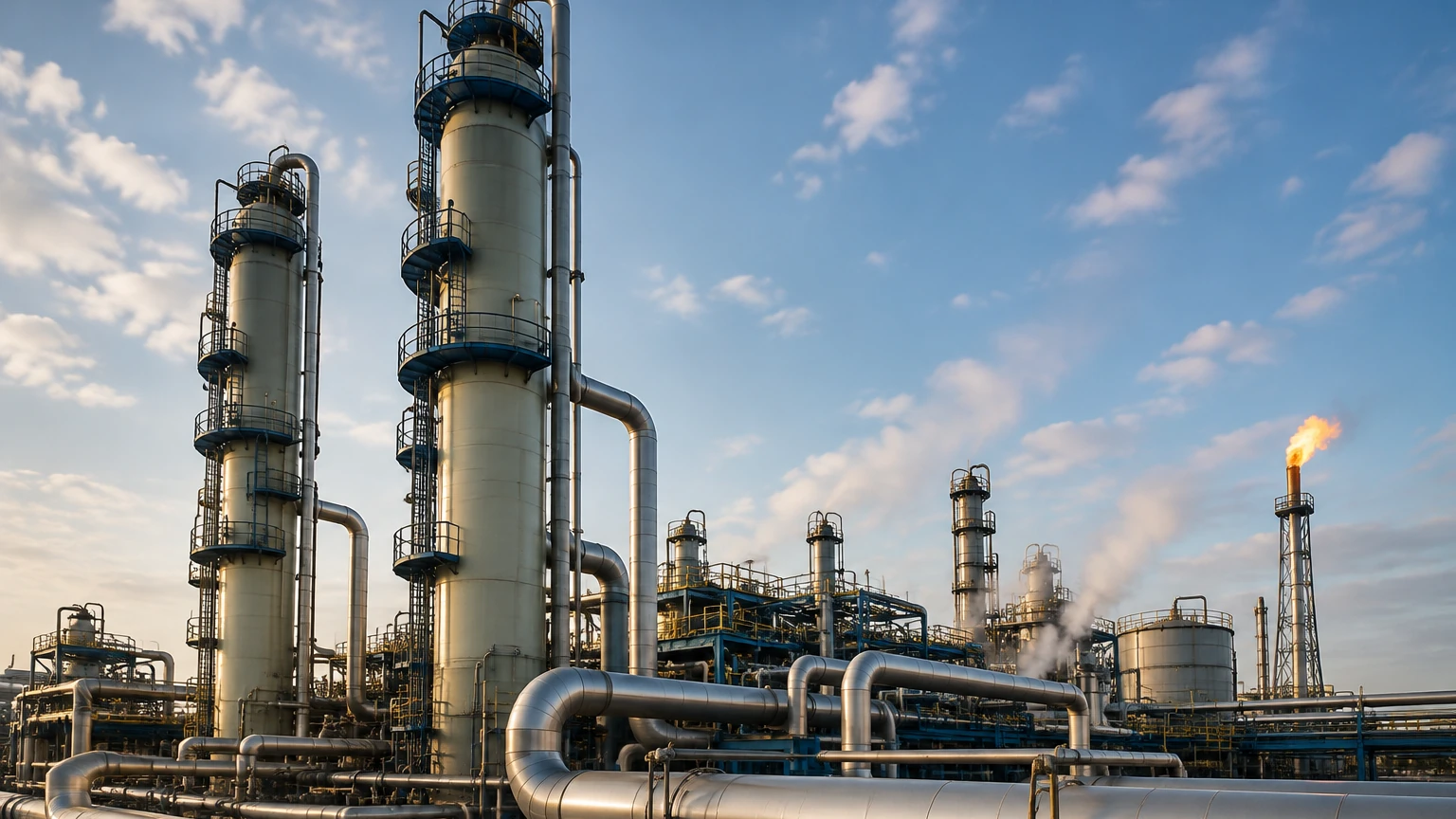
The amine sweetening process of natural gas is a continuous cycle involving absorption and regeneration. The primary components of an amine unit include the contactor (absorber), the flash tank, and the regenerator (stripper).
1. The Absorption Stage
Raw gas enters the bottom of the absorber column. A "lean" amine solution (amine that has been stripped of acid gases) is pumped into the top of the column. As the gas rises through trays or packing, it comes into contact with the descending amine. The amine chemically reacts with the $H_2S$ and $CO_2$, absorbing them. The "sweetened" gas exits the top of the vessel, while the "rich" amine (loaded with acid gases) collects at the bottom.
2. The Flash Tank
The rich amine is typically sent to a flash tank. Here, the pressure is reduced, allowing dissolved hydrocarbons (methane, ethane, etc.) to "flash" off as gas. This tank also serves as a separator where any liquid hydrocarbons (condensate) can be skimmed off the top of the amine solution. Accurate level and interface measurement are critical here to prevent amine from being lost with the hydrocarbons or vice versa.
3. The Regeneration Stage
The rich amine is heated and sent to the regenerator column. In this vessel, heat (usually provided by a steam-driven reboiler) breaks the chemical bond between the amine and the acid gases. The acid gases are stripped out and sent for further processing (such as a Claus unit for sulfur recovery), while the regenerated lean amine is cooled and recirculated back to the absorber.
Measurement Principles for Level Instrumentation
To manage the amine sweetening process of natural gas effectively, several level measurement technologies are utilized. Understanding their principles is the first step in making an informed selection.
Guided Wave Radar (GWR)
GWR operates on the principle of Time Domain Reflectometry (TDR). A low-energy electromagnetic pulse is guided along a probe (rod or cable). When the pulse hits the surface of the liquid, a change in the dielectric constant causes a reflection. The instrument measures the time of flight to calculate the distance.
* Advantages: GWR is highly effective for interface measurement (e.g., oil on top of amine) because a portion of the pulse continues through the top low-dielectric liquid to reflect off the higher-dielectric bottom liquid.
Non-Contact Radar (FMCW)
Frequency Modulated Continuous Wave (FMCW) radar emits a continuous signal with a changing frequency. The difference in frequency between the emitted and received signal is proportional to the distance.
* Advantages: Since it does not touch the process media, it is excellent for corrosive amine environments and high-temperature regenerator applications.
Magnetic Level Gauges (MLG)
MLGs consist of a bypass chamber mounted to the side of the vessel. A float containing a permanent magnet moves with the liquid level, flipping magnetized flaps on an external indicator.
* Advantages: They provide a clear visual indication without requiring power and can be fitted with reed switches or transmitters for remote monitoring.
Differential Pressure (DP)
DP transmitters measure the hydrostatic head of the liquid column. The pressure at the bottom of the vessel minus the pressure in the vapor space is used to calculate the level based on the known density of the amine solution.
* Limitations: Changes in amine concentration or temperature affect density, which can lead to inaccuracies in DP measurements unless compensated.
Practical Selection Table for Amine Units
Choosing the right instrument depends on the specific vessel and the process conditions. The following table provides a general guide for the amine sweetening process of natural gas.
| Vessel | Primary Requirement | Recommended Technology | Reason |
| :— | :— | :— | :— |
| Absorber (Contactor) | High Pressure / Foam Detection | Guided Wave Radar | Resists high pressure; can detect foam layers. |
| Flash Tank | Interface Measurement | GWR or Magnetic Gauge | Separates liquid hydrocarbons from rich amine. |
| Regenerator | High Temperature / Boiling | Non-Contact Radar | No moving parts; unaffected by vapor or turbulence. |
| Reboiler | Boiling Liquid / High Heat | Magnetic Level Gauge | Robust visual check; handles high temperatures. |
| Amine Storage Tank | Inventory Management | Ultrasonic or Radar | Cost-effective for atmospheric or low-pressure storage. |
Installation Considerations and Challenges
When implementing level measurement in the amine sweetening process of natural gas, several environmental factors must be addressed to ensure long-term reliability.
1. Foaming
Foaming is a common issue in amine contactors, often caused by hydrocarbon contamination, suspended solids, or chemical degradation. Foam can confuse some level technologies. Radar (specifically GWR) is often preferred here as it can be tuned to detect the true liquid level beneath the foam or, in some cases, identify the foam layer itself.
2. Corrosion and Material Compatibility
Amines, particularly when "rich" with $H_2S$ and $CO_2$, can be highly corrosive to carbon steel. Level instruments should use 316/316L stainless steel as a minimum, with some applications requiring exotic alloys like Hastelloy for probes and wetted parts. Welk provides customized OEM/ODM services to ensure that the materials used in their sensors meet these rigorous industrial standards.
3. Coating and Buildup
Amine solutions can leave residues or "gunk" on probes. Guided wave radar probes should be selected with a single-rod design rather than a coaxial design to minimize the risk of bridging and buildup. Non-contact radar is often the best solution for vessels where heavy coating is expected.
4. Bypass Chambers (Stilling Wells)
For turbulent vessels, such as the regenerator or reboiler, installing the level sensor in a bypass chamber or stilling well is recommended. This provides a calm surface for measurement and allows for maintenance (using isolation valves) without shutting down the entire process.
Maintenance and Troubleshooting
Regular maintenance is essential to prevent process upsets in the amine sweetening process of natural gas.
* Calibration Checks: For DP transmitters, the density of the amine solution should be verified periodically. If the amine concentration changes from 30% to 50% MEA (Monoethanolamine), the density change will cause a level error if the transmitter is not recalibrated.
* Probe Cleaning: In GWR applications, if the signal strength drops, it may indicate a buildup of iron sulfide or degraded amine on the probe. Periodic inspection is required.
* Float Inspection: In magnetic level gauges, ensure the float has not become "weighted" by solids or lost its buoyancy due to extreme pressure changes.
Frequently Asked Questions (FAQs)
Q: Which amine is most commonly used in the sweetening process?
A: Monoethanolamine (MEA), Diethanolamine (DEA), and Methyldiethanolamine (MDEA) are the most common. MDEA is often preferred for its selectivity in removing $H_2S$ over $CO_2$ and its lower energy requirements for regeneration.
Q: Can ultrasonic sensors be used in amine contactors?
A: Generally, no. Amine contactors operate at high pressures, and the vapor space is often saturated with hydrocarbons and acid gases. Ultrasonic signals are significantly affected by pressure and gas composition changes, making radar a much more reliable choice.
Q: How do I handle interface measurement if the densities of the hydrocarbon and amine are close?
A: If the density difference is less than 0.1 g/cm³, magnetic level gauges may struggle. Guided Wave Radar is the superior choice here, as it relies on the dielectric constant (DK) difference. Amines have a high DK (~50-80), while hydrocarbons have a low DK (~2), providing a sharp signal reflection at the interface.
Q: What is the impact of temperature on level measurement in the regenerator?
A: High temperatures (often exceeding 120°C / 250°F) can cause boiling and heavy vapors. Non-contact radar with a high-temperature antenna or GWR with a temperature-extension neck are necessary to protect the electronics from heat damage.
Conclusion
The amine sweetening process of natural gas is a complex chemical operation that demands high-precision instrumentation. By understanding the specific needs of the absorber, flash tank, and regenerator, engineers can select level measurement solutions that minimize downtime and maximize gas purity. Whether utilizing the robust visual feedback of a magnetic level gauge or the advanced signal processing of guided wave radar, the goal remains the same: safe, efficient, and continuous operation. For more information on professional-grade level measurement instruments, visit the Main Page of Welk's product catalog to review options tailored for industrial automation and chemical processing.