Vera Mag 3000 Flow Meter
Vera Mag 3000 Flow Meter
In industrial process control, the accurate measurement of liquid flow is as critical as monitoring tank levels. The Vera Mag 3000 flow meter represents a standard in electromagnetic flow measurement technology, designed specifically for conductive liquids. As a versatile instrument used across water treatment, chemical processing, and food production, understanding its operational principles and installation requirements is essential for engineers tasked with optimizing plant efficiency.
While industrial facilities often focus on level measurement solutions—such as those found on the Main Page of specialized instrumentation providers—flow measurement provides the dynamic data necessary for mass balance and real-time process adjustments. This guide explores the technical foundations, selection criteria, and practical application of the Vera Mag 3000.
Measurement Principle: Faraday’s Law of Induction
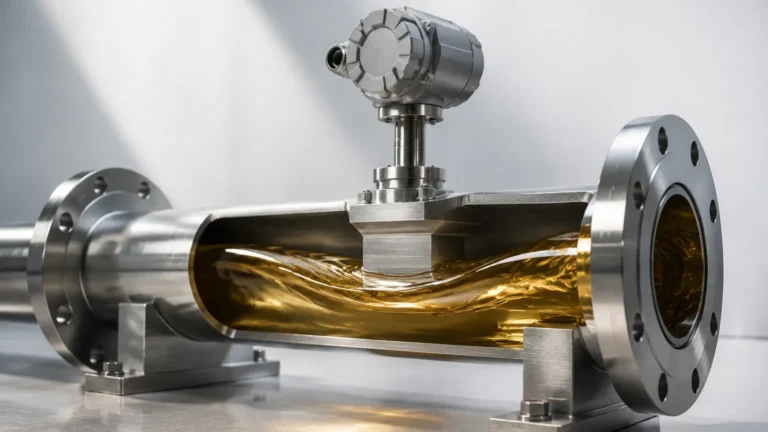
The Vera Mag 3000 operates on the principle of electromagnetic induction, first formulated by Michael Faraday. This method is non-intrusive, meaning there are no moving parts or obstructions within the flow stream, which significantly reduces pressure drop and maintenance requirements.
The Physics of Flow
When a conductive liquid moves through a magnetic field, it generates a voltage. The relationship is defined by the formula:
E = B × v × D
* E: The induced voltage (signal).
* B: The strength of the magnetic field created by the meter’s coils.
* v: The average velocity of the liquid.
* D: The distance between the electrodes (typically the inner diameter of the pipe).
In a Vera Mag 3000, two electromagnetic coils are placed outside the flow tube to generate a constant magnetic field. As the liquid flows through this field, a voltage is induced and picked up by two electrodes located on opposite sides of the tube. Since the magnetic field (B) and the diameter (D) are constants, the induced voltage is directly proportional to the flow velocity (v). The transmitter then converts this micro-voltage into a standard 4-20mA signal, pulse output, or digital communication protocol (such as Modbus or HART).
Key Technical Specifications
Selecting the correct configuration of a Vera Mag 3000 requires an understanding of its physical and electrical limits. These meters are typically available in sizes ranging from DN10 (3/8") to DN2000 (80").
Material Selection Table
The longevity of an electromagnetic flow meter depends heavily on the compatibility of its wetted parts with the process medium.
| Component | Material Options | Typical Applications |
| :— | :— | :— |
| Liner | PTFE (Teflon) | Strong acids, high temperatures, hygienic use |
| | Hard Rubber | Water treatment, general purpose |
| | Neoprene | Abrasive slurries, wastewater |
| | PFA | Highly corrosive chemicals at high pressure |
| Electrodes | Stainless Steel 316L | Clean water, mild chemicals |
| | Hastelloy C | Chlorine-based chemicals, sea water |
| | Titanium | Oxidizing acids, brine |
| | Tantalum | Highly aggressive acids (Hydrochloric, Sulfuric) |
Performance Parameters
* Accuracy: Standard units offer ±0.5% of the measured value, with high-precision versions reaching ±0.2%.
* Conductivity Requirement: The medium must have a minimum conductivity, usually ≥ 5 μS/cm. This makes the meter unsuitable for deionized water or hydrocarbons like oil and gasoline.
* Temperature Range: Depending on the liner, process temperatures can range from -20°C to +150°C (-4°F to 302°F).
Selection Criteria for Industrial Applications
When evaluating the Vera Mag 3000 against other flow measurement technologies (such as ultrasonic or vortex meters), engineers should consider the following factors:
1. Fluid Conductivity
As noted, the fluid must be conductive. For applications involving oils or pure solvents, a different technology, such as a mass flow meter or a level-based volume calculation system, should be utilized. You can review alternative measurement technologies on the Main Page.
2. Solid Content and Slurries
Because the Vera Mag 3000 has a smooth, unobstructed bore, it is ideal for fluids with high solids content, such as paper pulp or mining slurries. In these cases, choosing a wear-resistant liner like Neoprene or Ceramic is vital.
3. Pressure Drop Requirements
In gravity-fed systems or applications where pumping costs must be minimized, the zero-pressure-drop characteristic of the electromagnetic meter provides a significant advantage over orifice plates or turbine meters.
Installation Guidelines and Best Practices
Proper installation is the single most important factor in ensuring the accuracy and reliability of the Vera Mag 3000. Electromagnetic flow meters are sensitive to flow profiles and electrical interference.
Pipe Orientation and Fullness
The flow tube must always be completely full of liquid. If air pockets develop, the meter will provide erratic readings or fail entirely.
* Vertical Installation: This is the preferred orientation, with the flow moving upward. This ensures the pipe remains full and prevents the accumulation of solids.
* Horizontal Installation: The meter should be placed at a low point in the piping system. Avoid installing the meter at the highest point or on a downward-sloping pipe where the line may run partially empty.
Straight Pipe Runs
To ensure a stable flow profile, the meter requires straight sections of pipe both upstream and downstream.
* Upstream: Minimum 5 x DN (Diameter Nominal).
* Downstream: Minimum 2 x DN.
If there are pumps or valves immediately upstream, these distances should be increased to 10 x DN to allow turbulence to subside.
Grounding
Since the meter measures very small voltages, electrical noise from the surrounding environment can interfere with the signal. The meter must be properly grounded to the process fluid. If the piping is plastic or lined, grounding rings must be installed on both sides of the meter to create an electrical connection with the liquid.

Operational Limitations and Risks
While robust, the Vera Mag 3000 is not a universal solution. Engineers must be aware of the following limitations:
1. Electrode Coating: In applications involving sticky or oily substances, a film can build up on the electrodes, insulating them from the fluid. This leads to signal drift. Self-cleaning electrodes or periodic manual maintenance may be required.
2. Vacuum Conditions: Some liners, particularly PTFE, can collapse if the pipe is subjected to a vacuum. If vacuum conditions are possible (e.g., in a siphon or near a pump inlet), a PFA liner with a stainless steel mesh reinforcement should be specified.
3. Minimum Velocity: Electromagnetic meters typically require a minimum flow velocity of 0.3 m/s (approx. 1 ft/s) to maintain their rated accuracy. At very low flows, the signal-to-noise ratio becomes problematic.
Integration with Level Measurement Systems
In many B2B industrial environments, flow meters like the Vera Mag 3000 work in tandem with level sensors to provide a comprehensive view of the process. For example, in a chemical dosing station, a radar level meter monitors the inventory in the supply tank, while the Vera Mag 3000 ensures the precise volume of chemical is delivered to the process line.
This synergy allows for "mass balance" calculations, which can detect leaks or process inefficiencies. If the level in a tank drops faster than the cumulative flow recorded by the meter, it indicates a potential leak or an unmetered bypass. For more information on the level measurement side of this equation, engineers can consult the Main Page for technical data on radar and ultrasonic sensors.
Frequently Asked Questions (FAQ)
Q: Can the Vera Mag 3000 measure the flow of steam or gases?
A: No. Electromagnetic flow meters require a liquid medium with a minimum level of electrical conductivity. Gases and steam are non-conductive and cannot be measured using this technology.
Q: How often does the Vera Mag 3000 need to be calibrated?
A: In clean water applications, the meter is highly stable and may only require verification every 2-3 years. In corrosive or abrasive applications, annual calibration or verification is recommended to ensure the liner and electrodes remain in good condition.
Q: What happens if the fluid contains air bubbles?
A: Air bubbles are non-conductive. If they pass over the electrodes, they will cause noise in the signal. If the volume of air is significant, the meter will over-read because it measures the velocity of the mixture but assumes the entire cross-section is liquid.
Q: Is the Vera Mag 3000 suitable for hazardous areas?
A: Yes, many versions are available with ATEX, IECEx, or FM certifications for use in explosive atmospheres, provided the transmitter and housing are appropriately rated.
Conclusion
The Vera Mag 3000 flow meter is a foundational tool for modern industrial automation. By leveraging Faraday's Law, it provides a reliable, low-maintenance method for tracking the movement of conductive liquids. When combined with accurate level measurement, it empowers plant operators to maintain tight control over their processes, reduce waste, and ensure regulatory compliance. For those designing new systems or upgrading existing ones, careful attention to liner materials, grounding, and pipe geometry will ensure the Vera Mag 3000 delivers peak performance for years to come.