Ar Unlimited Supply Private Label Distillery Consumables Usage
Ar Unlimited Supply Private Label Distillery Consumables Usage
In the competitive landscape of spirits production, maintaining an "unlimited supply" mindset is essential for private label distilleries. To achieve this, the management of distillery consumables—ranging from raw spirits and demineralized water to cleaning chemicals and botanical extracts—must be handled with surgical precision. The concept of ar unlimited supply private label distillery consumables usage refers to the strategic oversight of these materials to ensure production never halts, quality remains consistent across batches, and waste is minimized through accurate level measurement.
For a distillery specializing in private label services, the ability to track usage in real-time is not just an operational preference; it is a contractual necessity. Clients expect their specific formulations to be produced on demand, which requires the facility to have a robust infrastructure for monitoring every liter of consumable material. This guide explores the engineering principles, technology selection, and practical applications of level measurement instruments in optimizing distillery consumable usage.
Understanding the Role of Level Measurement in Distillery Operations
Distillery consumables are the lifeblood of the production line. In a private label context, where a single facility may produce dozens of different brands, the complexity of managing these liquids increases exponentially. Level measurement instruments provide the data necessary to calculate consumption rates, trigger automated reordering, and prevent overfills or dry-run conditions in pumps.
Key Consumables Requiring Monitoring
1. Neutral Grain Spirits (NGS) and Ethanol: High-value base liquids that require high-accuracy measurement for tax compliance and inventory auditing.
2. Process Water: Used for proofing (dilution) and boiler feed. Consistency in water volume is critical for maintaining the target Alcohol By Volume (ABV).
3. Clean-in-Place (CIP) Chemicals: Caustics and acids used for sanitizing tanks. These are often corrosive and require specialized sensor materials.
4. Flavorings and Botanicals: Often stored in smaller quantities but representing high unit costs, requiring high-resolution sensors.
To see how these instruments integrate into broader industrial systems, professionals can Review product options and application support at the Welk main page.
Measurement Principles for Consumable Tracking
Before selecting an instrument to manage ar unlimited supply private label distillery consumables usage, it is vital to understand the underlying physics of the most common measurement technologies used in the food and beverage industry.
Radar Level Measurement (Non-Contact)
Radar level meters, particularly those utilizing Frequency Modulated Continuous Wave (FMCW) technology, are the gold standard for spirit storage. The sensor emits a high-frequency microwave signal (typically 26 GHz or 80 GHz) that travels to the liquid surface and reflects back. The time or frequency shift is used to calculate the distance.
* Advantages: Unaffected by vapor, pressure, or temperature fluctuations. Since it is non-contact, there is no risk of contaminating the consumable.
* Application: Ideal for high-proof ethanol tanks where evaporation creates a heavy vapor space that might interfere with other technologies.
Ultrasonic Level Sensors
Ultrasonic sensors work on the Time-of-Flight (ToF) principle, sending sound waves that bounce off the liquid surface.
* Principle: $Distance = (Speed of Sound \times Time) / 2$.
* Limitations: Because sound speed changes with air temperature and density, these sensors require temperature compensation. They are also sensitive to heavy foam or steam, which can absorb the sound signal.
* Application: Best suited for water storage tanks or open-air chemical sumps where conditions are relatively stable.
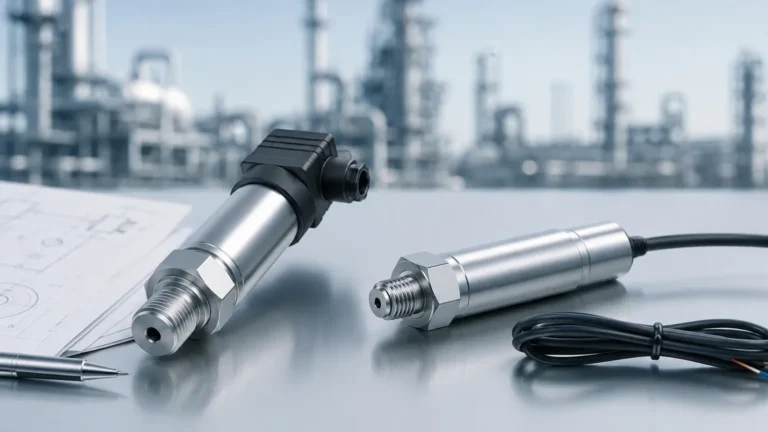
Hydrostatic Level Transmitters
These sensors measure the pressure exerted by the liquid column at the bottom of a tank.
* Principle: $Pressure (P) = Density (\rho) \times Gravity (g) \times Height (h)$.
* Consideration: This method is highly reliable but depends on the density of the liquid. If a distillery uses the same tank for different spirits with varying sugar contents (and thus different densities), the transmitter must be recalibrated or compensated.
* Application: Excellent for tall, outdoor silos containing water or base spirits.
Practical Selection Table for Distillery Consumables
Choosing the right technology depends on the physical properties of the consumable and the tank environment.
| Consumable Type | Recommended Technology | Accuracy | Key Benefit |
| :— | :— | :— | :— |
| High-Proof Ethanol | 80 GHz Radar | ±1 mm | Ignores vapors; high precision for tax audits |
| Process Water | Ultrasonic | ±0.25% of range | Cost-effective; easy installation |
| CIP Chemicals | Hydrostatic (PTFE diaphragm) | ±0.1% to 0.5% | Resists corrosion from caustics/acids |
| Finished Gin/Vodka | Guided Wave Radar | ±2 mm | Reliable measurement in narrow, agitated tanks |
| Waste Water/Slop | Ultrasonic or Radar | ±5 mm | Non-contact; avoids fouling from solids |
Optimizing "Unlimited Supply" through Automation
The goal of ar unlimited supply private label distillery consumables usage is to ensure that production never stops due to a lack of raw materials. This is achieved by integrating level data into a Supervisory Control and Data Acquisition (SCADA) system or a simpler PLC-based alarm system.
Inventory Management and Reordering
By setting "Low" and "Low-Low" setpoints, the system can automatically generate purchase orders for consumables. For instance, if the caustic soda tank for the CIP system falls below 20% (approx. 400 liters in a 2,000-liter tank), an alert is sent to the procurement team. This prevents the "out of stock" scenarios that can derail a private label production schedule.
Batch Consistency in Private Labeling
In private label production, the brand owner expects a specific profile. If the proofing water is measured inaccurately, the ABV will fluctuate, potentially leading to rejected batches. High-precision level meters ensure that the exact volume of water is added to the spirit, maintaining the integrity of the private label brand.
Installation and Engineering Considerations
Proper installation is critical to the performance of any level instrument. In a distillery environment, several factors must be addressed:
1. Sanitary Requirements: For any instrument in contact with the product (especially after distillation), 3-A or EHEDG certified sanitary fittings (like Tri-Clamp) are required to prevent bacterial growth.
2. Internal Obstructions: Distillery tanks often contain agitators, heating coils, or spray balls for CIP. Radar and ultrasonic sensors must be positioned to avoid these obstructions, or "false echo suppression" must be configured in the software.
3. Dead Zones: Every sensor has a "blocking distance" or dead zone near the top of the probe where it cannot measure. Engineers must ensure the tank nozzle height accounts for this to prevent overfills.
4. Explosion-Proof Ratings: Since ethanol is flammable, sensors installed on spirit tanks must be ATEX or IECEx certified for Zone 0 or Zone 1 environments.
Limitations and Challenges
While modern instrumentation is highly advanced, certain limitations persist:
* Foaming: During the mixing of certain botanical extracts or during high-speed tank filling, foam can develop. Foam can dissipate ultrasonic signals and weaken radar returns. In these cases, a Guided Wave Radar (GWR) with a coaxial probe is often the best solution.
* Temperature Shifting: In hydrostatic measurement, if the temperature of the spirit rises from 15°C to 25°C (59°F to 77°F), the volume expands while the mass stays the same. The level sensor will show a higher level, but the actual quantity of ethanol hasn't changed. Integrated temperature compensation is necessary for accurate inventory.
Frequently Asked Questions (FAQs)
Q: How often should distillery level meters be calibrated?
A: For inventory and tax-related spirit tanks, annual calibration is standard. For utility water or waste tanks, every two years is usually sufficient, provided the sensors show no drift.
Q: Can one sensor type be used for all consumables?
A: While radar is versatile, it may be overkill for a simple water tank. A mix of technologies—radar for spirits, ultrasonic for water, and hydrostatic for chemicals—is typically the most cost-effective approach.
Q: How does turbulence affect level measurement?
A: Turbulence caused by agitators can cause "noise" in the signal. Modern radar units use software algorithms to average the signal, providing a stable reading even when the surface is agitated.
Conclusion
Effective management of ar unlimited supply private label distillery consumables usage is the foundation of a profitable and reliable distillery operation. By understanding the measurement principles of radar, ultrasonic, and hydrostatic technologies, plant managers can select the right tools to monitor their critical inputs. This not only ensures a continuous supply for production but also protects the quality and consistency that private label clients demand. For comprehensive technical specifications and to explore the full range of measurement solutions, engineers are encouraged to visit the Main Page for professional guidance and product selection support.
Download Ar Unlimited Supply Private Label Distillery Consumables Usage as a PDF