Automated Samplers Bulk Solids
Automated Samplers Bulk Solids
In modern industrial processing, the accuracy of quality control depends entirely on the representativeness of the samples collected. Automated samplers for bulk solids are engineered systems designed to extract a specific volume of material from a process stream—whether from a conveyor belt, a gravity chute, or a pneumatic pipeline—without interrupting production. Unlike manual sampling, which is prone to human error and safety risks, automated systems provide a consistent, repeatable method for monitoring material composition, moisture content, and particle size distribution.
For engineers and plant managers, selecting the correct sampling technology is as critical as choosing the right level measurement or flow control instrumentation. This guide explores the mechanical principles, selection criteria, and integration strategies for automated sampling in bulk solids handling.
Fundamental Principles of Bulk Solid Sampling
To understand automated samplers, one must first distinguish between simple material extraction and representative sampling. Representative sampling is governed by the Theory of Sampling (TOS), which dictates that every particle in the lot must have an equal probability of being included in the sample.
The Delimitation and Extraction Principle
In bulk solids, materials are often heterogeneous. For instance, in a moving conveyor belt, smaller particles often settle at the bottom (percolation), while larger particles remain on top. An automated sampler must perform a complete cross-section cut of the material stream to ensure the sample reflects the true ratio of these particles.
Sampling Frequency and Logic
Automated systems typically operate on two logic types:
1. Time-Based Sampling: The sampler triggers at set intervals (e.g., every 15 minutes). This is suitable for stable processes with consistent flow rates.
2. Flow-Proportional Sampling: The sampler triggers based on the mass of material passed (e.g., every 500 metric tons). This requires integration with a belt scale or a flow meter to ensure the sample represents the total volume accurately.
Types of Automated Samplers for Bulk Solids
The physical characteristics of the material—such as abrasiveness, moisture, and particle size—determine which sampler design is most effective.
Cross-Cut Samplers
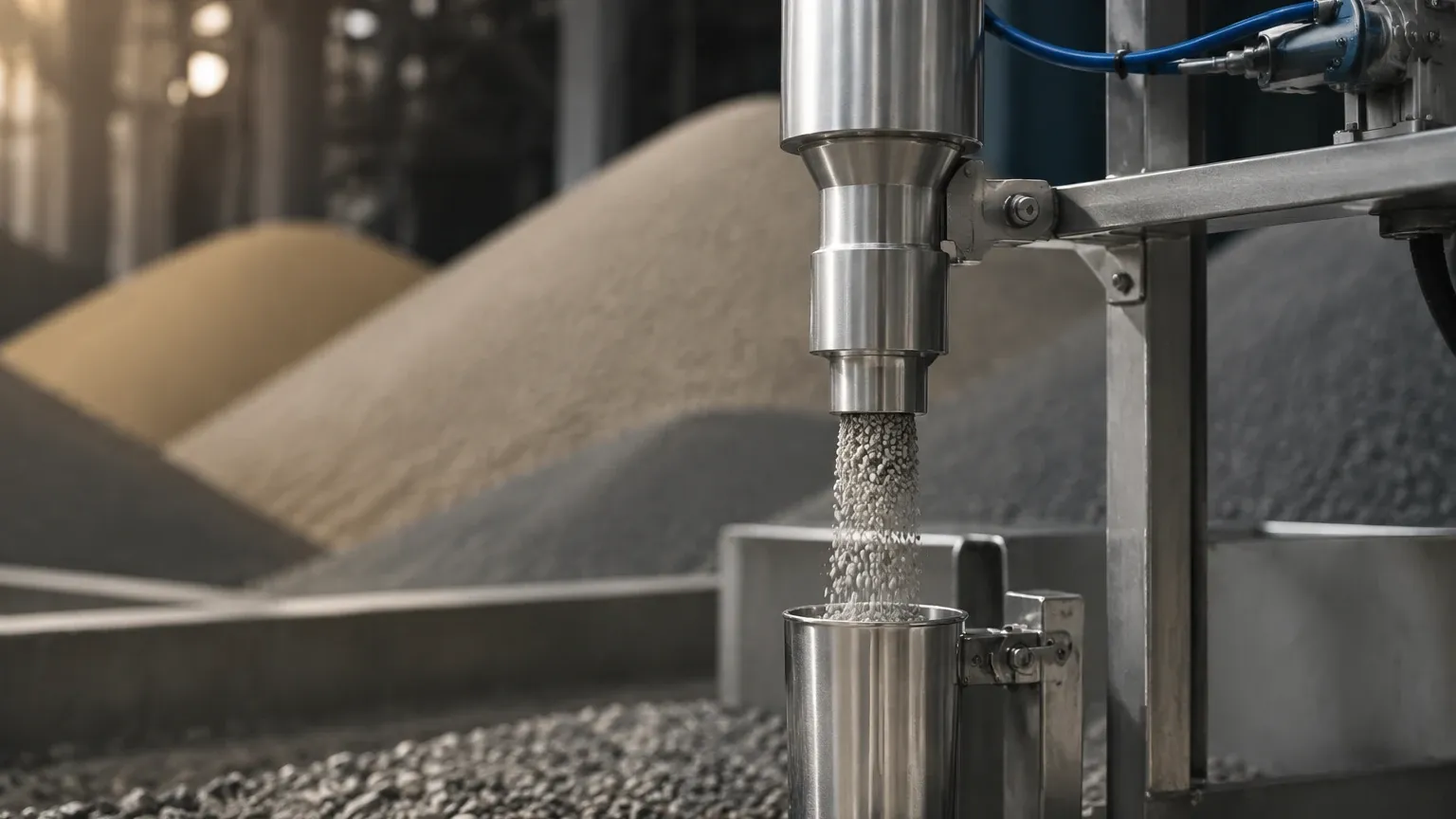
Often considered the "gold standard" for representativeness, cross-cut samplers move a collecting hopper (or cutter) through a falling stream of material at a constant speed. The cutter opening must be at least three times the diameter of the largest particle to prevent bridging and bias. These are typically installed at the discharge head of a conveyor belt.
Point Samplers (Probe Samplers)
Point samplers extract material from a specific point within the process stream. These often use a rotating tube or a reciprocating probe. While they are more compact and easier to install in existing chutes, they do not always capture a full cross-section of the material, making them better suited for homogeneous, free-flowing powders.
Auger Samplers
Auger samplers use a motorized screw to draw material out of a hopper or a slow-moving gravity line. They are particularly effective for cohesive materials that might clog a standard gravity-fed cutter. However, the mechanical action of the auger can sometimes degrade fragile particles, which may affect particle size analysis.
Strip Samplers
Used primarily in pneumatic conveying lines, strip samplers use a plunger or a small tube to capture a "strip" of material from the air-solid flow. These must be designed to withstand the pressure of the conveying system, often requiring specialized seals and hardened surfaces.
The Role of Level Measurement in Automated Sampling Systems
Automated sampling does not exist in a vacuum; it is a component of a broader process control strategy. To operate efficiently, sampling systems must be synchronized with inventory data. This is where level measurement instruments become indispensable.
For example, in a large storage silo, a radar level meter or an ultrasonic level sensor provides real-time data on the material volume. If the level falls below a certain threshold, the automated sampler should be programmed to pause to avoid "sampling air" or collecting stagnant material from the very bottom of the cone. Conversely, in high-throughput applications, level sensors can trigger sampling cycles when a specific volume of material has been processed.
Reliable instrumentation, such as those found on the Main Page of industrial measurement providers, ensures that the sampling system is fed with accurate data regarding the presence and state of the bulk solids. Integration with hydrostatic transmitters or magnetic gauges in associated liquid processes (such as chemical dosing for water treatment) further streamlines the entire automation loop.
Engineering Selection Criteria and Technical Specifications
Selecting the right automated sampler requires a detailed analysis of the material and the installation environment. The following table provides a baseline for evaluating different technologies:
| Material Characteristic | Recommended Sampler Type | Primary Advantage | Limitation |
| :— | :— | :— | :— |
| Free-flowing (Grains/Pellets) | Cross-Cut Sampler | High representativeness | Requires significant vertical headspace |
| Abrasive (Ores/Coal) | Heavy-duty Point Sampler | Replaceable wear liners | Potential for particle size bias |
| Cohesive/Sticky (Wet sand) | Auger Sampler | Positive displacement of material | Can cause particle degradation |
| Fine Powders (Cement/Flour) | Strip Sampler (Pneumatic) | Dust-tight operation | Limited to dilute-phase conveying |
| Large Aggregates (>50mm) | Swing-Arm Sampler | Captures large samples from belts | High mechanical stress on components |
Key Technical Considerations:
* Cutter Speed: For cross-cut systems, the cutter should move at a speed not exceeding 0.6 m/s to avoid "bouncing" larger particles out of the sample opening.
* Material Temperature: Standard samplers handle up to 80°C; specialized alloys and seals are required for high-temperature applications in smelting or calcining.
* Sample Volume: The system must be sized to collect enough material for a statistically valid sample without overfilling the collection containers.
Installation and Integration Guidelines
Proper installation is paramount to prevent mechanical failure and ensure operator safety.
1. Location: The best location for a sampler is at a point of transition where the material is in a free-falling state, such as a conveyor discharge. If installing in a vertical chute, ensures the sampler is at least 1 meter below any gates or valves to allow the flow to stabilize.
2. Access for Maintenance: Automated samplers are mechanical devices subject to wear. Ensure there is adequate platform space for technicians to inspect cutters, replace seals, and clear occasional blockages.
3. Control Integration: Modern samplers should be integrated into the plant's PLC (Programmable Logic Controller) or SCADA system. This allows for remote monitoring of sample counts, cycle times, and error logs (e.g., motor stall or container full).
4. Dust Mitigation: Bulk solids sampling often generates dust. Use flexible connectors and dust-tight enclosures to maintain air quality and prevent the loss of "fines," which are often a critical part of the sample.
Common Limitations and Operational Risks
While automated samplers bulk solids systems are highly efficient, they are not without challenges:
* Moisture Sensitivity: High moisture content can cause material to build up on the internal surfaces of the sampler, leading to cross-contamination between batches. Regular cleaning cycles or Teflon-coated internals may be necessary.
* Particle Segregation: If the sampler is not designed to capture the full width of the stream, it may disproportionately collect larger or smaller particles, leading to skewed lab results.
* Mechanical Wear: In mining and heavy industrial applications, the abrasive nature of the solids will eventually wear down the sampling components. Utilizing hardened steels (e.g., AR400 or AR500) or ceramic liners is essential for longevity.
* Sample Degradation: If the sampling process is too violent (e.g., high-speed augers or long drops), the physical state of the material might change before it reaches the lab, rendering physical tests (like friability) inaccurate.
Frequently Asked Questions (FAQs)
Q: How often should an automated sampler be calibrated?
A: The sampler itself doesn't require "calibration" in the way a sensor does, but the sampling *logic* should be validated annually. This involves performing a "bias test" where the automated sample is compared against a full-stop belt sample (the reference method).
Q: Can automated samplers handle hazardous materials?
A: Yes. For toxic or hazardous bulk solids, samplers can be designed with hermetically sealed collection chambers and automated container sealing systems to prevent operator exposure.
Q: What is the minimum particle size for automated sampling?
A: There is no lower limit; automated samplers are used for materials as fine as micronized pigments. However, for very fine powders, dust control and pneumatic transport within the sampler become the primary engineering concerns.
Q: How does the sampler handle varying flow rates?
A: If the flow rate is variable, the system should be linked to a belt scale or flow meter via a 4-20mA signal. The PLC then adjusts the frequency of the sampling cuts to maintain a constant ratio of sample mass to process mass.
By understanding the mechanical requirements and integrating these systems with precise level measurement and process control, industrial facilities can ensure that their quality data is both accurate and actionable. For further technical specifications on the sensors that support these systems, visiting the Main Page of a dedicated instrument manufacturer provides a foundation for building a complete automation suite.