Automated Samplers
Automated Samplers
In industrial water treatment, chemical processing, and environmental monitoring, the ability to obtain representative liquid samples is critical for regulatory compliance and process optimization. Automated samplers are specialized instruments designed to collect and store liquid samples from a source—such as a tank, open channel, or pressurized pipe—at programmed intervals or in response to specific process triggers. By removing the variability and safety risks associated with manual sampling, these systems ensure that the analytical data used for process control is both accurate and repeatable.
For engineers and plant managers, selecting the right automated sampler requires an understanding of how these devices interface with other process instrumentation, particularly level and flow sensors. This guide explores the technical principles, selection criteria, and installation requirements for automated sampling systems in industrial environments.
Understanding the Role of Automated Samplers in Process Control
Automated samplers serve as the bridge between the physical process and the analytical laboratory. Their primary function is to collect a "representative sample," meaning the chemical and physical characteristics of the collected liquid must precisely match the source at the time of sampling.
In many applications, sampling is not just a periodic task but a regulatory requirement. For instance, wastewater treatment plants must often provide composite samples to verify compliance with discharge permits. In chemical manufacturing, automated samplers allow for the monitoring of reaction kinetics or product purity without exposing personnel to hazardous environments.
These systems are typically categorized by their mobility (portable vs. stationary) and their sampling method (composite vs. discrete). Portable units are often used for short-term studies or remote monitoring, while stationary units are integrated into the plant's permanent infrastructure, often featuring climate-controlled housing to preserve sample integrity.
Measurement Principles and Trigger Mechanisms
The effectiveness of automated samplers depends on the logic used to initiate a sampling cycle. There are three primary modes of operation:
1. Time-Proportional Sampling
This is the simplest method, where the sampler is programmed to collect a fixed volume of liquid at regular time intervals (e.g., 500 ml every hour). While easy to implement, this method does not account for variations in flow rate, which can lead to skewed data if the concentration of pollutants or chemicals changes during periods of high flow.
2. Flow-Proportional Sampling
To obtain a truly representative composite sample in varying flow conditions, flow-proportional sampling is required. In this mode, the sampler receives a signal from a flow meter or a level transmitter. As the volume of water passing a point reaches a predefined threshold (e.g., every 1,000 liters), the sampler takes a fixed-volume aliquot. This ensures that the final composite sample reflects the total mass load of the substance being measured.
3. Event-Based Sampling
Event-based sampling is triggered by specific process conditions, such as a spike in pH, a change in temperature, or a specific liquid level. For example, if a storage tank reaches a high-level alarm, the automated sampler can be programmed to take immediate samples to document the conditions of a potential overflow or process deviation.
Integration with Level Measurement Systems
Automated samplers rarely operate in isolation. They are frequently integrated with level measurement technologies to facilitate flow-weighted sampling or to ensure the intake line is properly submerged.
In open-channel applications, such as flumes or weirs, a radar level meter or an ultrasonic level sensor is used to measure the head (depth) of the liquid. This level data is converted into a flow rate using standard hydraulic equations. The automated sampler then uses this flow data to determine when to trigger a sample.
When evaluating system components, it is helpful to Review product options and application support to ensure that the level transmitter and the sampler controller are compatible, particularly regarding signal outputs like 4-20mA or Modbus RS485. High-accuracy level measurement is the foundation of reliable flow-proportional sampling; even a small error in level detection can lead to significant discrepancies in the calculated flow volume and, consequently, the sample representation.
Key Components of an Automated Sampler
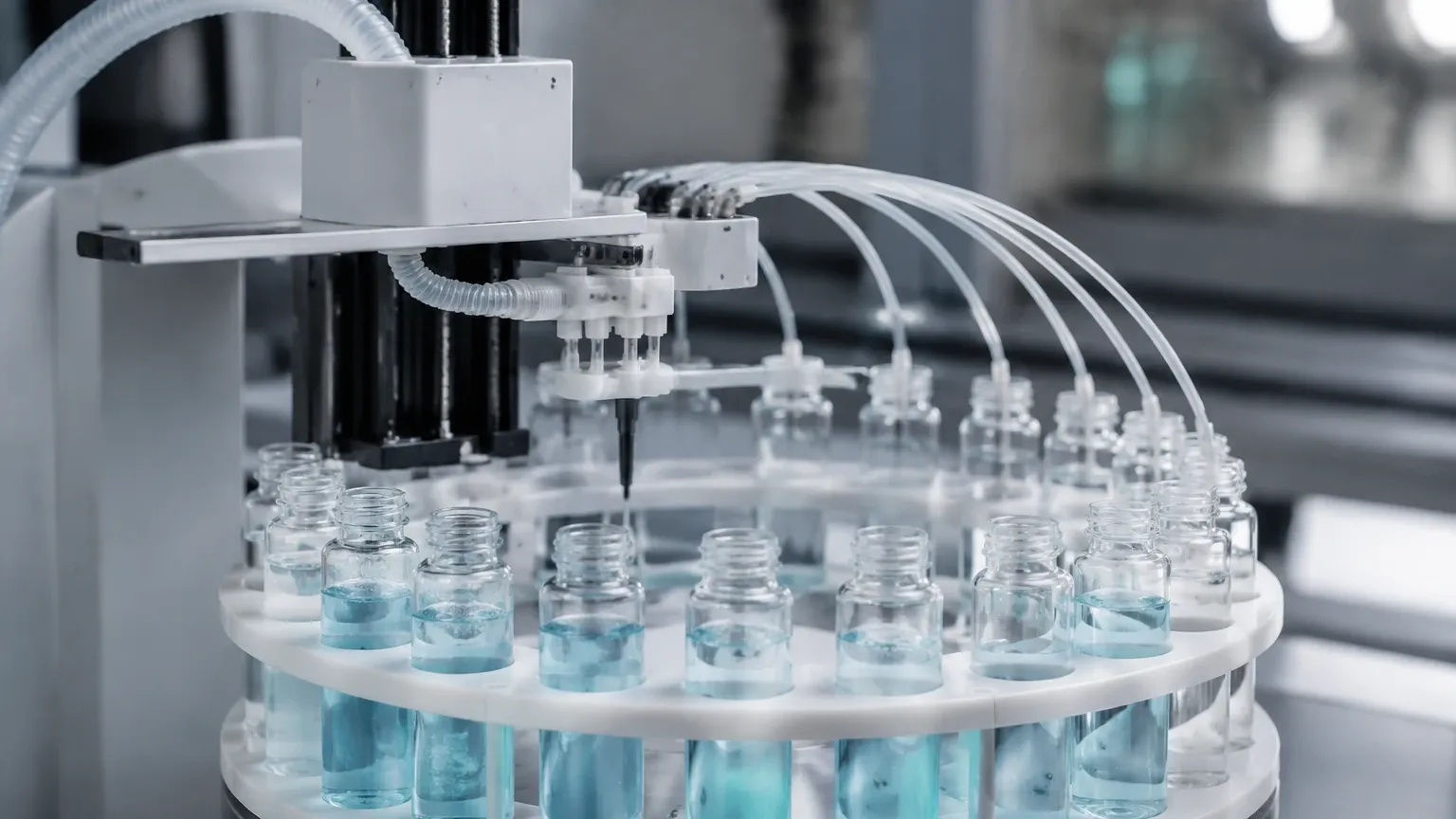
An industrial-grade automated sampler consists of several critical subsystems:
* Controller: The "brain" of the unit, where the user programs sampling intervals, volumes, and triggers. Modern controllers offer data logging and remote communication capabilities.
* Vacuum or Peristaltic Pump: The mechanism used to draw the liquid from the source. Peristaltic pumps are common because the liquid only touches the replaceable tubing, reducing cross-contamination risks.
* Distributor Arm: In discrete sampling, this motorized arm moves the discharge tube to different bottles within the sampler base.
* Sample Bottles: Available in various materials (PE, Glass, or PTFE) and configurations (single 10-liter composite bottle or sets of 24 discrete 1-liter bottles).
* Cooling System: For biological or volatile chemical samples, the sampler must maintain a temperature of approximately 4°C (39°F) to prevent sample degradation.
Selection Criteria for Industrial Automated Samplers
Choosing the correct sampler involves balancing the physical constraints of the site with the chemical requirements of the sample. The following table summarizes key evaluation factors:
| Feature | Peristaltic Pump Sampler | Vacuum/Pressure Sampler |
| :— | :— | :— |
| Max Vertical Lift | Typically 8.5 meters (28 feet) | Up to 9 meters (30 feet) |
| Sample Accuracy | High (volume controlled by pump revolutions) | Very High (volume controlled by physical chamber) |
| Suspended Solids | Good for small to medium solids | Excellent for heavy solids loading |
| Maintenance | Frequent tubing replacement required | Requires cleaning of the vacuum chamber |
| Best Application | General wastewater, chemical dosing | High-solids industrial waste, deep manholes |
Material Compatibility
If the liquid being sampled is corrosive or contains organic solvents, the wetted parts—including the intake strainer, suction line, and internal tubing—must be compatible. For example, while standard PVC tubing is sufficient for municipal wastewater, PTFE or specialized fluoroelastomers may be required for aggressive chemical processes.
Installation and Maintenance Best Practices
Proper installation is paramount to ensuring the longevity of the equipment and the accuracy of the samples. Engineers should consider the following:
1. Suction Line Routing: The suction line should be as short as possible and installed with a continuous slope toward the source. This allows the line to drain completely between samples, preventing cross-contamination and freezing in cold climates.
2. Intake Positioning: The intake strainer should be positioned in a representative area of the flow, typically at 60% of the liquid depth in an open channel. It should be located away from stagnant zones or areas with excessive turbulence.
3. Power Supply: Stationary samplers often require a dedicated AC power source, especially if they include refrigeration. Portable units rely on 12V DC batteries; in these cases, solar charging or high-capacity deep-cycle batteries are recommended for long-term deployments.
4. Calibration: Regular calibration of the sample volume is necessary. Most samplers allow the user to perform a "volume calibration" where the unit pumps a sample into a graduated cylinder to verify that the programmed volume matches the delivered volume.
Common Risks and Operational Limitations
Despite their automation, these systems are not "set and forget." Several risks can compromise data integrity:
* Cross-Contamination: If the pump does not perform a sufficient "pre-purge" and "post-purge" (blowing air through the line before and after sampling), residual liquid from the previous cycle may contaminate the new sample.
* Suction Head Limits: As the vertical distance between the sampler and the liquid source increases, the pump's efficiency decreases. If the lift exceeds the atmospheric pressure limits (approx. 9 meters at sea level), the sampler will fail to draw a sample.
* Sample Degradation: If the refrigeration system fails or the bottles are not collected promptly, chemical changes (such as pH shifts or bacterial growth) can occur, rendering the sample useless for laboratory analysis.
* Blockages: Large debris or high concentrations of fats, oils, and grease (FOG) can clog the intake strainer or the internal tubing. Regular inspection of the intake point is required in high-solids applications.
Frequently Asked Questions (FAQ)
Q: How often should I replace the pump tubing in a peristaltic sampler?
A: This depends on the frequency of sampling and the abrasiveness of the liquid. In standard municipal applications, tubing is typically replaced every 500 to 1,000 samples. Visual inspection for flattening or cracking should be part of weekly maintenance.
Q: Can automated samplers be used in hazardous (Ex) zones?
A: Yes, but you must specify an ATEX or IECEx-certified model. These units feature explosion-proof enclosures and intrinsically safe electronics to prevent ignition in environments with flammable gases or dust.
Q: What is the difference between a composite sample and a discrete sample?
A: A composite sample combines all aliquots into a single large container over a set period, providing an average concentration. A discrete sample places each aliquot (or a small group of aliquots) into separate bottles, allowing for the analysis of how concentrations changed at specific times throughout the day.
Q: How do I ensure the sample is representative if the liquid has suspended solids?
A: Ensure the transport velocity in the suction line is high enough (at least 0.6 to 0.9 meters per second) to keep solids in suspension. Additionally, use a sampler with a high-speed pump and avoid sharp bends in the suction tubing.
By integrating reliable automated samplers with high-precision level and flow measurement instruments, industrial facilities can achieve a higher standard of process transparency and environmental stewardship. For technical specifications and hardware options, engineers are encouraged to consult with specialists to match the instrumentation to their specific chemical and hydraulic environment.