Steam Flowmeter
Steam Flowmeter
Steam is one of the most versatile and widely used energy carriers in modern industry. From power generation and chemical processing to food production and district heating, steam provides the thermal energy required for critical processes. However, measuring steam flow accurately is significantly more challenging than measuring water or air. Steam is a compressible fluid that exists in different states—saturated or superheated—and is subject to rapid changes in pressure and temperature.
Choosing the correct steam flowmeter is essential for mass balance, energy billing, and process efficiency. This guide explores the fundamental measurement principles, selection criteria, and technical considerations necessary for successful industrial steam flow monitoring.
Principles of Steam Flow Measurement
Before selecting a specific instrument, it is vital to understand the physics of steam measurement. Most industrial flowmeters measure volume, but because steam density changes with pressure and temperature, mass flow is the preferred metric for energy calculations.
Vortex Shedding Principle
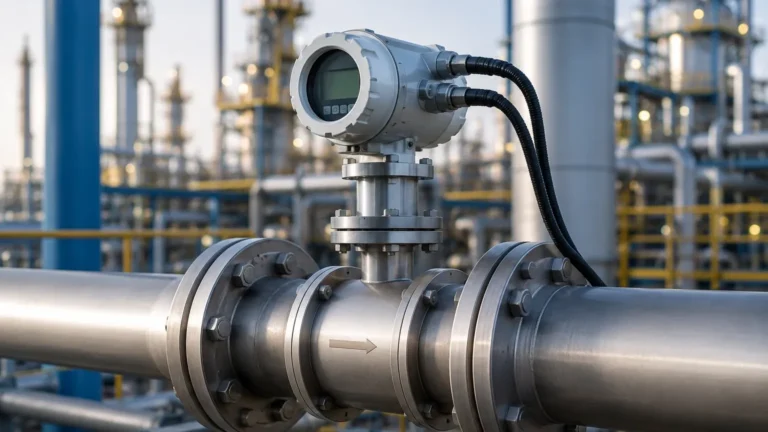
One of the most common technologies for steam is the vortex flowmeter. It operates on the Von Kármán effect. As steam flows past a "bluff body" (a non-streamlined object) placed in the pipe, vortices are shed alternately from each side. The frequency of these vortices is directly proportional to the velocity of the steam.
Modern vortex meters often include integrated temperature and pressure sensors to perform real-time density compensation, allowing the device to output an accurate mass flow reading for saturated steam.
Differential Pressure (DP) Principle
Differential pressure measurement remains a staple in steam applications. It relies on Bernoulli’s principle: as steam passes through a restriction in the pipe (such as an orifice plate, Venturi tube, or Pitot tube), its velocity increases and its pressure decreases. The difference in pressure across the restriction is proportional to the square of the flow rate.
While orifice plates are simple and cost-effective, they introduce a permanent pressure loss and have a limited turndown ratio (the ratio between maximum and minimum measurable flow).
Ultrasonic Principle
Ultrasonic flowmeters for steam use the transit-time method. Transducers send ultrasonic pulses diagonally across the pipe. The pulse traveling with the flow moves faster than the one traveling against it. The difference in time is used to calculate velocity. While non-invasive clamp-on versions exist, high-temperature steam often requires specialized wetted transducers to ensure signal reliability.
Types of Steam and Their Impact on Measurement
Steam behaves differently depending on its thermodynamic state. Identifying the type of steam in your system is the first step in instrument selection.
1. Saturated Steam: This occurs when liquid water and steam coexist at the same temperature and pressure. It is highly efficient for heating but can contain water droplets (wet steam). If the steam is too wet, it can erode flowmeter components or cause measurement errors in vortex and ultrasonic meters.
2. Superheated Steam: This is steam heated to a temperature higher than its boiling point at a given pressure. It behaves more like a dry gas. It is typically used in turbines to prevent moisture-induced blade damage. Superheated steam requires both pressure and temperature compensation for accurate mass flow measurement because it does not follow the standard saturation curve.
Selection Criteria for Industrial Applications
When evaluating a steam flowmeter, engineers must balance accuracy requirements with the total cost of ownership. The following table compares the most common technologies used in B2B industrial environments.
Technology Comparison Table
| Feature | Vortex Flowmeter | Orifice Plate (DP) | Pitot Tube (DP) | Ultrasonic (Inline) |
| :— | :— | :— | :— | :— |
| Accuracy | ±1.0% of rate | ±2.0% to ±3.0% | ±2.0% to ±4.0% | ±1.0% to ±2.0% |
| Turndown Ratio | 10:1 to 20:1 | 3:1 to 5:1 | 4:1 | 20:1 to 50:1 |
| Pressure Loss | Medium | High | Very Low | Negligible |
| Maintenance | Low (no moving parts) | High (orifice wear) | Medium | Low |
| Typical Use | Saturated/Superheated | General Process | Large Ducts/Pipes | High Precision |
Installation Considerations and Best Practices
Even the most advanced steam flowmeter will fail to provide accurate data if installed incorrectly. Steam systems are harsh environments characterized by thermal expansion and potential water hammer.
Straight Pipe Requirements
Flowmeters require a stable, fully developed flow profile to measure accurately. Turbulence caused by elbows, valves, or reducers can lead to significant errors.
* Upstream: Typically requires 10 to 20 pipe diameters (D) of straight run.
* Downstream: Typically requires 5 diameters (D).
If these distances cannot be met, flow conditioners or vanes may be necessary to straighten the flow.
Condensate Management
Steam pipes inevitably produce condensate, especially during startup. If condensate pools at the bottom of the pipe, it can interfere with the sensor or cause "slugs" of water to hit the meter at high velocity.
* Steam Traps: Ensure a high-capacity steam trap is installed upstream of the flowmeter.
* Orientation: For horizontal pipes, vortex meters should generally be mounted with the electronics to the side (90 degrees) to prevent the sensor from being submerged in condensate or overheated by rising heat.
Insulation
To prevent excessive condensation and protect the flowmeter’s electronics, the pipe and the meter body (but usually not the transmitter head) should be properly insulated. This ensures the steam remains at its intended quality as it passes through the measurement point.

Common Risks and Limitations
Operating a steam flowmeter involves managing specific risks that do not apply to water or gas systems.
* Steam Hammer: This occurs when a slug of condensate is pushed through the pipe by high-velocity steam. The impact can destroy orifice plates, bend Pitot tubes, and shatter vortex bluff bodies. Proper drainage is the only defense.
* Scale and Erosion: Industrial steam often carries chemicals or particulates from the boiler. Over time, these can erode the sharp edges of an orifice plate, leading to a gradual drift in accuracy (usually under-reading).
* Vibration: Vortex meters are sensitive to pipe vibration. If the installation site is near a heavy pump or compressor, the vibration may be misinterpreted as flow signals, leading to false readings at zero flow.
Project Audience Checklist: Before You Buy
Before contacting a supplier or integrating a new unit into your automation system, confirm the following technical details:
1. Maximum and Minimum Flow Rates: Ensure the "turndown" of the meter covers your entire operating range, including low-load periods at night or during weekends.
2. Operating Pressure and Temperature: Verify that the meter body and gaskets are rated for your maximum system pressure (e.g., 20 bar) and temperature (e.g., 250°C).
3. Steam Quality: Is your steam saturated or superheated? If saturated, what is the estimated dryness fraction?
4. Connectivity Requirements: Does your PLC/SCADA system require 4-20mA, HART, Modbus, or Foundation Fieldbus?
5. Calibration Certificates: For billing or carbon reporting, ensure the meter comes with a traceable calibration certificate.
For those managing complex industrial facilities, integrating these sensors with reliable level measurement is often part of a broader energy management strategy. You can Review product options and application support to see how different instrumentation technologies complement each other in a process loop.
Frequently Asked Questions (FAQ)
Q: Can I use a standard water flowmeter for steam?
A: No. Most water meters use materials (like plastic or low-temp elastomers) and measurement principles (like mechanical turbines) that will fail immediately under steam temperatures and pressures.
Q: Why is mass flow more important than volumetric flow for steam?
A: Because steam is a gas, its volume changes significantly with pressure. A cubic meter of steam at 10 bar contains much more energy and mass than a cubic meter at 2 bar. Mass flow provides a consistent measurement of the actual energy being delivered.
Q: How often should a steam flowmeter be calibrated?
A: For most industrial applications, an annual inspection is recommended. If the meter is used for fiscal billing, more frequent third-party calibration may be required by local regulations.
Q: What is the impact of "Wet Steam" on measurement?
A: Wet steam contains liquid droplets. Most flowmeters are calibrated for single-phase fluids. If the steam is wet, the meter will typically over-read because it is measuring the higher density of the liquid-vapor mix as if it were pure vapor.
Conclusion
Selecting a steam flowmeter requires a deep understanding of both the instrument's physics and the specific conditions of the steam system. While vortex meters offer a great balance of accuracy and durability for many B2B applications, differential pressure devices remain relevant for high-temperature, high-pressure legacy systems. By adhering to strict installation guidelines and ensuring proper condensate management, facility managers can achieve the precise data needed for energy optimization and cost reduction. For further technical specifications and to explore a wider range of industrial measurement tools, visit the Main Page.